Category: Marine Life

  • 7 Extraordinary Animals From the Frozen South and the Deep Ocean

    7 Extraordinary Animals From the Frozen South and the Deep Ocean

    7 Extraordinary Animals From the Frozen South and the Deep Ocean

    Updated: 2026
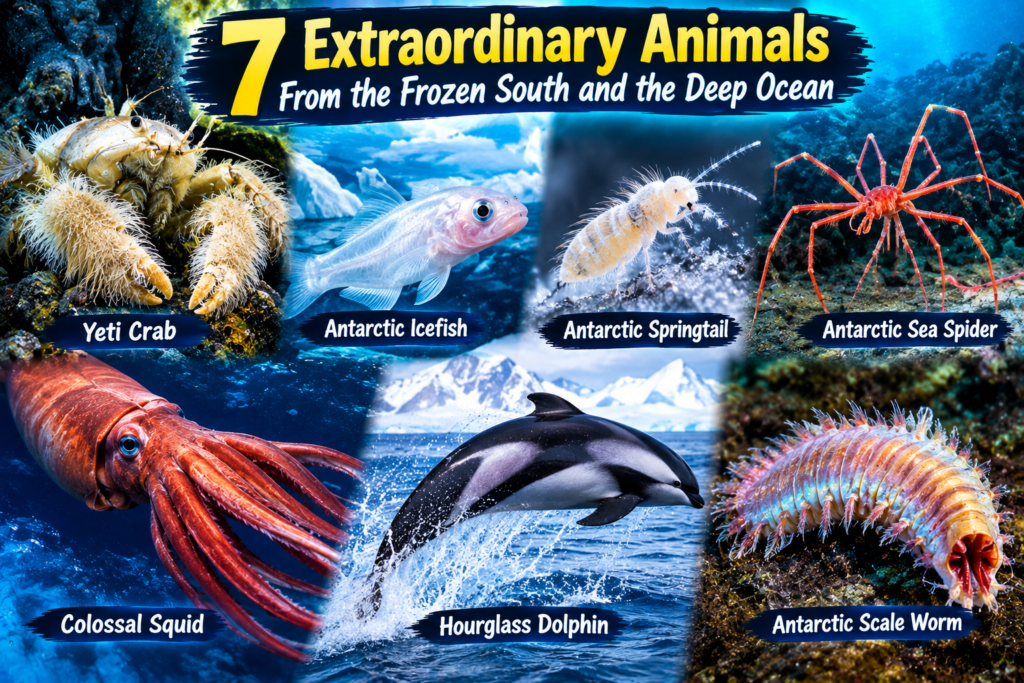
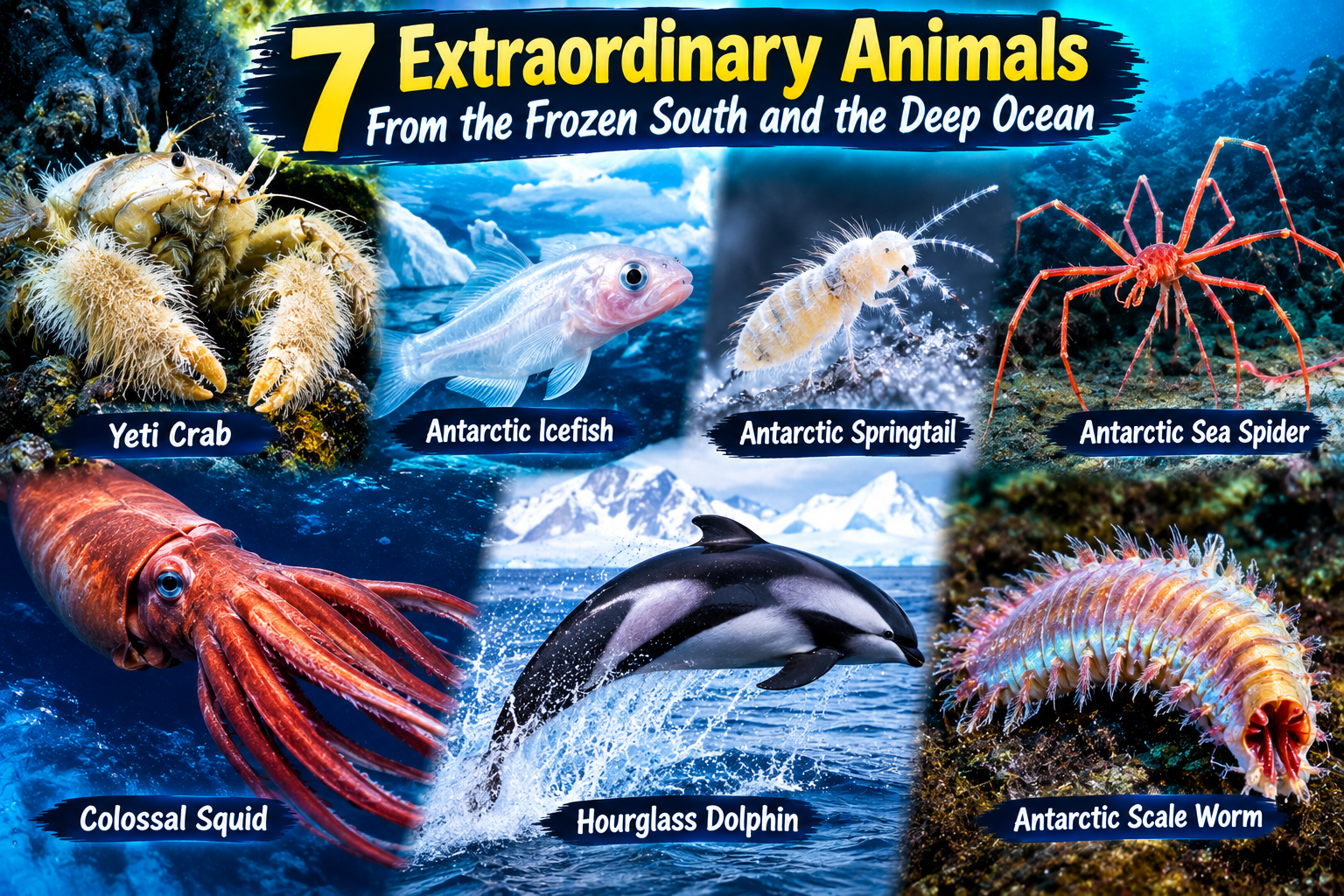
    Yeti crab, Antarctic icefish, springtail, sea spider, colossal squid, hourglass dolphin and scale worm representing extraordinary Antarctic and deep-sea wildlife
    Explore seven bizarre animals from Antarctica and the deep ocean and discover the remarkable adaptations that allow them to survive freezing temperatures, darkness and extreme pressure.

    Introduction: Where Survival Takes an Extreme Turn

    Some of Earth’s strangest animals live far away from cities, forests and familiar landscapes. They inhabit places where sunlight barely reaches, temperatures can fall below the freezing point of freshwater, and food may be scarce.

    The Southern Ocean around Antarctica and the deep seas beyond the continental shelves are particularly remarkable. These environments may appear empty at first glance, yet beneath the surface is a world filled with animals that have evolved extraordinary ways to survive.

    This article explores seven fascinating creatures: the Yeti Crab, Antarctic Icefish, Antarctic Springtail, Antarctic Sea Spider, Colossal Squid, Hourglass Dolphin, and Antarctic Scale Worm.

    They are very different animals. One is a tiny land-dwelling arthropod, another is a warm-blooded marine mammal, while others live hundreds or thousands of meters beneath the waves.

    Together, they reveal an important lesson about nature: extreme environments do not necessarily mean lifeless environments. They can produce some of the most specialized animals on Earth.

    https://images.openai.com/static-rsc-4/35whySyUk_-Kf05LmvExuTQroHjcYm9d82FCTvLlaoQRxhEsBqt_gw6LI8dNAcZUd0o0I6e-tGvmFy2z7S5RKg_yY5-oc2KsYBF6L8-E14RWzodyBDeUNzoS_yuzGEGg7N_OTspb1d-LfYSR9XvKtbGfjtMiW5oQswAH5BSKCPORV4ELCdMiOvjGMzYtu7bq?purpose=fullsize
    https://images.openai.com/static-rsc-4/2DdyW8TUrLouPYeTvydoMgcmys1oSegGC3R1e2vM9XV0wCj13UuCQpdBXwkwxcf3uTZmTlvX7RYVSa6kYt8H85bavfGrMbmwKhfzw4d6mge_dWXCqbDezfSNxYnkqxKDqpbqQE7_J3fJHJBtg-6zjJ-c-F7KsUTeVHa2HM1VkxOKm89zVZJjM9I1otsMRzL7?purpose=fullsize

    1. Yeti Crab: The Hairy Crab of the Deep

    https://images.openai.com/static-rsc-4/Rhf3Iq-fsiMHOVoP6VQeBZ9yK_-J7QhvRVOedRipY2ZODCWsxwofQcLUXCMUYqf1DfTerxAX8Hx__FLNTdGp7plEtZNVSENmj-rWHzj4RtladR4yoDyjMveDcBJCWe83PWxCjAD9FaHyiyow2WW67w9Gd2oYGjCTwIwE7eDFyzSPTXeGkihx_Uz-zXRATDfm?purpose=fullsize
    https://images.openai.com/static-rsc-4/sq1lfgeukToXvgT_DnV_3MqbRYcaKsoIabFJskqpOMz_KuYr8AaXIgJEHwn99pR82H0LInUKCRrAjfc1cgzTAwdU19SHsfSapqTZEERjrWaI2Qlzvd5R_jNUNd4AkgjEYXFobdiqKgQG3vDFqF8Sq7gxfIV8jSq7db7B6Cq55HOamePJsW6MSJoX01njgRDG?purpose=fullsize

    The Yeti Crab is one of the most unusual crustaceans ever discovered.

    The species Kiwa hirsuta was discovered in 2005 near a hydrothermal vent south of Easter Island. Smithsonian Ocean notes that the animal was so unusual that scientists established not only a new species but also a new genus, Kiwa.

    Its nickname comes from its strange appearance. The crab has hairy-looking structures covering its claws and body, giving it an almost furry appearance.

    But the hairs are not simply decoration.

    The structures are associated with bacteria, and scientists have proposed that the crab cultivates or harvests microbial growth around its body and claws. This relationship is connected with the unusual chemical environment surrounding deep-sea vents.

    Hydrothermal vents form where seawater interacts with hot material associated with Earth’s crust. They can support ecosystems without sunlight because microorganisms can obtain energy through chemical processes called chemosynthesis.

    Interestingly, Yeti crabs are not restricted to one small area. Related Kiwa crabs have also been documented around hydrothermal systems in the Southern Ocean, including the Australian-Antarctic Ridge. Research reported Kiwa crabs living around vent fields there, suggesting connections among distant Southern Ocean vent ecosystems.

    The Yeti Crab is therefore a perfect example of how life can flourish in environments that initially seem completely hostile.

    https://images.openai.com/static-rsc-4/K7b1V2uWhRx5bxs9t8Wz4Efg3ByfAIs2KzkBFgRnJTGo0akVs7Uyzq4Pp3nP3eFz2ZUgIxub76lEmg1lwNb0BQvtDf6VhBMagDCLh_ExlAehmXvrSptfcoscO_xP33rSFZFJp0NYf9GBXBq1pD5_ux1gVva0tRkbrStL3j5zgnorKx-bDhZP7ZG7xk6z0GMo?purpose=fullsize

    Image alt text: Yeti crab Kiwa living near a deep sea hydrothermal vent


    2. Antarctic Icefish: The Fish With Almost Invisible Blood

    https://images.openai.com/static-rsc-4/b9AaMj0KHDqPfReV6-YU_BtEkYrPkyGgfRvGm1Ysh_dd63G18MzMYBy-3vHqzHogx0ubEY6TH5S0vXZNkGH-NXpvZB9WYh2ja3zwEM2K6jEa5bsAemiVb0DUkl3R3lFnzjQpfBrGvNmZIHaDv6uauEWkPlVyXsAow8GbSVZkScIwbbMRvVZPS-lEcFmcJzAO?purpose=fullsize
    https://images.openai.com/static-rsc-4/jdxrgl1W1dKN904jhSYEGJXOHQhS41hL9AtFy_cuuWwHJXTYCWhkA7PT3VcuX52nXXJaslhFemHpg4Dm3oX0oiWP1UtHqPRc4ng5oAxZp_qwRlNLBOaUrXy4cbdPuspZVxW5TaJPr4QlO78VFetZl55ssy0LvJiKJFvySLJdqmHaK3TW_moz9Lde3t2yZaU1?purpose=fullsize

    5

    Imagine swimming through water that is cold enough to freeze ordinary body fluids.

    That is the challenge faced by Antarctic icefish.

    The Southern Ocean surrounding Antarctica can remain below the normal freezing point of freshwater. Yet icefish are specially adapted to this environment.

    One of their most remarkable characteristics is their lack of normal red blood cells and hemoglobin. British Antarctic Survey explains that icefish transport oxygen through their blood plasma instead.

    Smithsonian Ocean also describes how Antarctic icefish use antifreeze proteins to prevent damaging ice crystals from growing inside their bodies.

    This is a remarkable evolutionary solution.

    In most vertebrates, hemoglobin is essential for transporting oxygen. Icefish have taken a very different path.

    Their unusual blood works especially well in Antarctic water because cold water contains relatively high amounts of dissolved oxygen.

    Their bodies are also adapted to a slow, cold-water lifestyle.

    Scientists continue to study icefish because their biology can teach us about adaptation to extreme temperatures. Their antifreeze molecules are especially interesting because similar biological compounds may have potential applications in areas such as preservation and biotechnology.

    The icefish proves that surviving extreme cold does not always require thick fur or feathers. Sometimes the solution is hidden inside the bloodstream.

    https://images.openai.com/static-rsc-4/uTWznmc_2aapTL4BhxxqAwWUxIyC3Za55hCwfzb9PhQwQ0hR0hQXIg6vxts05iny04Q8aQ_BQX4gdbtssrUWh2Jd0v5GS_68CqMxj7Qzc5Gic-3_C2qGpKW23hM_sKqsaB2KlbIKDQwNIv_mT9Uga9U1etWJRsEt4Q9SZvUd3ciAAaZbbfV2q8Br76arSAsV?purpose=fullsize

    Image alt text: Antarctic icefish adapted to survive freezing Southern Ocean water


    3. Antarctic Springtail: A Tiny Survivor on Frozen Land

    https://images.openai.com/static-rsc-4/X0nfH6tIOGPb6OQmjinM8yTF_CtjsK9g8dv2hq5tew-F75jbdT0U09RFKeoNjy16PmHrB8IsaCoTe7xvKKmGAag4K7pnmRA4ncGjT_84k5_gkO_b3RIR2gHQqb4Llns3M1bhvQbEV9Zx2ROgMfWpkwYr_zTUX73Dz7dEfM08YnIyTpT3AtMebp48V-PBqVNn?purpose=fullsize

    4

    Antarctica is usually associated with penguins, seals and enormous glaciers.

    But one of the continent’s most fascinating animals is only about 1โ€“2 millimeters long.

    The Antarctic springtail, including species such as Cryptopygus antarcticus, is a tiny terrestrial arthropod that survives on ice-free areas of the continent.

    British Antarctic Survey describes this springtail as one of the most successful terrestrial arthropods to colonize Antarctica.

    Its biggest challenge is obvious: freezing.

    Unlike large Antarctic marine animals, springtails cannot simply swim away from cold conditions. They live on exposed ground, beneath rocks and around patches of vegetation, algae and organic material.

    Research has shown that Cryptopygus antarcticus has sophisticated cold-survival strategies. Its ability to avoid freezing is influenced by its water balance and physiological state. British Antarctic Survey research found that changes associated with molting can increase cold hardiness in this species.

    That means this tiny animal’s life cycle itself can contribute to its survival strategy.

    Springtails may be small enough to overlook completely, but they are part of the Antarctic terrestrial food web and help process organic material.

    Their existence is an excellent reminder that Antarctica is not biologically empty.

    There is life on the rocks, in the soil and around melting snowโ€”even when that life is almost invisible.

    https://images.openai.com/static-rsc-4/2DdyW8TUrLouPYeTvydoMgcmys1oSegGC3R1e2vM9XV0wCj13UuCQpdBXwkwxcf3uTZmTlvX7RYVSa6kYt8H85bavfGrMbmwKhfzw4d6mge_dWXCqbDezfSNxYnkqxKDqpbqQE7_J3fJHJBtg-6zjJ-c-F7KsUTeVHa2HM1VkxOKm89zVZJjM9I1otsMRzL7?purpose=fullsize

    Image alt text: Tiny Antarctic springtail surviving extreme cold on ice-free Antarctic ground


    4. Antarctic Sea Spider: An Animal With Enormous Legs

    https://images.openai.com/static-rsc-4/bvQDe5xeGLTfnuyNVnGOiQyeHqwa1sVrH8xiaWJVAzHHqjMIzZqMO3PMnuI-7uXKv10IREFBDiElFHvDZVdtyT0Nl3nqzhxXg4xIsjcc67vWGV8FjQqVovd0i9Yd7Ap-GE2y4CHNDJ8MgqaRAwrrMkbHvxTAeYH-hPkqPwvgx4E52bA89mLomiaQABUzTH7o?purpose=fullsize
    https://images.openai.com/static-rsc-4/v08MUyVcbDPFMn0IcBqT2h_4hPWKHSIXaJudCU15KTUvNlUt_0h-KeL2oIZOLp7wZIu7uM7ihjfiqVeR5LsYpNcmg2sZDPrnmmOrjjW0XNFmxwhq6KXwbbl1aJT92AteX3v0LM5pPJzdS0WW2JVZvpmqTmNgvrn8ayeZK8F017_PPLgL26u_2jNklexipxtI?purpose=fullsize

    6

    The name sea spider sounds like something from a science-fiction movie.

    These marine arthropods really can look spider-like, with extremely long legs extending from a relatively small central body.

    Antarctic waters are home to an extraordinary diversity of sea spiders. Research expeditions around the Antarctic Peninsula, Scotia Arc and Weddell Sea have documented numerous species and specimens.

    Australian Antarctic Program research notes that Antarctic sea spiders can range from tiny juveniles to species with leg spans exceeding 70 centimeters.

    Their unusual body proportions are connected to an evolutionary phenomenon sometimes called polar gigantism.

    In cold environments, some marine invertebrates can reach larger sizes than closely related species living in warmer regions.

    Sea spiders also have an unusual anatomy. Their digestive system extends into their legs, allowing them to process food through structures reaching far into the body appendages.

    Many species feed on small marine animals and soft-bodied organisms.

    Their long legs help them move across the seafloor while searching for food.

    Antarctic sea spiders show how dramatically body shape can change in response to environmental conditions.

    To someone standing on an Antarctic beach, they are completely hidden from view.

    But on the seafloor beneath the waves, these strange animals are part of a rich and complex ecosystem.

    https://images.openai.com/static-rsc-4/K9aJribRsJ8WtCxHsHS9zrEsf9SkwIZJF7tIWy-3nbSia0CFTnGlx5WAD9_jhMtOzM8Cdu9Z4ubisKIJUF5lV4gYxO-BOHpHO-MoNUMI5gw41ruef_pkJ99gOzyztkbWZe8ID2xjg_0MJZsD_CxUMhHJrwQYHh_PCprN5l2a9piQWC3WLYpM9YiSSJkjMXxG?purpose=fullsize

    Image alt text: Long-legged Antarctic sea spider on the Southern Ocean seafloor


    5. Colossal Squid: The Heavyweight of the Invertebrate World

    https://images.openai.com/static-rsc-4/UxDG4s2q8Cf0r4gJwLS6RYdIc0rXzYL5dvXxiuNA82tOUdadXI3ewaptkNmN7-cmJR0eJTMdEDiO5s2DGWHqvShu7rhJN3CjUH6KiNSp5936juARmZKBtcTs1PFSyTgXIxJmcU7OsoFckvGrVenTu_uZWEAsAIzisNZqRy3rdA1EKahoqTpbekoOoInK6O3m?purpose=fullsize
    https://images.openai.com/static-rsc-4/Cm_eh7iuNU0X4dOCMr41r-0OEicra3QYjHvW_o7Yc0MZQroji0Neq7omKrbVIQAVfjupS2EfqfougsrmatSG17GQDxkQTCy0OBPDEMrI5uY0Gn_eo2GYQKnvxzriulm1VtmB9DvJ0kcRLklupvwFNbvP50WXP9vS3S2ltzP4FUdtLbBukurMF7EMzQUPqUeE?purpose=fullsize

    4

    Few animals have generated as much mystery as the colossal squid (Mesonychoteuthis hamiltoni).

    It lives in the deep Southern Ocean and has historically been known mainly from specimens recovered by fishing vessels.

    That changed dramatically in recent years.

    In 2025, scientists operating the remotely operated vehicle SuBastian captured the first confirmed observation of a live colossal squid in its natural environment. The juvenile was approximately 30 centimeters long and observed around 600 meters deep.

    Seeing a living animal rather than a damaged specimen gave researchers an entirely new opportunity to study its movement and appearance.

    The colossal squid is also famous for its enormous potential size. Smithsonian Ocean reports estimates of up to about 14 meters (45 feet).

    It is particularly distinctive because of the hooks on its arms.

    These structures help the squid grasp prey in the darkness of the deep ocean.

    Unlike a giant squid, which is famous for exceptionally long tentacles, the colossal squid is built with a much heavier, more muscular body.

    It is considered the heaviest known invertebrate, making its biology particularly extraordinary.

    Yet much about this animal remains unknown.

    Scientists still have questions about its complete life cycle, behavior, feeding patterns and population distribution.

    The first confirmed live sighting demonstrated just how much remains to be discovered beneath the Southern Ocean.

    https://images.openai.com/static-rsc-4/Wzrz74Chp5h2RXh7R5js2ZrkXndYIhTe_jX_GnbfCMble2CjmAzEaPeRN_eaAfyhAUE8G5OgL0bbIUfe3ljr5BqDzjcCVcvqXDSPubvQ90iI8b42AA1uPzKtvMGNy17Um2CpM9v4kYEBh97bckU1jY5bH-m5EB3dhR-AXkYOc4K658nWmMqKh6gjy1_ULSEW?purpose=fullsize

    Image alt text: Live juvenile colossal squid Mesonychoteuthis hamiltoni photographed by a deep sea ROV


    6. Hourglass Dolphin: The Black-and-White Dolphin of the Southern Ocean

    https://images.openai.com/static-rsc-4/pU3uvfOtbcYf3jEBfN5jDe43O5aQQvVS5HlJSKESu-ikMn9E7Gsew3mr4T0oCTU7BADuOGAo_a9oDnEH6AjwTniVJOwTqkbJlcALf5fAv0gpMr-f1BhZ1lAWlRoIBBIAO61ZZfCOuy1MAlsHgPiZdsThSNM380UwH6Xl0vTE-NqyCvALY3tKQTOCtVfs-IfS?purpose=fullsize
    https://images.openai.com/static-rsc-4/K_oQLVooAOGcLpcs9g-343H7hEUpvGuPUOksDhfus4dD3cT8n5oNpO1P__Px2LTCvzRSFMPQLjlAnHtPnXjBKi0z9j45T8O74GhYHfL3Q6ZQrRF1NREiGrCscIRRRqGXLlin12DKxPpkBTRK6HC39VCR7dtZPrpE3dP4GJxvMIFxeg8KpOfBBCB0vl3xgWSS?purpose=fullsize

    7

    The Hourglass Dolphin (Lagenorhynchus cruciger) is one of the most distinctive dolphins in the Southern Ocean.

    Its black-and-white markings form an hourglass-like pattern along its body, giving the species its memorable common name.

    Unlike many dolphins familiar from warm coastal waters, hourglass dolphins are associated with the cold waters of the Southern Ocean.

    Australian Antarctic Program records list the species among the cetaceans found around Antarctic and sub-Antarctic waters.

    Researchers and expedition crews have observed these dolphins from ships traveling through Southern Ocean waters.

    Their streamlined bodies allow them to move efficiently through cold, energetic seas.

    Like other dolphins, they use sound as an important part of their underwater world. Echolocation helps toothed whales navigate and locate objects and prey.

    Hourglass dolphins may travel in groups and can sometimes be seen riding waves or moving alongside vessels.

    Their striking appearance is another reminder that Antarctic wildlife isn’t limited to penguins and seals.

    There is an entire community of marine mammals moving through the waters surrounding the continent.

    Because the Southern Ocean is vast and difficult to study, much remains to be learned about the species’ population size, behavior and movements.

    https://images.openai.com/static-rsc-4/GyNEajkvKsKyEikFf_VVsXG3rzVvOmqJUI3bX9V_BkbfNwNdAnqSVzzSp5-SMW_LrRZ4kJlrr8Trkk88DOY1iVVzo0qwwylmlVeN7-gfy9NWRoS8V2mip_yKNuK_-aE62BARHCBcsD53e5Pd7yYZsVmXAJ9AK6cLWtjxdD_Hc6Qw-jKzXHiIr1uaDTsl_R2c?purpose=fullsize

    Image alt text: Hourglass dolphin swimming in the cold Southern Ocean near Antarctica


    7. Antarctic Scale Worm: A Creature That Looks Almost Alien

    https://images.openai.com/static-rsc-4/iTvbGOhOWqNwq7gPeTDTYcIx-L4S_avE01ag_hSwyt8WDpGfeBrI4ONiHCOZVlQGdk5DKCAyL1MOwKvHyKA3564Hrd0Xbk_RI0nG1XBJHRKVgCPglFVORMxTf_D6qxiyerz5rYDx7clSJzdWevm3xKVGUqTElayoT7qUyyHFH--kTEXhZXzxZgiM78su4aft?purpose=fullsize
    https://images.openai.com/static-rsc-4/Xs3aczzkENpeKe5Q05pDh-sFQaT_mSSB1wotz1CX-Lna_jzjo30U9ZPv58ogwKPQ1YN5vw0r1HyQmTYSRPNjcvvKgbzwL7Wg9sZuD3KL7utxBOcIfE7hQmX66lY_PfREOxMfDVmhlb_E4Z7YcLACuc_JWHzGuRs4F0ihSbOx-Jc9wEHx3qZLm4FJyECSZczu?purpose=fullsize

    5

    The Antarctic scale worm (Eulagisca gigantea) may be one of the most visually bizarre creatures in this entire collection.

    Its body is covered by overlapping scales, while a prominent retractable mouth structure gives it an almost alien appearance.

    The Smithsonian’s National Museum of Natural History has preserved specimens of Eulagisca gigantea collected in the Scotia Sea. One documented specimen was collected at depths of approximately 523โ€“671 meters.

    Another Smithsonian specimen came from the South Orkney Islands region at roughly 298โ€“302 meters.

    Scale worms belong to the polychaete group of segmented marine worms.

    The name “scale worm” refers to the overlapping structures covering much of the back.

    These animals are part of benthic communitiesโ€”the ecosystems living on or near the seafloor.

    Their strange appearance has made them popular in photographs and museum collections, but their biology is more important than their unusual looks.

    Marine worms contribute to food webs and nutrient cycling, and different species occupy a huge range of ecological roles.

    The Antarctic scale worm is particularly interesting because the deep Southern Ocean remains difficult to explore.

    Every research expedition has the potential to reveal animals that humans have rarely, if ever, observed alive.

    https://images.openai.com/static-rsc-4/bklTAYo9GmF4quzm_ALRtKSE8tefouDZUkocdGLfBgIphcNWeqeCRcpY-vKFuYSAWHRZPsKpxZ14xhH9Gpof5DIXg0Ihaf258TifBeQLZjtCtgomcbnBwzGlOnF4z8VttguSa6PhlcKhlGd_FLJ34mCLyVNOlHQZTkM9iNIrqzLxyV3IsnMEDcxq7X8IxofE?purpose=fullsize

    Image alt text: Antarctic scale worm Eulagisca gigantea with its unusual retractable mouth


    Seven Animals, Seven Extraordinary Survival Strategies

    Although these animals live in dramatically different environments, their adaptations reveal several common themes.

    Fighting the cold

    The Antarctic icefish uses antifreeze proteins and unusual blood chemistry, while the Antarctic springtail relies on physiological mechanisms that help prevent lethal freezing.

    Finding food without sunlight

    The Yeti Crab lives around hydrothermal environments where microbial communities can use chemical energy rather than sunlight.

    Surviving the deep

    The colossal squid and scale worm live in environments where pressure, darkness and limited observations make scientific research extremely challenging.

    Adapting body shape

    The enormous legs of Antarctic sea spiders demonstrate how unusual body proportions can evolve in polar marine environments.

    Moving through cold oceans

    The Hourglass Dolphin has a streamlined body adapted to life in the Southern Ocean.

    https://images.openai.com/static-rsc-4/thsvDprt75x1qZG8txCozEH2Aa2arQxjxjMBACVIE9wMKvLoCZ0HqaXA_3_D4tI0BEmTL9TEY175DKOBPSY8qjE9iVpoGBaPvKdfiJ4FA6dnfSK0u6WhMbYZes5HNaztFsNcDR5wO1Eyu077JxF5xZNv0MqrJ4ZivAqkiuVTOR7tcd6nhln7_wFrWOp5Gmu6?purpose=fullsize

    These strategies are completely different, yet they all accomplish the same basic goal: staying alive in an environment with serious challenges.


    Why These Animals Matter to Science

    Studying unusual animals isn’t just about collecting strange facts.

    These species can help scientists understand some of the most important biological questions on Earth.

    How does life survive freezing temperatures?

    How can animals function under enormous water pressure?

    How can organisms obtain energy without sunlight?

    How does evolution create new body designs?

    And how might animals respond as their environments change?

    Antarctica is particularly important because the region is experiencing significant environmental changes. British Antarctic Survey describes the Southern Ocean as a biologically rich ecosystem and notes that Antarctic species have developed striking adaptations to cold conditions.

    Some animals may be able to adapt to changing conditions, while others may be more vulnerable.

    That makes long-term research extremely valuable.

    The creatures in this article are not merely curiosities. They are living examples of evolution working under extreme environmental pressure.


    Final Thoughts

    The Yeti Crab looks furry but lives around deep-sea vents.

    The Antarctic Icefish survives water cold enough to threaten ordinary fish.

    The tiny Antarctic Springtail survives on frozen land.

    The Antarctic Sea Spider walks on extraordinary long legs across the seafloor.

    The mysterious Colossal Squid can grow to enormous proportions while remaining one of the least understood large animals in the ocean.

    The Hourglass Dolphin travels through the cold Southern Ocean with a distinctive black-and-white body pattern.

    And the bizarre Antarctic Scale Worm looks like something from another planet despite being a real resident of the deep seafloor.

    Together, these seven animals reveal a hidden world where survival requires extraordinary specialization.

    The colder, darker and more difficult the environment becomes, the more remarkable some of nature’s solutions can be.


    ๐Ÿ“ธ WordPress Image SEO โ€” 7 Real Image Suggestions

    Image 1 โ€” Yeti Crab

    Alt text: Yeti crab Kiwa hirsuta living near a deep sea hydrothermal vent
    Filename: yeti-crab-kiwa-deep-sea.jpg

    Image 2 โ€” Antarctic Icefish

    Alt text: Antarctic icefish swimming in freezing Southern Ocean water
    Filename: antarctic-icefish-freezing-ocean.jpg

    Image 3 โ€” Antarctic Springtail

    Alt text: Antarctic springtail Cryptopygus antarcticus photographed at microscopic scale
    Filename: antarctic-springtail-cryptopygus.jpg

    Image 4 โ€” Antarctic Sea Spider

    Alt text: Long-legged Antarctic sea spider on the Southern Ocean seafloor
    Filename: antarctic-sea-spider.jpg

    Image 5 โ€” Colossal Squid

    Alt text: Juvenile colossal squid Mesonychoteuthis hamiltoni observed alive in the deep Southern Ocean
    Filename: colossal-squid-antarctic-ocean.jpg

    Image 6 โ€” Hourglass Dolphin

    Alt text: Hourglass dolphin swimming through the Southern Ocean near Antarctica
    Filename: hourglass-dolphin-southern-ocean.jpg

    Image 7 โ€” Antarctic Scale Worm

    Alt text: Antarctic scale worm Eulagisca gigantea showing its unusual body and retractable mouth
    Filename: antarctic-scale-worm-eulagisca.jpg

    Image licensing note: Use photographs only when the license permits WordPress publication. The Smithsonian record for Eulagisca gigantea specifically identifies its media as CC0/public domain, while other wildlife photographs may have separate restrictions.


    ๐Ÿ”Ž Complete WordPress SEO Package

    New Article Title

    7 Extraordinary Animals From the Frozen South and the Deep Ocean

    Alternative SEO Title

    7 Strange Antarctic Animals With Incredible Survival Adaptations

    Focus Keyword

    Antarctic animals

    Secondary Keywords

    • Antarctic animals 2026
    • strange Antarctic animals
    • unusual Antarctic wildlife
    • Southern Ocean animals
    • deep sea animals
    • Yeti Crab
    • Kiwa hirsuta
    • Antarctic icefish
    • Antarctic springtail
    • Antarctic sea spider
    • colossal squid
    • hourglass dolphin
    • Antarctic scale worm
    • Eulagisca gigantea
    • deep ocean wildlife
    • polar animals
    • unusual marine animals
    • extreme animal adaptations
    • weird animals
    • rare ocean creatures

    Meta Description

    Discover 7 extraordinary Antarctic and deep-sea animals, from the hairy Yeti Crab and bloodless icefish to colossal squid, sea spiders and hourglass dolphins.

    Short Description / Excerpt

    Explore seven bizarre animals from Antarctica and the deep ocean and discover the remarkable adaptations that allow them to survive freezing temperatures, darkness and extreme pressure.

    Category

    Animals & Wildlife

    Subcategory

    Rare & Unusual Animals

    Tags

    Antarctic Animals, Southern Ocean, Deep Sea Animals, Strange Animals, Unusual Wildlife, Rare Animals, Yeti Crab, Icefish, Antarctic Springtail, Sea Spider, Colossal Squid, Hourglass Dolphin, Scale Worm, Antarctic Wildlife, Marine Animals, Ocean Animals, Animal Adaptations, Wildlife Facts, Nature 2026

    Suggested URL Slug

    7-extraordinary-antarctic-deep-sea-animals

    Featured Image Title

    7 Extraordinary Animals From the Frozen South and the Deep Ocean

    Featured Image Alt Text

    Yeti crab, Antarctic icefish, springtail, sea spider, colossal squid, hourglass dolphin and scale worm representing extraordinary Antarctic and deep-sea wildlife

    Featured Image Caption

    Seven extraordinary animals reveal how life survives in Antarctica and the deepest parts of the ocean.

    Recommended Featured Image Size

    1200 ร— 675 px

    Recommended WordPress Schema

    Article

    Author

    World Animals TV

    Publication / Update Year

    2026

    Suggested Internal Links

    • Antarctic Wildlife
    • Deep Sea Animals
    • Ocean Animals
    • Rare Animals
    • Strange Animals
    • Animal Adaptations
    • Marine Life
    • Wildlife Facts

    Suggested Image Keywords

    Antarctic wildlife, deep sea creatures, Yeti Crab, icefish, colossal squid, sea spider, hourglass dolphin, Antarctic scale worm

    Suggested Social Media Description

    From nearly invisible icefish blood to hairy Yeti Crabs and mysterious colossal squid, discover seven extraordinary animals that survive in some of Earth’s harshest environments.

  • Sea Giants: The Story of the Largest Lobster in the Ocean

    Image
    Image
    Image
    Image
    Image
    Image
    Image

    Sea Giants: The Story of the Largest Lobster in the Ocean

    Introduction

    Deep beneath the cold waters of the North Atlantic lives one of the oceanโ€™s most impressive crustaceansโ€”the giant lobster. While most people imagine lobsters as seafood served at restaurants, these remarkable animals can grow to astonishing sizes and live far longer than many realize.

    Among all known lobsters, the American lobster holds the record as the largest lobster species in the world. Some individuals have reached extraordinary dimensions, turning these creatures into legends of the sea.

    Meet the Oceanโ€™s Heavyweight

    The American lobster (Homarus americanus) is found mainly along the Atlantic coast of North America. These powerful crustaceans inhabit rocky seabeds where they hide among crevices and search for food.

    Most adult lobsters weigh only a few pounds, but under ideal conditions they continue growing throughout life because they shed their shells in a process called molting. Unlike many animals that stop growing after adulthood, lobsters can keep increasing in size for decades.

    This unusual growth pattern has allowed a few exceptional individuals to become truly gigantic.

    The Largest Lobster Ever Recorded

    The largest documented lobster ever recorded weighed approximately 44 pounds (20 kilograms) and measured around 3.5 feet (over 1 meter) long.

    Captured near Nova Scotia in 1977, this enormous American lobster became famous worldwide and remains one of the biggest verified specimens ever documented.

    To put that into perspective, that lobster weighed about as much as a medium-sized dog.

    Scientists believe reaching this size requires a rare combination of factors:

    • Long lifespan
    • Cold water conditions
    • Abundant food
    • Avoidance of predators and fishing pressure

    Because lobsters grow slowly, reaching giant proportions may take several decades.

    Why Lobsters Can Become So Large

    Lobsters possess several fascinating biological traits that support their growth.

    Their exoskeleton protects soft tissues but must be shed regularly. After molting, the new shell expands before hardening.

    Cold environments also play a role. Lower temperatures slow metabolism and can contribute to longer lifespans.

    Another advantage is their varied diet. Lobsters eat fish remains, mollusks, sea worms, crabs, and even plant material.

    This adaptability allows them to survive across changing marine environments.

    The Mystery of Lobster Aging

    For years, stories circulated claiming lobsters never age.

    Scientists now understand that lobsters do experience aging, but their biology differs from mammals. Some research suggests they maintain cellular repair abilities longer than many animals, helping explain their extended lifespan.

    However, eventually energy demands, molting stress, and environmental challenges catch up.

    Even so, a giant lobster may represent decades of survival in a difficult underwater world.

    Gentle Giants of the Seafloor

    Despite their intimidating claws, giant lobsters are not aggressive sea monsters.

    They spend most of their time moving slowly across the seabed, hunting small prey or scavenging. Their claws serve different purposesโ€”one often crushes while the other cuts.

    These giants are an important part of marine ecosystems, helping recycle nutrients and maintain ecological balance.

    Final Thoughts

    The largest lobster ever discovered reminds us that the ocean still contains incredible surprises. Hidden beneath waves and rocky coastlines, these armored giants continue living quiet lives far from human attention.

    The next time you hear the word โ€œlobster,โ€ imagine not a dinner plateโ€”but a powerful sea creature that may have spent decades growing into one of the largest crustaceans on Earth.

    Suggested Alt Text (for 6โ€“7 images)

    1. Giant American lobster resting on the rocky ocean floor.
    2. Close-up of enormous lobster claws underwater.
    3. Fisherman displaying an unusually large lobster catch.
    4. Detailed view of a lobsterโ€™s shell and antennae.
    5. Large lobster emerging from a rocky seabed shelter.
    6. Underwater scene showing giant lobster in natural habitat.
    7. Comparison of giant lobster size beside an average lobster.
  • This Crab Doesnโ€™t Build a Homeโ€”It Steals a Snail Shell and Lives Inside It

    Image
    Image
    Image
    Image
    Image
    Image
    Image

    This Crab Doesnโ€™t Build a Homeโ€”It Steals a Snail Shell and Lives Inside It

    Imagine searching for a house not by building oneโ€”but by finding an abandoned shell and moving in.

    Thatโ€™s exactly how one of the oceanโ€™s most unusual animals survives.

    Hermit crabs are famous for using empty snail shells as portable homes. Unlike most crabs, their bodies are not fully protected by a hard outer shell. Instead, they depend on abandoned snail shells as mobile shelters, carrying their homes everywhere they go.

    This strange lifestyle has turned hermit crabs into one of natureโ€™s most fascinating examples of adaptation and survival.

    Why Hermit Crabs Need Borrowed Homes

    Most crabs have thick, armored bodies that protect them from predators and rough environments.

    Hermit crabs are different.

    Only the front part of their body is strongly protected. Their soft, curved abdomen remains vulnerable.

    To solve this problem, evolution created an unusual strategy.

    Hermit crabs search for empty snail shells and carefully move inside. Their curved bodies fit naturally into spiral interiors, creating a surprisingly secure shelter.

    The shell becomes more than protectionโ€”it becomes the crabโ€™s bedroom, fortress, and transportation system.

    Without shells, many hermit crabs would struggle to survive.

    The Great Shell Hunt

    Finding the perfect shell is not easy.

    Hermit crabs spend large portions of their lives evaluating potential homes.

    A shell must be:

    • Large enough to fit comfortably
    • Light enough to carry
    • Strong enough to resist predators
    • Shaped correctly for balance and movement

    Crabs inspect shells carefully before committing.

    They rotate around openings, test the interior using their claws, and sometimes enter partially before deciding.

    If a shell feels wrong, they quickly move on.

    A poor shell choice may reduce movement speed or increase vulnerability.

    Real Estate Competition Underwater

    Suitable shells are valuable.

    In some environments, shell availability becomes so limited that competition intensifies.

    Researchers have observed hermit crabs gathering in groups whenever an empty shell appears.

    Sometimes a chain of crabs formsโ€”smallest to largestโ€”waiting for a shell exchange.

    When one crab upgrades to a larger shell, another immediately occupies the abandoned one, creating an orderly housing market beneath the sea.

    This phenomenon is often called a โ€œvacancy chain.โ€

    Instead of fighting constantly, many crabs benefit from timing and opportunity.

    Moving Day: One of Natureโ€™s Fastest Decisions

    Changing shells is risky.

    During the transfer, a hermit crab briefly exposes its soft body.

    Predators such as fish and octopuses may attack during these vulnerable moments.

    Because of this danger, shell changes happen incredibly fast.

    The crab positions both shells close together and performs a rapid switch that can take only seconds.

    This quick relocation reduces exposure and increases survival.

    Scientists studying shell exchanges continue discovering how accurately crabs judge shell size and quality.

    More Than Protection: Shells Become Ecosystems

    Over time, a hermit crabโ€™s shell may become home to more than one creature.

    Small algae, marine worms, and tiny organisms sometimes attach to the outside.

    Some hermit crabs even develop partnerships with sea anemones.

    The anemones gain transportation and access to food scraps.

    The crab gains additional defense because anemones possess stinging cells that discourage predators.

    What begins as a discarded snail shell can eventually become a tiny moving ecosystem.

    Growing Means Constantly Moving

    Hermit crabs never stop growing.

    As they increase in size, their shells eventually become too small.

    This means they must repeatedly search for larger homes throughout life.

    Young crabs may switch frequently.

    Older individuals can become extremely selective.

    Growth creates constant pressure to find better housing.

    In areas where snail populations decline or shells become scarce, hermit crab survival may also decrease.

    Their entire lifestyle depends on the availability of abandoned shells.

    Unexpected Intelligence in Tiny Creatures

    Hermit crabs demonstrate surprisingly complex behavior.

    Studies suggest they compare shell quality, remember locations, and evaluate future opportunities.

    Some even wait strategically near larger crabs, expecting shell exchanges.

    Their decisions balance energy use, protection, and long-term survival.

    For such small animals, their behavior appears remarkably sophisticated.

    Why Hermit Crabs Fascinate People

    Part of the appeal comes from how relatable their behavior feels.

    Humans search for homes.

    Hermit crabs search for homes.

    Humans upgrade when life changes.

    Hermit crabs do the same.

    Their unusual relationship with abandoned snail shells transforms something simple into one of the oceanโ€™s most memorable survival stories.

    Final Thoughts

    Hermit crabs prove that survival doesnโ€™t always require building something new.

    By transforming abandoned snail shells into portable shelters, these animals created one of natureโ€™s most elegant solutions to a difficult problem.

    Every shell tells a story.

    First, it belonged to a snail.

    Then, after being abandoned, it became a traveling nest for a crab.

    In the ocean, even an empty shell can begin a second life.

    Image Alt Text

    Figure 1:
    Close-up of a hermit crab partially emerging from an empty snail shell on the ocean floor.

    Figure 2:
    Small hermit crab carrying a spiral snail shell while moving across sandy seabed.

    Figure 3:
    Hermit crab inspecting a larger shell before changing homes underwater.

    Figure 4:
    Several hermit crabs gathered together competing for available shells.

    Figure 5:
    Colorful hermit crab using an abandoned shell as a portable shelter.

    Figure 6:
    Macro view showing the detailed claws and shell opening of a hermit crab.

    Figure 7:
    Hermit crab walking across the seafloor carrying its protective shell

  • 7 Most Expensive Sea Creatures in the World โ€“ The Oceanโ€™s Million-Dollar Wonders


    7 Most Expensive Marine Animals Ever Sold or Valued Around the World

    Image
    Image
    Image
    Image

    The world’s oceans contain some of the most fascinating creatures ever discovered. While many marine animals are admired for their beauty and ecological importance, some are also incredibly valuable. Their rarity, demand in luxury food markets, unique appearance, or ability to produce precious materials has made them worth astonishing amounts of money.

    From record-breaking tuna sold at auctions to rare shellfish prized by collectors and gourmet chefs, these marine creatures demonstrate that the ocean is home to some of the most expensive living treasures on Earth.

    Let’s explore seven of the most expensive sea creatures ever known.


    1. Pacific Bluefin Tuna

    Image
    Image
    Image
    Image
    Image

    The Pacific Bluefin Tuna is often considered the king of luxury seafood. Highly prized for premium sushi and sashimi, large specimens regularly fetch enormous prices at fish auctions.

    One famous Bluefin Tuna weighing over 600 pounds sold for more than $3 million at Tokyo’s famous fish market. Wealthy restaurant owners often compete fiercely to purchase the best specimens, driving prices to extraordinary levels.

    These powerful fish can travel thousands of miles across the Pacific Ocean and are among the fastest swimmers in the sea. Unfortunately, overfishing has also made them increasingly rare, contributing to their high value.

    Estimated Value: Up to $3 million+


    2. Blue Lobster

    Rare blue lobsters are among the ocean’s most unusual creatures. Their brilliant blue color results from a rare genetic mutation that occurs in approximately one out of every two million lobsters.

    Although most blue lobsters are not sold for food, they often become valuable attractions for aquariums and marine research centers. Their rarity makes them highly sought after and admired worldwide.

    The stunning cobalt-blue coloration makes them one of nature’s most extraordinary marine animals.

    Estimated Value: Several thousand dollars


    3. Abalone

    Abalone is a marine mollusk known for its beautiful shell and highly prized meat. In many Asian countries, abalone is considered a luxury delicacy and is frequently served during important celebrations and special events.

    Wild abalone populations have declined significantly due to overharvesting, causing prices to rise dramatically. Premium specimens can sell for hundreds of dollars per pound.

    Their iridescent shells are also used in jewelry, decorative artwork, and luxury crafts.

    Estimated Value: Hundreds to thousands of dollars


    4. Pearl Oyster

    Pearl oysters have generated immense wealth for centuries because they can produce natural pearls. While cultured pearls are now common, naturally occurring high-quality pearls remain extremely rare.

    A single exceptional pearl can be worth tens of thousandsโ€”or even hundreds of thousandsโ€”of dollars. Throughout history, pearl diving industries have flourished because of the extraordinary value hidden inside these oysters.

    Many luxury jewelry brands continue to rely on pearl oyster farming around the world.

    Estimated Value: Up to hundreds of thousands of dollars


    5. Japanese Spider Crab

    The Japanese Spider Crab is the largest crab species on Earth, with leg spans reaching over 12 feet (3.7 meters). Its impressive size and unusual appearance have made it highly valuable for aquariums and marine exhibitions.

    These giant crabs live in deep waters around Japan and can survive for many decades. Because of their rarity and extraordinary size, collectors and institutions are willing to pay significant amounts for healthy specimens.

    Their prehistoric appearance often fascinates visitors and marine enthusiasts.

    Estimated Value: Thousands of dollars


    6. Giant Clam

    Image
    Image
    Image
    Image
    Image
    Image
    Image

    Giant clams are among the largest mollusks in the world and can weigh more than 400 pounds. Their vibrant colors and ecological importance make them highly valued in marine conservation and aquarium industries.

    Many species are protected because their populations have declined in several regions. Large healthy specimens can command impressive prices among authorized conservation and display facilities.

    These magnificent creatures also play a crucial role in maintaining healthy coral reef ecosystems.

    Estimated Value: Thousands to tens of thousands of dollars


    7. Red Coral

    Unlike many animals on this list, Red Coral is valued primarily for its skeleton, which has been used in jewelry for centuries. Deep-red coral branches are transformed into necklaces, bracelets, and luxury ornaments.

    Because high-quality red coral is increasingly rare, premium specimens can fetch extremely high prices on international markets. Conservation efforts now regulate harvesting in many regions to protect natural populations.

    Its striking color and rarity continue to make it one of the ocean’s most valuable treasures.

    Estimated Value: Thousands to hundreds of thousands of dollars


    Why Are These Sea Creatures So Expensive?

    Several factors determine the value of marine animals:

    • Rarity: Scarce species naturally command higher prices.
    • Luxury Food Demand: Premium seafood markets greatly increase value.
    • Unique Appearance: Rare colors and extraordinary sizes attract collectors.
    • Jewelry Production: Pearls and coral have long-standing luxury appeal.
    • Conservation Status: Protected species often become more valuable due to limited availability.

    Final Thoughts

    The ocean is filled with remarkable creatures, but only a handful reach extraordinary financial value. Whether it’s a multi-million-dollar Bluefin Tuna, a rare Blue Lobster, or a precious Pearl Oyster, these marine animals highlight the incredible diversity and economic significance of life beneath the waves.

    As conservation efforts continue worldwide, protecting these species remains essential. Their value extends far beyond moneyโ€”they are important parts of Earth’s marine ecosystems and natural heritage.


  • The Freshwater Giant That Can Weigh More Than 300 Kilograms

    The Largest Freshwater Fish Ever Recorded Shocked the World


    Image
    Image
    Image
    Image
    Image
    Image
    Image

    Alt Text for Images

    1. Giant freshwater stingray resting on the riverbed.
    2. Massive freshwater stingray discovered by researchers.
    3. Giant stingray in the Mekong River ecosystem.
    4. Comparison between giant freshwater fish species.
    5. Scientists studying a giant freshwater stingray.
    6. Freshwater habitat supporting large aquatic animals.
    7. Conservation efforts to protect giant freshwater fish.

    The World’s Largest Freshwater Fish: Meet the Giant Freshwater Stingray

    Deep beneath the muddy waters of Southeast Asia’s rivers lives one of the most extraordinary creatures on Earthโ€”the giant freshwater stingray. Known for its incredible size and mysterious lifestyle, this remarkable animal has captured the attention of scientists, conservationists, and wildlife enthusiasts around the world.

    Freshwater ecosystems contain thousands of fish species, ranging from tiny minnows to enormous giants. Among them, the giant freshwater stingray stands out as one of the largest freshwater fish ever documented. Some individuals can grow to extraordinary dimensions, reaching lengths of several meters and weighing more than 300 kilograms.

    A True Giant of the Rivers

    The giant freshwater stingray is primarily found in major river systems throughout Southeast Asia, especially within the Mekong River. This species spends much of its life near the river bottom, where it uses its flattened body to blend into sandy or muddy environments.

    Unlike many large marine stingrays that inhabit oceans, the giant freshwater stingray has adapted to life entirely in freshwater environments. Its broad, disc-shaped body allows it to move gracefully across the riverbed while searching for food.

    Researchers have documented specimens so large that they rival some of the world’s most impressive aquatic animals. The sheer size of these creatures often surprises local fishermen who occasionally encounter them during their daily activities.

    Physical Characteristics

    One of the most striking features of the giant freshwater stingray is its enormous body width. Adult individuals can exceed two meters in width and possess long tails equipped with sharp defensive spines.

    Their coloration typically consists of brown or gray shades that help camouflage them against river sediments. This natural camouflage provides protection from potential threats and helps them remain hidden while hunting prey.

    Despite their intimidating appearance, these stingrays are generally not aggressive toward humans. They prefer to avoid confrontation and usually remain motionless when disturbed.

    Diet and Feeding Habits

    The giant freshwater stingray is a carnivorous predator. It feeds primarily on fish, crustaceans, mollusks, and other aquatic organisms found along river bottoms.

    Using specialized sensory organs, the stingray can detect movements and electrical signals produced by nearby prey. Once a suitable target is identified, the stingray quickly captures it using powerful jaws designed for crushing hard-shelled animals.

    This feeding strategy plays an important role in maintaining ecological balance within freshwater ecosystems. By controlling populations of smaller aquatic creatures, the stingray contributes to the overall health of river environments.

    Habitat and Distribution

    The giant freshwater stingray inhabits large rivers, deep pools, and slow-moving freshwater channels. These environments provide the space and food resources necessary to support such massive animals.

    Historically, the species has been recorded in several Southeast Asian countries. River systems connected to the Mekong basin have become particularly famous for sightings and scientific studies involving these extraordinary fish.

    Because these animals require healthy freshwater habitats, they are highly vulnerable to environmental changes. Pollution, dam construction, and habitat destruction can significantly affect their populations.

    Record-Breaking Discoveries

    In recent years, scientists and conservation groups have reported astonishing discoveries involving giant freshwater stingrays. Some specimens have broken records for size and weight, demonstrating just how enormous freshwater fish can become.

    One famous specimen weighed hundreds of kilograms and required multiple people to safely measure and release it back into the river. Such discoveries highlight the importance of continued scientific research and conservation efforts.

    These record-breaking individuals remind us that many mysteries still exist beneath the surface of the world’s rivers. Even today, researchers continue learning new information about the biology and behavior of giant freshwater fish.

    Importance to Ecosystems

    Large freshwater species often serve as indicators of ecosystem health. When populations of giant freshwater stingrays remain stable, it suggests that river habitats are functioning properly.

    Healthy rivers support countless forms of life, including fish, birds, reptiles, mammals, and aquatic plants. The giant freshwater stingray represents an important component of this complex ecological network.

    Protecting these animals helps safeguard entire freshwater ecosystems that millions of people depend upon for food, transportation, and economic activities.

    Conservation Challenges

    Unfortunately, giant freshwater stingrays face numerous threats in the modern world. Overfishing, habitat degradation, pollution, and infrastructure development have contributed to declining populations in some regions.

    Many conservation organizations are working to better understand these animals and implement strategies for their protection. Educational programs also help local communities appreciate the ecological value of freshwater biodiversity.

    Scientists emphasize that conservation efforts must focus not only on individual species but also on preserving the rivers and habitats that support them.

    Fascinating Facts

    • Giant freshwater stingrays can weigh over 300 kilograms.
    • They are among the largest freshwater fish ever recorded.
    • Their flattened bodies help them hide on river bottoms.
    • They possess sharp tail spines used for defense.
    • They rely on electrical sensing abilities to locate prey.
    • They can live in deep river channels for many years.
    • They play an important role in maintaining river ecosystem balance.

    Why These Giants Matter

    The giant freshwater stingray represents one of nature’s most impressive freshwater creatures. Its enormous size, unique adaptations, and ecological significance make it a symbol of the remarkable biodiversity found within the world’s rivers.

    As scientific exploration continues, these incredible fish remind us that freshwater environments still hold many secrets waiting to be discovered. Protecting river ecosystems today ensures that future generations can continue to marvel at the world’s largest freshwater fish.

    Whether viewed as a biological wonder, a conservation priority, or simply an extraordinary animal, the giant freshwater stingray stands as one of the most fascinating inhabitants of our planet’s freshwater habitats.


  • The Giant Grouper: Meet the Biggest Reef Fish That Looks Like an Underwater Monster

    The Giant Grouper: Meet the Biggest Reef Fish That Looks Like an Underwater Monster

    • This Massive Fish Can Swallow a Shark Whole โ€“ Meet the Giant Grouper
    • The Ocean Giant That Terrifies Divers With Its Incredible Size
    • Worldโ€™s Largest Grouper Ever Recorded Leaves Scientists Amazed
    • The Reef Monster Hiding Beneath Tropical Waters
    • Meet the Giant Fish Bigger Than Most People
    Image
    Image
    Image
    Image
    Image
    Image
    Image

    Meet the Giant Grouper: The Largest Grouper Fish in the World

    The world’s oceans contain countless creatures that seem almost unbelievable. Some are fast, some are dangerous, and some grow to astonishing sizes that make them appear more like sea monsters than ordinary fish.

    Among these giants is a fish so large that divers often stop in disbelief when they encounter one underwater. This remarkable animal is known as the Giant Grouper, one of the largest reef-dwelling fish species on Earth.

    With a body that can outweigh several adult humans and a mouth large enough to swallow surprisingly big prey, the Giant Grouper has earned its reputation as one of the ocean’s true giants.

    Despite its intimidating appearance, this enormous fish is usually calm and slow-moving, making it one of the most fascinating creatures found in tropical waters.


    What Is a Giant Grouper?

    The Giant Grouper is scientifically known as Giant Grouper.

    It belongs to the grouper family, a group of large predatory fish commonly found around coral reefs and rocky underwater habitats.

    While many grouper species are relatively modest in size, the Giant Grouper is in a class of its own.

    It is considered the largest species of grouper in the world and one of the heaviest bony fish living in tropical oceans.

    These fish are commonly found in:

    • The Indo-Pacific region
    • Northern Australia
    • Southeast Asia
    • The waters around Indonesia
    • Coral reef systems throughout the tropical Pacific

    Their enormous size and distinctive appearance make them easy to recognize.


    How Big Can a Giant Grouper Get?

    Image
    Image
    Image
    Image
    Image
    Image

    The most impressive feature of the Giant Grouper is undoubtedly its size.

    A fully grown adult can reach:

    • Length: Over 2.7 meters (9 feet)
    • Weight: More than 400 kilograms (880 pounds)

    Some unverified reports suggest even larger individuals may exist in remote areas.

    To understand how enormous this fish is:

    • It can be longer than a small car.
    • It can weigh more than a grand piano.
    • It can be several times heavier than an average adult human.

    When photographed beside divers, Giant Groupers often appear almost unreal.

    Their massive heads and thick bodies give them an ancient, prehistoric appearance.


    A Mouth Built for Ambush Hunting

    One reason the Giant Grouper appears so intimidating is its gigantic mouth.

    Unlike fast predators that chase prey over long distances, Giant Groupers are ambush hunters.

    They often remain motionless near reefs, caves, or rocky ledges.

    When prey comes close, they suddenly open their mouths, creating a powerful suction force that pulls the victim inside.

    Their diet includes:

    • Fish
    • Crabs
    • Lobsters
    • Octopuses
    • Rays
    • Small sharks

    Scientists have even documented groupers consuming surprisingly large prey relative to their body size.

    Their hunting strategy allows them to conserve energy while remaining highly effective predators.


    Why Divers Are Fascinated by Giant Groupers

    Image
    Image
    Image
    Image
    Image
    Image

    Unlike many large marine predators, Giant Groupers are generally not aggressive toward humans.

    Divers frequently report close encounters with these fish.

    In some locations, groupers seem curious and may slowly approach divers to investigate.

    Because of their immense size, these encounters can be both exciting and intimidating.

    Many divers describe seeing a Giant Grouper for the first time as one of the most memorable experiences of their lives.

    Imagine floating underwater and suddenly noticing a fish nearly as large as yourself emerging from the shadows of a coral reef.

    It is an unforgettable sight.


    The Giant Grouper’s Secret Strength

    Although they usually appear calm, Giant Groupers possess incredible strength.

    Their thick muscular bodies allow them to:

    • Move large distances with minimal effort.
    • Defend territory.
    • Escape predators.
    • Capture large prey.

    Fishermen who accidentally hook Giant Groupers often describe the experience as similar to fighting a small submarine.

    Many fishing lines snap before the fish can be brought to the surface.

    This tremendous power has helped the species survive in challenging marine environments.


    A Master of the Coral Reef

    Image
    Image
    Image
    Image
    Image
    Image

    Coral reefs are among the most diverse ecosystems on Earth.

    Within these habitats, Giant Groupers serve as apex predators.

    By controlling populations of smaller fish and other marine animals, they help maintain ecological balance.

    Healthy grouper populations often indicate healthy reef ecosystems.

    Scientists consider them important contributors to marine biodiversity.

    Unfortunately, many reef environments face growing threats from pollution, climate change, and overfishing.

    Protecting these habitats helps ensure the survival of species like the Giant Grouper.


    Amazing Facts About Giant Groupers

    Here are some surprising facts about these underwater giants:

    1. They Are the Largest Grouper Species

    No other grouper species grows larger.

    2. They Can Live for Decades

    Some individuals may survive for more than 40 years.

    3. They Start Life Tiny

    Like most fish, Giant Groupers begin as tiny larvae drifting in the ocean.

    4. They Have Excellent Camouflage

    Their coloration helps them blend into reef environments.

    5. They Can Swallow Large Prey Whole

    Their enormous mouths allow them to consume surprisingly large animals.

    6. They Are Important Reef Predators

    They help maintain healthy marine ecosystems.

    7. They Continue Growing for Many Years

    Unlike many animals, fish can continue growing throughout much of their lives.


    Threats Facing Giant Groupers

    Image
    Image
    Image
    Image
    Image

    Despite their size, Giant Groupers face several challenges.

    Overfishing

    Large fish are often targeted by commercial and recreational fisheries.

    Habitat Loss

    Coral reef degradation reduces available shelter and feeding areas.

    Climate Change

    Rising ocean temperatures can damage reef ecosystems.

    Pollution

    Plastic waste and chemical pollutants affect marine habitats worldwide.

    Conservation programs in several countries are working to protect important grouper populations and breeding areas.


    Why the Giant Grouper Matters

    The Giant Grouper is more than just a huge fish.

    It represents the incredible diversity of life hidden beneath the ocean’s surface.

    Its size, power, and ecological importance make it one of the most remarkable marine species on Earth.

    Studying these fish helps scientists better understand coral reef ecosystems and the challenges facing ocean wildlife today.

    As one of the ocean’s true giants, the Giant Grouper reminds us how much wonder still exists beneath the waves.


    Conclusion

    The Giant Grouper is one of the largest and most impressive reef fish in the world. Growing up to 9 feet long and weighing hundreds of kilograms, this underwater giant commands attention wherever it appears.

    Yet despite its monster-like appearance, the Giant Grouper is usually a calm and fascinating creature that plays a vital role in maintaining healthy marine ecosystems.

    Whether you’re a diver, wildlife enthusiast, or simply someone who loves unusual animal stories, the Giant Grouper stands as a powerful reminder that some of the most extraordinary giants on Earth live hidden beneath the ocean’s surface. ๐ŸŒŠ๐ŸŸ