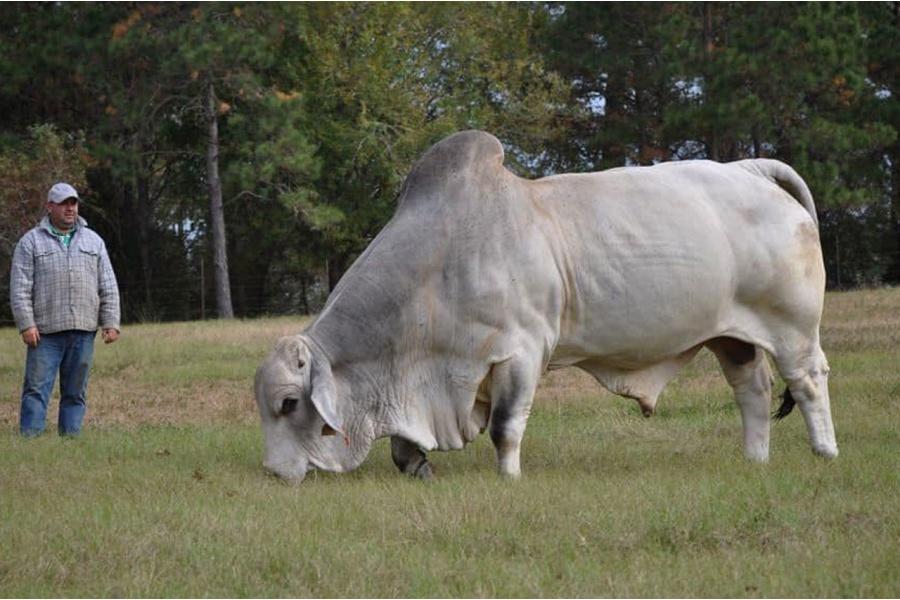
The Brahman is a large cattle breed with a completely different appearance from the European giants. Its most recognizable feature is the prominent hump over the shoulders, accompanied by loose skin, large ears, and a distinctive dewlap.
According to the American Brahman Breeders Association, mature bulls in good condition generally weigh about 1,600–2,200 pounds, or roughly 725–998 kilograms.
The Brahman’s importance goes beyond its weight. These cattle are famous for their ability to tolerate hot climates and challenging tropical conditions. Their genetics have been used extensively in crossbreeding programs around the world.
Their loose skin, short coat, and other physical characteristics help them cope with heat and insects.
A mature Brahman bull can therefore look enormous without necessarily being one of the heaviest European beef breeds.
Image alt text: Large gray Brahman bull with a prominent shoulder hump in a pasture.
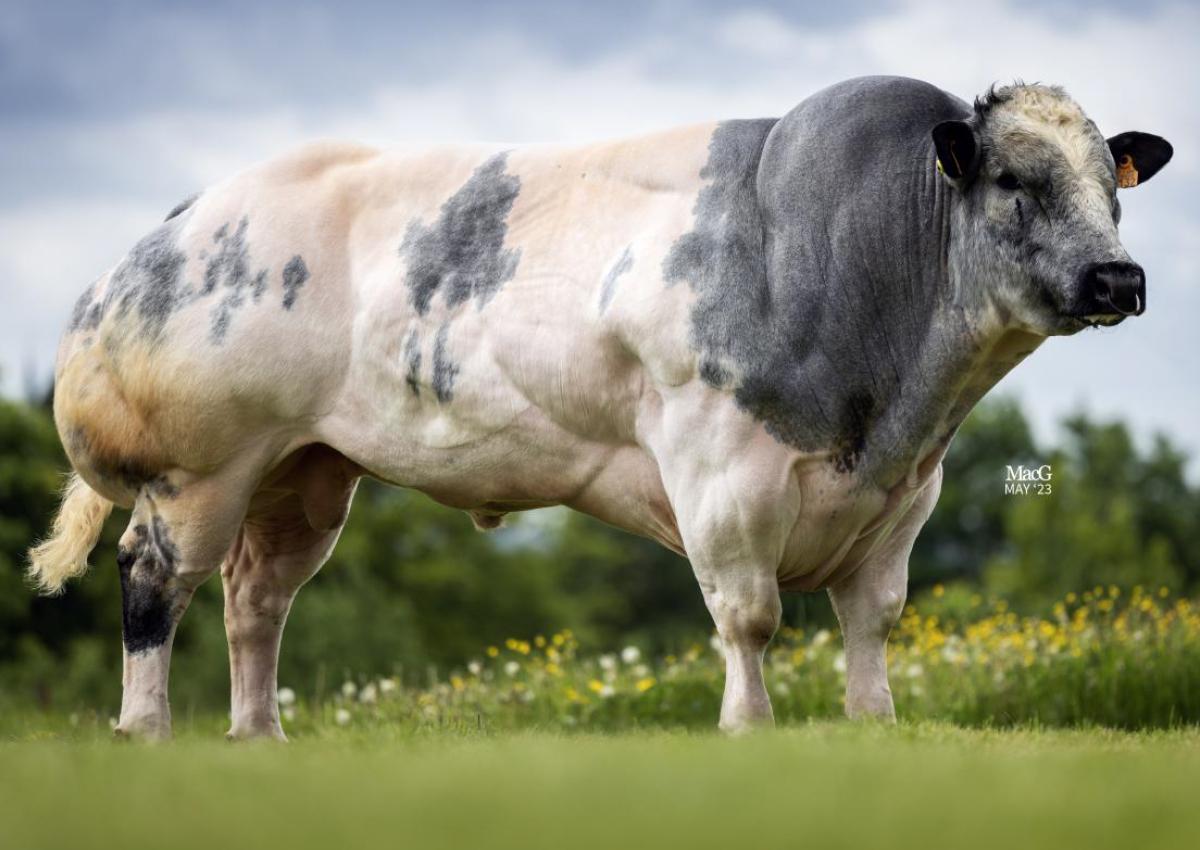
The Belgian Blue looks dramatically different from many other large cattle breeds. Its most famous characteristic is its extraordinary muscular development.
The breed is associated with the “double-muscling” phenotype, a condition linked to changes affecting the myostatin pathway. This can produce unusually large muscles and a very high muscle-to-bone ratio. Belgian Blue is one of the breeds commonly associated with this trait.
Adult Belgian Blue bulls typically weigh around 1,100–1,250 kilograms, although animals exceeding 1,300 kilograms are not unusual.
Instead of appearing exceptionally tall like the Chianina, a Belgian Blue often looks extremely broad and thick. Its shoulders, back, hindquarters, and thighs can appear almost sculpted.
This makes the Belgian Blue one of the most visually recognizable cattle breeds in the world.
Image alt text: Powerful Belgian Blue bull displaying its heavily muscled body.
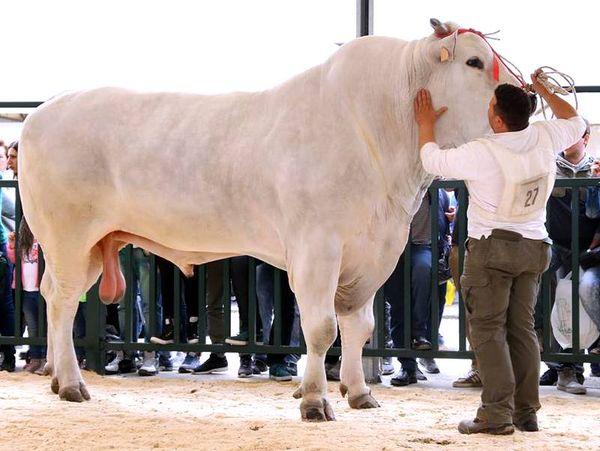
The Chianina is one of the most famous giant cattle breeds in the world. Originating in central Italy, this breed is recognized for its remarkable height, long body, white-to-gray coat, black skin, and powerful frame.
Mature Chianina bulls commonly weigh around 1,200–1,500 kilograms, while exceptional animals can become considerably heavier. Famous bulls have reached approximately 1,700 kilograms and around two meters at the withers. The breed’s official standard describes it as having a distinctive form of “somatic gigantism.”
Unlike some extremely muscular cattle, the Chianina’s impressive appearance comes from both height and length. Its long legs make it look almost horse-like when compared with ordinary cattle.
The breed was historically used as a draft animal, but modern Chianina cattle are primarily associated with beef production and are also valued as terminal sires in crossbreeding programs.
Image alt text: Massive white Chianina bull standing in an Italian pasture.
10 Amazing Types of Ants: Tiny Insects With Extraordinary Superpowers
Updated for 2026 | Original Wildlife Article
7
Ants are among the most successful social insects on Earth. They can be found in tropical rainforests, deserts, grasslands, mountains, gardens and even cities. Although an individual ant may be tiny, a colony can become a remarkably organized society containing thousands or even millions of workers.
What makes ants particularly fascinating is the enormous variety of lifestyles found within the family Formicidae. Some ants cultivate underground fungus gardens, others build nests from living leaves, some launch coordinated raids across the forest floor, and a few have developed extraordinary weapons for catching prey or defending their colonies.
In this original 2026 wildlife article, we explore 10 fascinating types of ants, their habitats, unusual abilities, feeding strategies and the remarkable ways they cooperate.
1. Leafcutter Ants — The Tiny Farmers of the Forest
6
Leafcutter ants are among the most impressive insects in tropical America. Species belonging to the genera Atta and Acromyrmex can create enormous underground societies.
Their name comes from one of their most obvious behaviors: workers cut pieces from leaves and carry them back to the colony. But there is an important detail—the ants do not primarily eat the leaves themselves.
Instead, the plant material is processed and used to cultivate a specialized fungus. The fungus becomes the colony’s principal food source. Smithsonian research describes this relationship as one of the most sophisticated examples of agriculture outside humans.
Different workers have different jobs. Some cut vegetation, others transport it, while smaller workers process plant material and maintain the fungus garden.
Recent Smithsonian research has revealed another fascinating challenge. Some leafcutter ants can carry loads weighing several times their own body mass. Large pieces can interfere with their ability to sense the trail, creating something researchers compared to a “blind spot” in a vehicle.
A single colony can contain millions of individuals, making leafcutters one of nature’s most impressive examples of cooperative organization.
Image alt text:Leafcutter ants carrying pieces of green leaves through a tropical rainforest
2. Bullet Ant — A Powerful Defender of the Rainforest
7
The bullet ant (Paraponera clavata) is a large tropical ant found in parts of Central and South America.
It has earned its intimidating common name because of its exceptionally painful sting.
Bullet ants are generally dark reddish or black and can reach roughly 18–30 millimeters in length. They inhabit tropical forests and feed on resources including nectar and small arthropods.
Their size is impressive for an ant, but their defensive behavior is even more remarkable.
Rather than relying only on large numbers, bullet ants can use their sting to discourage predators and defend themselves.
In the rainforest, where countless insects compete for food and nesting space, having a powerful chemical defense can make a major difference.
Despite their fearsome reputation, bullet ants are also important members of tropical ecosystems. Like other ants, they participate in food webs and contribute to the movement and breakdown of organic material.
Their sting is a reminder that size does not necessarily determine defensive power.
Image alt text:Bullet ant resting on a green leaf in a tropical rainforest
3. Weaver Ants — Architects That Sew Living Leaves
7
Weaver ants are among the world’s most remarkable insect architects.
Species such as the Asian weaver ant (Oecophylla smaragdina) build nests by pulling living leaves together and fastening them with silk.
But there is a surprising part to this process: adult worker ants cannot produce the silk in the same way that silkworms do.
Instead, workers use their larvae as living silk-producing tools. Several ants pull leaves together while others carry larvae between the leaf edges, allowing the larvae to release silk that joins the leaves.
The result is a leafy shelter suspended in the canopy.
Weaver ants are active predators and can help control other insects in tropical environments. Their colonies may occupy numerous nests across several trees.
Their cooperative construction behavior demonstrates the remarkable power of collective action.
One ant cannot build a large leaf nest. Hundreds or thousands working together can transform a cluster of leaves into a protected home.
Image alt text:Red weaver ants constructing a nest by joining tropical green leaves together
4. Army Ants — The Moving Predators
7
Few ant behaviors are as dramatic as the raids of army ants.
Species such as Eciton burchellii live in tropical regions of the Americas and move through forests in large groups searching for prey.
Instead of remaining in one permanent nest like many ants, army ants can organize massive foraging raids.
The moving swarm may overwhelm insects and other small animals that cannot escape quickly enough.
Smithsonian information notes that army ant colonies in the American tropics can contain hundreds of thousands to around a million individuals and may attack prey in coordinated swarm raids.
Their success depends on communication.
Individual ants release chemical signals and respond to signals left by their nestmates. This allows thousands of animals to coordinate their movements without a central commander giving instructions.
The result resembles a living wave moving across the forest floor.
For smaller rainforest creatures, encountering an army ant column can be a major ecological event.
Image alt text:Army ants moving together across the rainforest floor during a coordinated raid
5. Trap-Jaw Ants — Masters of the Lightning Strike
Trap-jaw ants are famous for one of the fastest mechanical movements found in the animal world.
Species in genera such as Odontomachus possess enormous mandibles that can snap shut extremely rapidly.
The jaws are held open under tension. When the ant triggers the mechanism, the mandibles slam together to capture prey or defend the colony.
This is very different from simply biting with ordinary jaws.
The trap-jaw mechanism stores energy and releases it extremely quickly.
Some species can also use the powerful movement for escape. By striking their jaws against a surface, they can propel themselves away from danger.
AntWeb records numerous trap-jaw species and highlights the distinctive anatomy of this group.
Their hunting strategy shows how evolution can transform a basic body structure—the mandible—into a highly specialized biological machine.
Image alt text:Trap-jaw ant using its powerful mandibles to capture prey on the forest floor
6. Honeypot Ants — Colonies With Living Food Storage
6
Honeypot ants have one of the strangest food-storage systems found among insects.
In species such as Myrmecocystus mexicanus, certain workers become specialized living storage containers.
During periods when food is abundant, these ants consume large quantities of liquid food. Their abdomens expand dramatically, turning the workers into living reservoirs.
When food becomes scarce, other colony members can obtain stored nourishment from them.
This strategy is particularly useful in dry environments where food availability may change dramatically between seasons.
Instead of storing food in a separate chamber, the colony effectively stores part of its food supply inside specialized members.
The swollen workers remain inside the nest, protected from environmental extremes.
Their unusual bodies demonstrate how social insects can divide not only labor but also physical roles within the colony.
Image alt text:Honeypot ants with swollen abdomens storing food inside an underground nest
7. Fire Ants — Small Ants With a Powerful Defense
6
Fire ants are known for their aggressive defense and painful stings.
Several species belong to the genus Solenopsis, including the red imported fire ant.
They construct nests in soil and can rapidly mobilize workers when their colony is disturbed.
Unlike ants that rely primarily on jaws, fire ants combine biting with venom delivery.
Their colonies are highly organized, with workers performing different tasks such as foraging, caring for developing young and defending the nest.
Fire ants have also become successful in many human-modified environments.
Their ability to exploit disturbed habitats has contributed to their spread in regions where they were introduced.
This success comes from a combination of social organization, flexible feeding behavior and effective colony defense.
Although often considered pests in areas where they are invasive, fire ants are still fascinating examples of insect social evolution.
Image alt text:Red fire ants working together around their colony nest
8. Carpenter Ants — The Wood-Dwelling Builders
7
Carpenter ants belong primarily to the large genus Camponotus.
Despite their name, they do not actually eat wood like termites.
Instead, they excavate galleries in wood to create nesting chambers and passageways.
In forests, they may establish colonies in dead or damaged trees, fallen logs and other wooden structures.
Their ability to excavate wood can contribute to decomposition because their nesting activity helps break down already weakened plant material.
Carpenter ants are also highly adaptable.
Some species live in natural forests, while others can become associated with buildings and wooden structures.
Their powerful mandibles allow workers to remove tiny pieces of wood and gradually create complex internal tunnel systems.
A piece of wood that looks solid from the outside may contain an extensive network of ant chambers hidden within.
Image alt text:Carpenter ants excavating tunnels inside natural wood
9. Bullet-Sized Acrobat — Acrobat Ants
6
Acrobat ants, members of the genus Crematogaster, are named for their unusual ability to raise and position their abdomen above the rest of the body.
They can be found in many habitats and often nest in trees, under bark or in other protected locations.
Their flexible abdomen is important for defense and chemical communication.
When threatened, an acrobat ant may raise its abdomen and use defensive chemicals against an attacker.
Some species are also associated with plant relationships.
In certain ecosystems, ants can protect plants from herbivores while receiving food or shelter in return.
Their ability to rapidly change body position gives these small insects a surprisingly expressive appearance.
A colony may appear quiet one moment and become highly coordinated when danger approaches.
Image alt text:Acrobat ants displaying their raised abdomens on a tropical tree
10. Weaver and Harvester Ants — Specialists of Different Environments
7
Harvester ants represent another completely different approach to survival.
Rather than cultivating fungi or hunting primarily for animal prey, many harvester ants collect seeds.
They can create underground storage chambers where seeds remain protected until needed.
This strategy is especially useful in dry landscapes, where seeds may provide a dependable food resource.
Workers travel along established routes, collecting food and returning it to the colony.
Their underground nests also provide protection from extreme temperatures.
Harvester ants show that ants do not need tropical forests to become highly organized societies. Desert and grassland species can be equally sophisticated.
Their ability to locate, transport and store seeds demonstrates how collective behavior can turn scattered resources into a stable food supply.
How Ant Colonies Work Like Superorganisms
One of the most extraordinary characteristics of ants is that a colony can behave almost like a single living system.
An individual ant has limited information about what is happening across the entire colony. Yet thousands of individuals can collectively make complex decisions.
They communicate using chemical signals, touch, vibrations and other forms of interaction.
A worker may discover food and leave a chemical trail. Other workers follow it, strengthening the trail as they travel.
If the food disappears, the trail gradually becomes weaker.
This simple system can allow colonies to discover efficient routes without a central leader.
The Smithsonian notes that ants use chemical messages and pheromones to coordinate colony activities.
This is one reason ants are so successful in environments ranging from rainforests to deserts.
Why Ants Are Important to Ecosystems
Ants do far more than build nests.
They move seeds, aerate soil, recycle dead organic matter, hunt insects and provide food for many other animals.
In tropical forests, leafcutter ants can dramatically influence vegetation and soil processes. Smithsonian research describes their colonies as major ecological forces in Neotropical forests.
Other ants protect plants from herbivores.
Some disperse seeds by carrying them underground, where discarded seeds may eventually germinate.
Ants can also influence populations of other insects by acting as predators.
Their activities create connections between plants, soil, fungi, insects and larger animals.
A forest without ants would be a very different ecosystem.
The Amazing Communication System of Ants
Ants do not communicate like humans, but their chemical communication systems are incredibly sophisticated.
A worker can leave chemical information on a surface. Other ants detect those signals with their antennae.
Ants can use chemical cues to identify nestmates, locate food, warn of danger and organize defensive behavior.
This helps explain how a colony can coordinate thousands of individuals.
Recent Smithsonian research on leafcutter ants even examined how workers use their antennae while carrying large leaves. Scientists found that oversized loads can affect how frequently ants use their antennae to interact with the environment.
The more scientists study ants, the clearer it becomes that their societies are dynamic systems rather than simple groups of insects.
Final Thoughts
Ants may be tiny, but their abilities are enormous.
Leafcutter ants are farmers.
Bullet ants are heavily defended rainforest specialists.
Weaver ants are living architects.
Army ants form moving hunting forces.
Trap-jaw ants possess astonishing mechanical weapons.
Honeypot ants turn their own bodies into food storage containers.
Fire ants combine aggression and venom.
Carpenter ants excavate elaborate wooden homes.
Acrobat ants use flexible bodies and chemical defenses.
And harvester ants specialize in collecting and storing seeds.
Together, these animals demonstrate why ants are among the most fascinating insects on Earth.
Their greatest strength is not necessarily the power of one individual. It is the ability of thousands of individuals to cooperate.
A single ant may be tiny—but an entire colony can transform its environment.
10 Amazing Types of Ants: Tiny Insects With Extraordinary Superpowers
SEO Title
10 Amazing Ant Types and Their Extraordinary Abilities | Wildlife 2026
Focus Keyword
ant types
Secondary Keywords
types of ants
ant species
amazing ants
fascinating ants
ant facts
leafcutter ants
bullet ant
weaver ants
army ants
trap-jaw ants
honeypot ants
fire ants
carpenter ants
acrobat ants
harvester ants
rainforest ants
tropical ants
desert ants
insect facts
social insects
ant colony
ant behavior
wildlife facts 2026
Meta Description
Discover 10 amazing ant types, from leafcutter farmers and army ants to bullet ants, trap-jaw ants, honeypot ants and incredible weaver ants.
Short Description / Excerpt
Explore 10 fascinating ant types and discover their unusual habitats, feeding strategies, defenses, communication systems and extraordinary colony behaviors.
Category
Animals & Wildlife
Subcategory
Insects
Tags
Ants, Ant Types, Ant Species, Amazing Ants, Leafcutter Ants, Bullet Ant, Weaver Ants, Army Ants, Trap Jaw Ants, Honeypot Ants, Fire Ants, Carpenter Ants, Acrobat Ants, Harvester Ants, Insects, Social Insects, Rainforest Animals, Tropical Animals, Animal Facts, Wildlife Facts, Nature 2026
Suggested URL Slug
10-amazing-ant-types-extraordinary-abilities-2026
Featured Image Title
10 Amazing Types of Ants With Extraordinary Abilities
Featured Image Alt Text
Ten amazing ant types including leafcutter, bullet, weaver, army, trap-jaw, honeypot, fire, carpenter, acrobat and harvester ants
Featured Image Caption
From rainforest farmers to desert seed collectors, these remarkable ants show how powerful cooperation can be.
Recommended Schema
Article
Author
World Animals TV
Update Year
2026
Suggested Internal Links
Amazing Insects
Rainforest Animals
Strange Animals
Animal Adaptations
Amazon Rainforest Wildlife
World’s Most Unique Animals
Wildlife Facts
Incredible Small Animals
Social Media Description
Tiny bodies, giant abilities! Discover 10 amazing types of ants, including leafcutter farmers, powerful bullet ants, army ants, trap-jaw ants and incredible weaver ants.
12 Fascinating Types of Worms: Strange, Useful and Surprisingly Powerful
Updated for 2026 | Original Wildlife Article
Worms may look simple at first glance, but the word “worm” describes an astonishing variety of animals. They live beneath soil, inside forests, along beaches, on coral reefs, in freshwater ponds and throughout the open ocean. Some are microscopic, while others can grow to extraordinary lengths.
Even more surprising is the variety of ways these animals survive. Earthworms reshape soil, marine bristle worms use specialized appendages to move and breathe, ribbon worms can capture prey with a remarkable proboscis, and arrow worms hunt drifting plankton in the ocean. Some creatures commonly called worms are not even closely related to one another.
This article explores 12 fascinating worm types, focusing on their habitats, body structures, feeding behaviors and unusual survival strategies.
1. Earthworms — Nature’s Underground Engineers
7
The earthworm is probably the worm most familiar to people. Species such as the common earthworm (Lumbricus terrestris) spend much of their lives underground, where they constantly interact with soil, decaying leaves and organic material.
The common earthworm can reach around 14 inches in length and is native to Europe, although it is now widespread in other parts of the world.
Earthworms are sometimes called ecosystem engineers because their burrowing changes the physical structure of soil. Their tunnels can improve movement of air and water, while their feeding and digestion help process organic matter.
An earthworm has no legs, but its segmented body contains tiny bristles called setae that help it anchor itself while moving. Its skin must remain moist because it plays an important role in respiration.
This creates an interesting challenge: the animal needs moisture to survive but can be harmed by overly dry conditions.
Rather than being merely creatures found in gardens, earthworms are important participants in soil ecosystems.
2. Marine Bristle Worms — The Hairy Hunters of the Ocean
7
Marine bristle worms, also called polychaetes, are among the most diverse worm-like animals in the sea.
Scientists know thousands of polychaete species, and they occupy an enormous range of marine habitats—from coral reefs to the deep ocean. Smithsonian sources describe more than 10,000 known species and an extraordinary diversity of forms.
Their name comes from the numerous bristles projecting from their bodies. These bristles can help with movement, defense or other specialized functions.
Some species have paddle-like structures for swimming. Others use their appendages to crawl across the seabed or circulate water through tubes.
Their lifestyles are incredibly varied.
Some polychaetes are hunters. Others consume organic particles, algae or decaying material. Tube-dwelling species can construct protective homes on the seafloor.
There are even extraordinary deep-sea species associated with hydrothermal vents, where temperatures and chemical conditions are extremely challenging.
The diversity of bristle worms demonstrates that a simple segmented body can evolve into many specialized forms.
3. Ribbon Worms — Long Predators With a Hidden Weapon
7
Ribbon worms, belonging to the phylum Nemertea, are usually marine animals with extraordinarily elongated bodies.
Some species are short and compact, while others can stretch to remarkable lengths. They often live beneath rocks, within sediment or among other organisms on the seafloor.
Their most interesting feature is a specialized proboscis.
Instead of relying only on jaws, many ribbon worms can rapidly extend this structure to capture prey. Depending on the species, the proboscis may help seize small animals or deliver venom.
The Natural History Museum lists Nemertea among the major groups of small invertebrate phyla represented in its collections.
Ribbon worms are therefore a reminder that a soft-bodied animal does not necessarily need claws or a hard shell to be an effective predator.
Their long, flexible bodies allow them to explore narrow spaces, while the extendable feeding structure gives them a specialized method of capturing prey.
4. Flatworms — Masters of Regeneration
7
Flatworms, or planarians in the group commonly studied by scientists, are famous for their unusual body structure and remarkable regenerative abilities.
Many freshwater planarians live in ponds, streams and other aquatic environments. Their flattened bodies allow them to move across surfaces while searching for food.
Their most famous biological characteristic is regeneration.
Certain planarian species can regenerate missing body parts, and researchers have studied these animals extensively to understand how cells communicate during regeneration.
A planarian’s simple appearance hides a surprisingly sophisticated biological system.
Some have distinct eye spots that can detect changes in light. They can also respond to chemical signals in their surroundings and navigate toward food.
Not every flatworm is harmless. The broader flatworm group includes parasitic species that have evolved extremely specialized relationships with their hosts.
This makes “flatworm” a huge biological category containing free-living predators, scavengers and parasites.
5. Leeches — The Suckers With a Surprising Lifestyle
Leeches are segmented worms belonging to the group Hirudinea.
Many people immediately associate them with blood-feeding, but not all leeches have this lifestyle. Different species have developed different feeding strategies.
Some are predators that consume small invertebrates, while others feed on the blood or tissues of larger animals.
A typical leech has suckers that help it attach to surfaces or hosts.
Blood-feeding species have evolved specialized mouthparts and saliva containing compounds that help maintain blood flow while they feed.
Their ability to remain attached in moving water is particularly impressive.
Leeches can inhabit freshwater environments, while some species live on land in humid forests.
Their flexible bodies allow them to move in a distinctive looping motion, attaching one end and then pulling the other end forward.
Although they often have a bad reputation, leeches are important components of aquatic and terrestrial food webs.
6. Arrow Worms — Transparent Predators of the Open Ocean
Arrow worms, or chaetognaths, are among the strangest predators in the ocean.
They are often nearly transparent, which makes them difficult to see in the water. The Australian Museum describes them as part of the holoplankton—animals that remain within the plankton for their entire lives.
Despite their delicate appearance, arrow worms are active predators.
They use grasping spines near the head to capture tiny organisms such as copepods. Their transparent bodies provide camouflage in the open water.
Living in the plankton creates a difficult survival problem. There are few places to hide, and predators can approach from almost any direction.
Transparency is therefore extremely useful.
Arrow worms demonstrate that some of the most important predators in an ecosystem can be tiny animals that drift through the water column rather than large fish or marine mammals.
7. Velvet Worms — The “Worm” That Shoots Sticky Slime
The velvet worm is one of the most unusual animals included in this list.
But there is an important scientific detail: velvet worms are not true annelid worms. They belong to their own phylum, Onychophora, and are more closely related to arthropods than to earthworms.
They look somewhat like soft caterpillars, with many pairs of short legs extending along the body.
Velvet worms usually live in moist environments such as rotting logs, leaf litter and forests. Their bodies can dry out easily, so humidity is extremely important.
Their strangest adaptation is their hunting weapon.
A velvet worm can eject sticky slime from specialized glands. The slime entangles prey, allowing the worm to approach and consume it.
The Australian Museum reports that velvet worms can prey on small invertebrates such as termites, woodlice and spiders.
These animals have survived in recognizable form for an extremely long period of Earth’s history, making them especially interesting to evolutionary scientists.
8. Scale Worms — The Armored Worms of the Seafloor
5
Scale worms are a specialized group of marine polychaetes.
They are covered with overlapping structures called elytra, which can give the animals an armored appearance.
These scales provide protection while the worms move across the seafloor.
Some species are predators, feeding on other small marine animals. Others may scavenge organic material.
Scale worms can be found in a variety of marine environments, including cold polar waters.
Smithsonian researchers have documented remarkable polychaete diversity, including Antarctic scale worms and species with unusual defensive adaptations.
Some polychaetes can even produce light, adding another layer of strangeness to this already unusual group.
The scale worm’s body demonstrates how a worm can combine flexibility with protective structures without developing a hard external skeleton.
9. Bobbit Worm — A Hidden Ambush Predator
6
The Bobbit worm (Eunice aphroditois) is one of the most dramatic marine worms.
It belongs to the polychaetes and spends much of its body buried beneath sand or sediment.
Only part of the animal may remain exposed while it waits for prey.
Sensitive structures around its head help detect passing animals. When an opportunity appears, the worm can rapidly emerge from its hiding place.
The Smithsonian reports that Bobbit worms can reach around 10 feet in length, making them giants compared with many other polychaetes.
Its jaws are adapted for grabbing prey, and its ambush strategy means it does not need to constantly search across the seabed.
The Bobbit worm is a perfect example of a predator that lets the environment do much of the hiding work.
10. Christmas Tree Worms — Living Decorations on Coral Reefs
7
The Christmas tree worm is one of the most beautiful worms in the ocean.
Its colorful, spiral structures extend from tubes built inside coral.
These feather-like structures help the animal collect food particles and also participate in respiration.
When danger approaches, the worm can quickly retract its delicate structures into its tube.
The Smithsonian describes Christmas tree worms as common inhabitants of tropical coral reefs, where their colorful structures can make colonies look like tiny underwater forests.
Their lifestyle is a fascinating example of cooperation between an animal and its habitat.
The worm receives protection from its tube, while its feeding structures extend into the surrounding water to collect food.
11. Zombie Worms — Specialists That Feed on Bones
7
Few animals have a name as dramatic as the zombie worm.
Species in the genus Osedax live on the bones of dead marine animals on the deep seafloor.
They are particularly famous for colonizing whale bones.
Unlike ordinary predators, these worms have developed a way to exploit nutrients locked inside hard skeletal material.
Smithsonian research describes their unusual root-like structures, which penetrate bone and contain symbiotic bacteria that help the worms obtain nutrients.
Another extraordinary feature is their reproduction.
The females are visible on the bone, while males are microscopic and live within females.
This unusual arrangement makes sense in the deep sea, where finding a mate can be extremely difficult.
Rather than searching across enormous areas of seafloor, tiny males can remain associated with females.
12. Pompeii Worms — Life Beside Scorching Hydrothermal Vents
6
The Pompeii worm (Alvinella pompejana) lives around hydrothermal vents deep beneath the ocean.
This environment is among the most extreme habitats occupied by complex animals.
Hydrothermal vents release hot, chemically rich fluids from the seafloor. Temperatures can change dramatically over very short distances.
The Smithsonian describes Pompeii worms as living partly within cooler tubes while portions of their bodies can be exposed to much hotter conditions.
Their survival is linked to their ability to tolerate extreme conditions and maintain relationships with microorganisms.
Scientists study such animals because they can reveal how life adapts to environments that once seemed almost impossible for animals to inhabit.
The Pompeii worm reminds us that the ocean floor is not an empty desert. It contains ecosystems powered by chemistry rather than sunlight.
What Makes Worms So Important?
The animals commonly called worms perform many different ecological roles.
Earthworms help process soil and organic material.
Marine bristle worms contribute to food webs and sediment ecosystems.
Flatworms can act as predators, scavengers or parasites.
Leeches participate in aquatic and terrestrial food chains.
Arrow worms help regulate populations of tiny planktonic animals.
Velvet worms prey on small forest invertebrates.
Scale worms move through marine sediments and participate in seafloor food webs.
Christmas tree worms live among coral communities.
Zombie worms recycle nutrients from large marine bones.
Pompeii worms occupy some of the most extreme ecosystems on Earth.
Their ecological importance is easy to overlook because many are small, hidden or unfamiliar.
Worms Are Not One Single Animal Group
One of the most important things to understand about worms is that “worm” is not a single scientific classification.
Earthworms belong to segmented worms called annelids.
Bristle worms are also annelids.
Leeches are another specialized group of annelids.
Flatworms belong to the phylum Platyhelminthes.
Ribbon worms belong to Nemertea.
Arrow worms belong to Chaetognatha.
Velvet worms belong to Onychophora and are more closely related to arthropods than to true segmented worms.
This diversity is what makes worms so interesting.
Their similar long-bodied appearance evolved in animals that may be separated by enormous evolutionary distances.
Final Thoughts
From a humble earthworm beneath a garden to a transparent predator drifting through the ocean, worms have evolved an incredible range of lifestyles.
Some improve soil. Some hunt from hidden burrows. Some glide through plankton-filled water. Others live among coral reefs or consume the bones of enormous marine animals.
The 12 worm types featured here show that a long, soft body can support remarkably sophisticated survival strategies.
Perhaps the most fascinating lesson is that animals that look simple can have extraordinarily complex lives.
The next time you see a worm, remember: you may be looking at just one small member of a vast and surprisingly diverse world of animals.
📸 7 Real-Image Sets for Your WordPress Article
Image 1 — Earthworm
Alt text:Common earthworm moving across a damp forest floor Filename:common-earthworm-wildlife-2026.jpg
Image 2 — Marine Bristle Worms
Alt text:Colorful marine bristle worm living on a coral reef Filename:marine-bristle-worm-polychaete.jpg
Image 3 — Ribbon Worm and Flatworm
Alt text:Ribbon worm and freshwater flatworm representing unusual worm species Filename:ribbon-worm-flatworm.jpg
Image 4 — Leeches and Arrow Worm
Alt text:Leech and transparent arrow worm showing two very different worm adaptations Filename:leech-arrow-worm.jpg
Image 5 — Velvet Worm
Alt text:Velvet worm crawling across damp rainforest vegetation Filename:velvet-worm-rainforest.jpg
Image 6 — Deep-Sea Worms
Alt text:Bobbit worm and deep sea worms showing extraordinary marine adaptations Filename:bobbit-worm-deep-sea-worms.jpg
Image 7 — All Worm Types Featured
Alt text:Collage of 12 fascinating worm types including earthworm, bristle worm, ribbon worm, flatworm, leech, arrow worm, velvet worm, scale worm, Bobbit worm, Christmas tree worm, zombie worm and Pompeii worm Filename:12-fascinating-worm-types-2026.jpg
For publication, verify the license of each individual wildlife photograph. The Australian Museum, for example, identifies some of its velvet-worm imagery as CC0 or CC BY 4.0, while other wildlife photographs have different rights.
🔎 Complete WordPress SEO Package
New Article Title
12 Fascinating Types of Worms: Strange, Useful and Surprisingly Powerful
SEO Title
12 Fascinating Worm Types and Their Amazing Survival Skills | 2026
Focus Keyword
worm types
Secondary Keywords
types of worms
worm species
fascinating worms
unusual worms
amazing worms
earthworm
marine worms
bristle worms
polychaete worms
ribbon worms
flatworms
planarian
leeches
arrow worms
velvet worms
scale worms
Bobbit worm
Christmas tree worm
zombie worm
Pompeii worm
deep sea worms
marine animals
soil animals
unusual animals
invertebrate facts
animal facts 2026
Meta Description
Discover 12 fascinating worm types, from earthworms and leeches to Bobbit worms, velvet worms, arrow worms and strange deep-sea species.
Short Description / Excerpt
Explore 12 fascinating types of worms and discover where they live, what they eat and the extraordinary adaptations that help them survive in soil, forests, freshwater and oceans.
12 Fascinating Worm Types and Their Amazing Survival Skills
Featured Image Alt Text
12 fascinating worm types including earthworm, marine bristle worm, ribbon worm, flatworm, leech, arrow worm, velvet worm and deep-sea worms
Featured Image Caption
From soil-dwelling earthworms to extraordinary deep-sea predators, worms have evolved remarkable ways to survive.
Recommended Schema
Article
Author
World Animals TV
Update Year
2026
Suggested Internal Links
Amazing Invertebrates
Strange Animals
Deep-Sea Animals
Ocean Animals
Rainforest Animals
Soil Animals
Rare Animals
Animal Adaptations
Wildlife Facts
World’s Most Unique Animals
Social Media Description
Think worms are simple? Think again! Discover 12 extraordinary worm types, from earthworms and velvet worms to Bobbit worms, zombie worms and bizarre deep-sea species.
15 Amazing Bird Types Around the World: Colors, Skills and Survival Secrets
Updated for 2026 | Original Wildlife Article | WordPress Ready
7
Birds can be found almost everywhere on Earth. They soar above mountains, walk across deserts, swim through oceans, hunt in forests and even survive in some of the coldest places on the planet. With thousands of species occupying different habitats, birds have developed an extraordinary variety of shapes, colors, behaviors and survival strategies.
Some birds are famous for their incredible flying ability. Others are powerful hunters, expert swimmers, long-distance migrants or masters of camouflage. A few are unable to fly at all, yet they have developed other impressive ways to survive.
This guide explores 15 fascinating types of birds, from powerful eagles and colorful kingfishers to mysterious owls, spectacular birds of paradise and unusual flightless species. Each one demonstrates a different side of bird evolution.
1. Eagles — Masters of the Sky
6
Eagles are among the most recognizable birds of prey. Their powerful legs, curved talons and hooked bills make them highly effective hunters.
Species such as the Bald Eagle, Golden Eagle and Harpy Eagle occupy very different habitats. Bald Eagles are strongly associated with lakes, rivers and coastal areas, while Golden Eagles can live across mountains, grasslands and open country. Harpy Eagles are specialized rainforest predators.
Their exceptional eyesight helps them locate prey from considerable distances. Broad wings allow many species to soar on rising air currents instead of constantly flapping.
The Bald Eagle, for example, is strongly associated with aquatic environments and frequently hunts fish. Cornell’s All About Birds describes adults as large raptors with long, broad wings and notes their association with fish near water.
Eagles also demonstrate an important lesson about conservation. Some populations have recovered dramatically after decades of protection and habitat management.
2. Kingfishers — Precision Hunters Near Water
7
Few birds are as visually striking as kingfishers.
Their brilliant blue, green, orange or turquoise plumage makes them favorites among wildlife photographers. But their beauty is matched by impressive hunting skills.
Many kingfishers live close to rivers, streams, lakes or coastal environments. They often sit quietly on a branch before suddenly diving toward the water.
Their long, pointed bills are perfectly suited to catching fish and other aquatic prey.
The Common Kingfisher, for example, combines vivid blue and orange plumage with an extremely specialized hunting technique. A patient bird can remain motionless until the right moment, then plunge into the water with remarkable precision.
Kingfishers demonstrate how body shape and behavior can evolve together. Their streamlined bills, sharp eyesight and hunting posture are all connected to life around water.
3. Hornbills — The Birds With Extraordinary Bills
5
Hornbills are immediately recognizable because of their enormous bills and the structures called casques found on the upper part of the bill in many species.
The Great Hornbill is one of the most spectacular examples. It inhabits forests of South and Southeast Asia and spends much of its life in the canopy.
Despite the impressive size of its bill, the bird is capable of moving efficiently through branches.
Hornbills eat a variety of foods, including fruit and small animals. Fruit-eating species can play an important ecological role because seeds may be transported from one location to another after the birds feed.
Their nesting behavior is equally fascinating. In several hornbill species, the female becomes enclosed inside a tree cavity during part of the nesting period while the male delivers food.
This unusual family strategy protects the nest and developing young from many potential predators.
A documented Great Hornbill image and taxonomic record are available through Wikidata, which identifies the species as Buceros bicornis.
4. Owls — Silent Hunters of the Night
7
Owls have evolved a remarkable collection of features for hunting in low light.
Their large forward-facing eyes provide excellent depth perception, while their facial disks help collect and direct sound toward the ears.
Many owl species are also capable of extremely quiet flight.
Specialized feather structures reduce the noise produced by air moving across the wings. This allows some owls to approach prey with surprisingly little warning.
Owls occupy many habitats, including forests, grasslands, deserts and wetlands.
Their diets vary according to species and location. Some primarily hunt rodents and other small mammals, while others specialize in insects, fish or birds.
An owl sitting motionless on a branch may appear calm, but it is often carefully listening for movement below.
That combination of exceptional hearing, vision and quiet flight makes owls some of nature’s most effective nighttime predators.
5. Flamingos — Specialists of Shallow Water
7
Flamingos are among the most recognizable wetland birds in the world.
Their long legs and curved bills allow them to feed in shallow lakes, lagoons and other wetlands.
The pink or reddish coloration of their feathers comes largely from pigments called carotenoids obtained through their diet.
Their unusual bills are specialized for filter feeding. Depending on the species, flamingos consume algae, tiny aquatic organisms and other small food items.
One of their most remarkable behaviors is gathering in large groups.
Huge colonies can provide safety through numbers and create spectacular scenes when thousands of birds move together.
Flamingos also demonstrate how a bird’s physical appearance can be closely connected to its feeding strategy and habitat.
6. Birds of Paradise — Evolution’s Greatest Showmen
7
Birds of paradise are famous for some of the most elaborate courtship displays in the animal kingdom.
Many species live in the forests of New Guinea and nearby islands.
Male birds can possess extraordinary feathers, bright colors and specialized ornamental structures. During courtship, they may spread feathers, change their posture, perform dances or make unusual sounds.
The purpose is often to attract females.
This creates an extraordinary example of sexual selection, where traits that improve mating success can become increasingly elaborate over generations.
The result is a group of birds that seem almost unreal.
Their displays also demonstrate that survival is not always about fighting or escaping predators. For some animals, successfully attracting a mate is one of life’s most important challenges.
7. Hummingbirds — Tiny Birds With Incredible Flight
7
Hummingbirds are among the smallest birds on Earth, but their flying abilities are enormous compared with their size.
They can hover in place, move backward and maneuver rapidly around flowers.
Their wings beat extremely quickly, producing the characteristic humming sound associated with the group.
Many hummingbirds feed on nectar while also consuming small insects and other tiny organisms.
Their long bills and specialized tongues allow them to reach nectar hidden inside flowers.
Because they transfer pollen while visiting flowers, hummingbirds can also contribute to pollination.
Their high-energy lifestyle means they need to feed frequently.
The hummingbird is a remarkable example of how a very small body can support a highly specialized aerial lifestyle.
8. Penguins — Birds Designed for the Ocean
6
Penguins are birds, but they have traded traditional flight for exceptional swimming ability.
Their wings have evolved into flipper-like structures, allowing them to move efficiently underwater.
Penguins live mainly in the Southern Hemisphere, with species occupying environments ranging from Antarctic ice to temperate coastal regions.
The Emperor Penguin is particularly famous for surviving extreme Antarctic conditions.
Dense feathers, body fat and social behavior help penguins deal with cold environments.
Underwater, they can pursue fish, squid and other marine prey.
Their streamlined bodies demonstrate how dramatically evolution can transform a bird’s anatomy when life becomes centered on the ocean rather than the sky.
9. Toucans — Tropical Birds With Oversized Bills
6
Toucans are famous for their enormous, colorful bills.
The Keel-billed Toucan is particularly striking, with a multicolored bill that contrasts strongly with its dark body.
Toucans are primarily associated with tropical forests of Central and South America.
Their bills may look heavy, but they are surprisingly lightweight because they contain a honeycomb-like internal structure.
Many toucans eat fruit, but they can also consume insects, eggs and small animals.
By eating fruit and later moving through the forest, they can help distribute seeds.
Their bills also play roles beyond feeding, including social interactions and temperature regulation.
10. Secretarybirds — Raptors That Hunt on Foot
6
The Secretarybird is one of Africa’s most unusual birds of prey.
Unlike eagles and hawks that spend much of their hunting time in the air, Secretarybirds are highly adapted to walking across open landscapes.
Their long legs allow them to move through grasslands while searching for prey.
They are known for attacking prey with powerful downward strikes of their feet.
Snakes, insects and other small animals can become prey.
Their unusual hunting technique demonstrates that being a successful predator does not always require powerful flight.
Sometimes the best strategy is to become an expert walker.
11. Potoos — Masters of Camouflage
6
The Potoo is one of the strangest-looking nocturnal birds in the Americas.
During the day, it often sits motionless on a branch and relies heavily on camouflage.
Its mottled feathers can resemble bark, making the bird surprisingly difficult to detect.
Large eyes help it hunt insects during the night.
When threatened, a potoo may remain perfectly still rather than immediately flying away.
This behavior is known as crypsis—using appearance and behavior to blend into the surroundings.
Potoos demonstrate that survival sometimes depends on being almost invisible.
12. Peacocks — Feathers Used for Courtship
7
The male Indian Peafowl, commonly called a peacock, has one of the most spectacular feather displays in the bird world.
During courtship, the male spreads his long ornamental tail feathers into an enormous fan.
The feathers contain numerous eye-like patterns called ocelli.
This display requires considerable energy and creates an obvious visual signal, yet it can provide an important reproductive advantage.
The peacock is a classic example of sexual selection.
Females evaluate males, and ornamental characteristics can influence mating success.
Its extravagant appearance therefore has an evolutionary purpose rather than being merely decorative.
13. Woodpeckers — Birds Built for Tree Trunks
5
Woodpeckers have evolved bodies specially adapted to life on tree trunks.
Their strong bills can hammer into wood while searching for insects or creating cavities.
Many species have stiff tail feathers that help brace the body against a tree.
Their feet are also adapted for gripping vertical surfaces.
Woodpeckers can play an important ecological role by creating tree cavities later used by other animals.
Their behavior therefore affects more than just their own survival.
A single old tree with several woodpecker holes can become a valuable shelter for insects, birds and small mammals.
14. Albatrosses — Champions of Long-Distance Flight
7
Albatrosses are among the greatest long-distance flyers in the animal kingdom.
Their enormous wings allow them to travel across oceans while using wind efficiently.
Rather than continuously flapping, they can use a technique called dynamic soaring, gaining energy from differences in wind speed above the ocean.
This allows them to cover extraordinary distances with relatively little effort.
Albatrosses spend much of their lives at sea and return to land primarily for breeding.
Their lifestyle demonstrates how birds can become perfectly adapted to enormous marine environments.
15. Ostriches — Giants That Chose the Ground
6
The Ostrich is the largest living bird and one of the most recognizable flightless species.
Instead of using wings for powered flight, ostriches rely on their extremely powerful legs.
They can run at high speeds across open African landscapes.
Their long necks provide an excellent view over grasslands, helping them detect approaching predators.
Ostriches also lay enormous eggs—the largest eggs produced by any living bird.
Their story shows that losing the ability to fly does not necessarily mean losing evolutionary success.
On open ground, speed, eyesight and powerful legs can be more useful than wings.
What Makes Birds So Successful?
The 15 bird types in this article live very different lives, yet their survival strategies reveal several common themes.
Eagles dominate through strength and aerial vision.
Kingfishers specialize in precision fishing.
Hornbills are adapted to tropical forests and unusual nesting systems.
Owls dominate the darkness.
Flamingos specialize in shallow wetlands.
Birds of paradise use spectacular courtship displays.
Hummingbirds have mastered hovering flight.
Penguins transformed their wings into underwater propulsion systems.
Toucans use oversized bills in tropical forests.
Secretarybirds became exceptional terrestrial hunters.
Potoos disappear against tree bark.
Peacocks use elaborate feathers to attract mates.
Woodpeckers exploit tree trunks.
Albatrosses travel enormous distances over oceans.
And ostriches demonstrate the power of running instead of flying.
This diversity is one reason birds are so important to ecosystems around the world.
Why Birds Matter to Nature
Birds perform countless ecological functions.
They pollinate flowers, spread seeds, control insects, recycle nutrients and serve as prey for other animals. Some birds are also important indicators of environmental change because their populations can respond quickly when habitats deteriorate.
Forests, wetlands, grasslands, deserts and oceans all depend on complex relationships between species.
Protecting birds therefore means protecting the environments that support them.
For wildlife photographers, birdwatchers and nature enthusiasts, birds also provide an extraordinary opportunity to observe evolution in action.
Every bill, feather, wing and hunting technique tells part of a much larger story.
Final Thoughts
Birds are far more than creatures that fly through the sky.
They are hunters, swimmers, climbers, runners, pollinators, seed dispersers and long-distance travelers.
Some are tiny enough to fit comfortably in a person’s hand. Others have wingspans several times wider than a human’s height. Some survive in deserts, while others spend most of their lives above the open ocean.
The eagle, kingfisher, hornbill, owl, flamingo, bird of paradise, hummingbird, penguin, toucan, Secretarybird, potoo, peacock, woodpecker, albatross and ostrich each represent a different solution to the challenges of survival.
The more closely we look at birds, the more remarkable the natural world becomes.
📸 7 Real-Image Suggestions for Your WordPress Article
Image 1 — Bird Diversity
Alt text:Different wild bird species representing the incredible diversity of birds around the world Filename:amazing-bird-types-world-2026.jpg
Image 2 — Birds of Prey
Alt text:Eagle, owl and Secretarybird representing powerful birds of prey Filename:eagle-owl-secretarybird.jpg
Image 3 — Colorful Tropical Birds
Alt text:Colorful hornbill, toucan and bird of paradise in tropical forest habitats Filename:colorful-tropical-birds.jpg
Image 4 — Water Birds
Alt text:Flamingo, kingfisher and penguin representing different water-loving bird species Filename:flamingo-kingfisher-penguin.jpg
Image 5 — Unusual Birds
Alt text:Potoo, peacock and ostrich showing unusual bird adaptations Filename:unusual-birds-potoo-peacock-ostrich.jpg
Image 6 — Flying Specialists
Alt text:Hummingbird and albatross demonstrating extraordinary bird flight abilities Filename:hummingbird-albatross-flight.jpg
Image 7 — Featured Image
Alt text:Collage of 15 amazing bird types including eagle, kingfisher, hornbill, owl, flamingo, hummingbird, penguin, toucan and ostrich Filename:15-amazing-bird-types-featured-2026.jpg
Recommended featured image:1200 × 675 px
Important: The web photo results above are examples of real wildlife photography, but you should check the individual photograph’s license before uploading it to a commercial WordPress website. For example, Cornell’s Bald Eagle gallery identifies photographs from the Macaulay Library with individual photographer credits.
🔎 Complete WordPress SEO Package
New Title
15 Amazing Bird Types Around the World: Colors, Skills and Survival Secrets
SEO Title
15 Amazing Bird Types Around the World | Wildlife Facts 2026
Focus Keyword
bird types
Secondary Keywords
bird species
types of birds
amazing birds
beautiful birds
unusual birds
wild birds
bird facts
bird adaptations
birds of prey
tropical birds
water birds
colorful birds
rare birds
bird wildlife
birds of the world
eagle
kingfisher
hornbill
owl
flamingo
hummingbird
penguin
toucan
bird of paradise
Secretarybird
potoo
peacock
albatross
ostrich
wildlife 2026
Meta Description
Discover 15 amazing bird types from around the world, including eagles, kingfishers, hornbills, owls, flamingos, hummingbirds, penguins and birds of paradise.
Short Description / Excerpt
Explore 15 fascinating bird types and discover their unique habitats, appearances, behaviors, feeding strategies and extraordinary adaptations.
15 amazing bird types including eagle, kingfisher, hornbill, owl, flamingo, hummingbird, penguin, toucan, bird of paradise and ostrich
Featured Image Caption
From powerful eagles to tiny hummingbirds, these remarkable birds reveal the incredible diversity of avian life.
Recommended Schema
Article
Author
World Animals TV
Update Year
2026
Suggested Internal Links
Amazing Animals
Rare Birds
Birds of the Amazon Rainforest
Birds of Paradise
Birds of Prey
Colorful Birds
Rainforest Animals
Wildlife Facts
World’s Most Unique Animals
Social Media Description
From powerful eagles and silent owls to colorful kingfishers, spectacular birds of paradise and flightless ostriches, discover 15 amazing bird types and their incredible survival skills.
10 Incredible Lizards With Extraordinary Survival Skills
Updated for 2026 | Original Wildlife Article
6
Lizards are among the most diverse reptiles on Earth. They can live in tropical rainforests, deserts, rocky islands, grasslands and even along ocean shorelines. Some are enormous predators, while others are tiny climbers that spend their lives hidden among leaves and branches.
What makes lizards especially fascinating is the extraordinary range of adaptations they have developed. Some can change color, some can run across water, some use venom, and others have specialized bodies that allow them to survive intense heat or scarce water.
In this updated 2026 wildlife guide, we explore 10 remarkable types of lizards and the unusual characteristics that help each one survive.
1. Komodo Dragon — The World’s Largest Living Lizard
7
The Komodo dragon (Varanus komodoensis) is the largest living lizard and one of the most famous reptiles on the planet.
Native to several Indonesian islands, including Komodo, Rinca and Flores, these giant monitor lizards live in tropical savanna forests and can travel across a surprisingly wide variety of terrain. The Smithsonian’s National Zoo records a verified maximum length of about 10.3 feet (3.13 meters) and a weight of 366 pounds (166 kilograms).
Komodo dragons are powerful predators. Their strong limbs, claws and serrated teeth help them capture and consume prey. Their forked tongues are constantly sampling the air, helping them detect scents.
Another remarkable characteristic is their ability to swallow very large meals. According to the Smithsonian, an adult can consume an amount of food equivalent to as much as 80 percent of its own body weight in one meal.
They are a spectacular example of how a lizard can become an apex predator within its ecosystem.
Image alt text:Komodo dragon walking through its natural Indonesian habitat
2. Marine Iguana — The Lizard That Feeds in the Sea
6
The marine iguana (Amblyrhynchus cristatus) may be the strangest member of the iguana family because it spends part of its life feeding in the ocean.
This species is endemic to the Galápagos Islands and is the only lizard in the world known to live and forage at sea. It feeds primarily on algae, diving into cold coastal water and gripping rocks with its powerful claws.
The cold ocean creates a major problem for a reptile because lizards depend on external heat to regulate their body temperature. Marine iguanas therefore spend considerable time basking on volcanic rocks after feeding.
They also have a clever solution to another problem: salt.
Because they consume seawater while eating algae, marine iguanas have specialized salt glands and expel excess salt through their nostrils. Sometimes salt crystals can be seen around their noses.
Their ability to survive both on land and in the sea makes them one of the most specialized lizards in existence.
Image alt text:Marine iguana basking on volcanic rocks in the Galapagos Islands
3. Green Iguana — A Powerful Climber of the Tropics
7
The green iguana (Iguana iguana) is one of the most recognizable tropical lizards.
Despite its common name, green iguanas can display a variety of colors, including shades of green, brown and gray. Their long tails, strong claws and muscular bodies make them excellent climbers.
They are commonly associated with tropical forests and areas near rivers and other water sources. Young iguanas spend much of their time in vegetation, while adults may occupy higher branches.
Their diet is primarily plant-based, making them an important part of tropical food webs.
One of their most useful defensive abilities is swimming. If threatened on land, a green iguana can leap into water and use its laterally compressed tail to propel itself away.
This combination of climbing and swimming gives the animal several ways to escape predators.
Image alt text:Green iguana climbing a tree in a tropical rainforest
4. Chameleon — The Lizard With Extraordinary Eyes and a Lightning-Fast Tongue
6
Few lizards are as famous as the chameleon.
There are more than 200 recognized chameleon species, with many found in Africa and Madagascar. They inhabit forests, savannas and other environments, depending on the species.
Their eyes are extraordinary. Each eye can move independently, allowing the animal to watch different directions at the same time. When hunting, the eyes can also work together to judge distance.
Then comes the tongue.
A chameleon’s projectile tongue can extend rapidly to capture insects. National Geographic describes the tongue as capable of reaching remarkable speeds and catching prey surprisingly far from the animal’s head.
Color change is another famous feature, but there is an important misconception: chameleons do not simply change color to match whatever background they are sitting on.
Color changes can communicate social information, indicate stress or temperature, and play a role in courtship and territorial behavior.
Their gripping feet and prehensile tails are equally useful for life in trees.
Image alt text:Colorful chameleon perched on a branch in a tropical habitat
5. Frilled Lizard — The Reptile That Opens a Giant Collar
7
The frilled lizard (Chlamydosaurus kingii) is an Australian reptile famous for its enormous neck frill.
When relaxed, the frill folds close to the body. When threatened, the lizard suddenly spreads it around its head, creating an intimidating display.
The Australian Museum describes the frill as an important defensive structure. If the display does not scare away a predator, the lizard may rear onto its hind legs, hiss and attempt to escape.
It can also run on two legs.
This unusual running style allows the lizard to move quickly toward the nearest tree, where it can climb using its sharp claws.
Frilled lizards inhabit woodland, forest and open scrub environments in northern Australia and New Guinea.
Their dramatic appearance is not simply for show. The entire defensive routine is designed to make a potential predator hesitate long enough for the lizard to escape.
Image alt text:Frilled lizard displaying its large neck frill in an Australian woodland
6. Green Basilisk — The Famous “Jesus Lizard”
7
The green crested basilisk (Basiliscus plumifrons) has earned the nickname Jesus Lizard because of its extraordinary ability to run across the surface of water.
It lives near streams and other waterways in tropical Central America.
Its long toes and specialized scales help spread its weight and create enough force to support rapid movement across shallow water. The Smithsonian reports that these lizards can sprint on their hind legs at more than 7 miles per hour (11.3 km/h).
Eventually, gravity wins. As the basilisk slows, it becomes partially submerged and switches from running to swimming.
It can also remain underwater for more than 10 minutes, giving it another way to escape predators.
This is an excellent example of how an animal can exploit the physical properties of its environment.
Instead of simply running away from danger, the basilisk can use the water itself as an escape route.
Image alt text:Green basilisk lizard running across the surface of a tropical stream
7. Gila Monster — One of the World’s Venomous Lizards
7
The Gila monster (Heloderma suspectum) looks almost as though it has been painted with orange and black beads.
Native to parts of the southwestern United States and Mexico, it is one of the world’s few venomous lizards.
Unlike venomous snakes, the Gila monster does not rely on hollow fangs to inject venom. Its lower teeth have grooves, and venom moves into a bite through these structures as the animal holds onto its victim.
Gila monsters also have an impressive energy-storage strategy.
They store fat in their bodies and tails, allowing them to survive long periods without eating. The Smithsonian notes that they can consume very large meals relative to their size.
Most of the time, Gila monsters are not chasing prey across the desert. They spend considerable periods underground, emerging more often when conditions are favorable.
Their slow lifestyle is actually part of their survival strategy.
Image alt text:Gila monster moving across rocky desert terrain in Arizona
8. Thorny Devil — The Desert Lizard That Collects Water Through Its Skin
6
The thorny devil (Moloch horridus) looks like a miniature dragon covered in spikes.
It lives in arid regions of central and western Australia, where finding water can be difficult.
Its spines provide protection, but its most amazing adaptation is its skin.
Tiny channels between the scales can collect moisture and move it toward the mouth through capillary action. The Australian Museum explains that the animal can obtain water from rain, dew and even moist sand.
The thorny devil also has an unusual false head on the back of its neck. When threatened, this can confuse a predator about which end of the animal is the real head.
Its diet is dominated by ants, and its specialized mouth is well suited to capturing them.
In a landscape where water may be unpredictable, the thorny devil has essentially turned its entire skin into a miniature water-collection system.
Image alt text:Thorny devil lizard standing on red Australian desert sand
9. Flying Dragon — A Lizard That Glides Between Trees
6
The flying dragons of the genus Draco are small lizards with one of the most unusual forms of locomotion among reptiles.
They do not actually fly like birds.
Instead, they have expandable membranes supported by elongated ribs. When spread, these membranes act like gliding surfaces, allowing the lizards to travel from one tree to another without climbing down to the forest floor.
This is an extremely efficient strategy for an animal living in a tropical canopy.
The forest floor can contain predators and obstacles, while neighboring branches may be relatively close together.
By gliding, a Draco lizard can cross gaps quickly while conserving energy.
When the gliding membranes are folded against the body, the lizard can move normally along branches.
Their ability is another example of evolution transforming an ordinary-looking body structure into a highly specialized transportation system.
Image alt text:Flying dragon Draco lizard gliding between tropical rainforest trees
10. Leopard Gecko — A Small Lizard Built for Harsh Landscapes
7
The leopard gecko (Eublepharis macularius) is smaller than most of the lizards on this list, but its adaptations are just as interesting.
Native to parts of South Asia and surrounding dry regions, leopard geckos are ground-dwelling lizards adapted to rocky and arid environments.
Their spotted bodies provide camouflage against stones and soil.
Unlike many geckos, leopard geckos have movable eyelids. Their eyes are protected while they move through dusty environments, and their vertical pupils are particularly useful in low-light conditions.
They are also known for storing fat in their tails.
That reserve can provide energy when food is less available.
Their nighttime activity is another adaptation to harsh climates. Avoiding the hottest part of the day can reduce water loss and overheating.
Although small, the leopard gecko demonstrates an important principle of reptile survival: sometimes the best strategy is not strength but efficiency.
Image alt text:Leopard gecko resting among rocks in a dry natural habitat
What Makes Lizards Such Successful Survivors?
These 10 lizards demonstrate how differently reptiles can solve the same basic problems.
Komodo dragons rely on size, strength and predatory ability.
Marine iguanas have conquered an environment that seems almost impossible for a lizard—the ocean.
Green iguanas use climbing, swimming and plant-based diets to thrive in tropical habitats.
Chameleons combine specialized eyes, gripping feet and an extraordinary tongue.
Frilled lizards use visual intimidation and speed.
Basilisks have learned to exploit water as an escape route.
Gila monsters use venom and energy storage.
Thorny devils harvest water from their own surroundings.
Flying dragons use gliding to travel through the forest canopy.
And leopard geckos combine camouflage, nocturnal activity and fat storage to cope with dry environments.
The diversity is extraordinary.
Why Lizards Matter to Ecosystems
Lizards are more than fascinating animals for wildlife photographers and nature enthusiasts.
They occupy important positions in food webs.
Some eat insects and help regulate insect populations. Others consume plants, fruit or small vertebrates. At the same time, lizards themselves provide food for birds, snakes, mammals and other predators.
Their presence can therefore influence many other species.
Lizards are also useful indicators of environmental health. Because many species depend on specific temperatures, habitats and food sources, changes in their populations can reveal larger ecological problems.
Habitat destruction, invasive predators, illegal wildlife collection and climate-related changes can all affect reptile populations.
Protecting lizards means protecting the ecosystems in which they evolved.
Final Thoughts
From the enormous Komodo dragon to the tiny leopard gecko, lizards demonstrate an astonishing range of evolutionary solutions.
One can hunt large prey. Another dives into the sea. One can glide between trees, while another can run across water. A desert species can collect moisture through its skin, and a venomous lizard can store enough fat to survive long periods between meals.
These animals show why reptiles deserve a closer look.
They may appear simple when sitting motionless on a rock or branch, but beneath their scales are highly specialized bodies shaped by millions of years of adaptation.
The world of lizards is not just about scales and tails—it is a story of survival, innovation and evolution.
📸 WordPress Image SEO — 7 Image Sets
Image 1 — Giant & Marine Lizards
Animals: Komodo Dragon + Marine Iguana Alt text:Komodo dragon and marine iguana showing two extraordinary types of lizards Filename:komodo-dragon-marine-iguana-lizards.jpg
Image 2 — Tropical Lizards
Animals: Green Iguana + Chameleon Alt text:Green iguana and colorful chameleon in tropical habitats Filename:green-iguana-chameleon-tropical-lizards.jpg
Image 3 — Australian Lizards
Animals: Frilled Lizard + Thorny Devil Alt text:Frilled lizard and thorny devil in Australian natural habitats Filename:frilled-lizard-thorny-devil-australia.jpg
Image 4 — Water & Desert Specialists
Animals: Green Basilisk + Gila Monster Alt text:Green basilisk and Gila monster showing unusual lizard survival adaptations Filename:green-basilisk-gila-monster.jpg
Image 5 — Gliding & Ground Lizards
Animals: Flying Dragon + Leopard Gecko Alt text:Flying dragon lizard and leopard gecko representing unusual reptile adaptations Filename:flying-dragon-leopard-gecko.jpg
Image 6 — All Ten Lizards
Alt text:Ten incredible lizards including Komodo dragon, marine iguana, green iguana, chameleon, frilled lizard, basilisk, Gila monster, thorny devil, flying dragon and leopard gecko Filename:10-incredible-lizards-2026.jpg
Image 7 — Featured Website Image
Alt text:Collage of ten incredible lizard species from deserts, forests, islands and tropical habitats Filename:incredible-lizards-wildlife-2026-featured.jpg
Recommended featured-image size:1200 × 675 px
Image licensing: For a WordPress website, use photographs whose licenses permit online publication. For example, Smithsonian has some animal photographs explicitly marked CC0/public domain, including a Komodo dragon image record.
🔎 Complete WordPress SEO Package
New Article Title
10 Incredible Lizards With Extraordinary Survival Skills
SEO Title
10 Incredible Lizards and Their Amazing Survival Skills | Wildlife 2026
Focus Keyword
incredible lizards
Secondary Keywords
lizards
lizard species
amazing lizards
unusual lizards
rare lizards
incredible reptiles
lizard facts
reptile facts 2026
Komodo dragon
marine iguana
green iguana
chameleon
frilled lizard
Jesus lizard
green basilisk
Gila monster
thorny devil
flying dragon lizard
leopard gecko
lizard adaptations
exotic reptiles
wildlife animals
Meta Description
Discover 10 incredible lizards, from the giant Komodo dragon and marine iguana to the water-running basilisk, thorny devil, chameleon and flying dragon.
Short Description / Excerpt
Meet 10 extraordinary lizards and discover the remarkable adaptations that help them survive in oceans, rainforests, deserts, rocky landscapes and tropical forests.
10 Incredible Lizards With Extraordinary Survival Skills
Featured Image Alt Text
Ten incredible lizards including Komodo dragon, marine iguana, green iguana, chameleon, frilled lizard, basilisk, Gila monster, thorny devil, flying dragon and leopard gecko
Featured Image Caption
Ten remarkable lizards demonstrate the extraordinary ways reptiles adapt to deserts, forests, islands and waterways.
Recommended Schema
Article
Author
World Animals TV
Publication / Update Year
2026
Suggested Internal Links
Amazing Reptiles
Rare Animals
Rainforest Animals
Desert Animals
Ocean Animals
Animal Adaptations
Wildlife Facts
World’s Most Unique Animals
Suggested Social Media Description
From Komodo dragons and marine iguanas to water-running basilisks and gliding flying dragons, discover 10 incredible lizards and the amazing adaptations that help them survive.
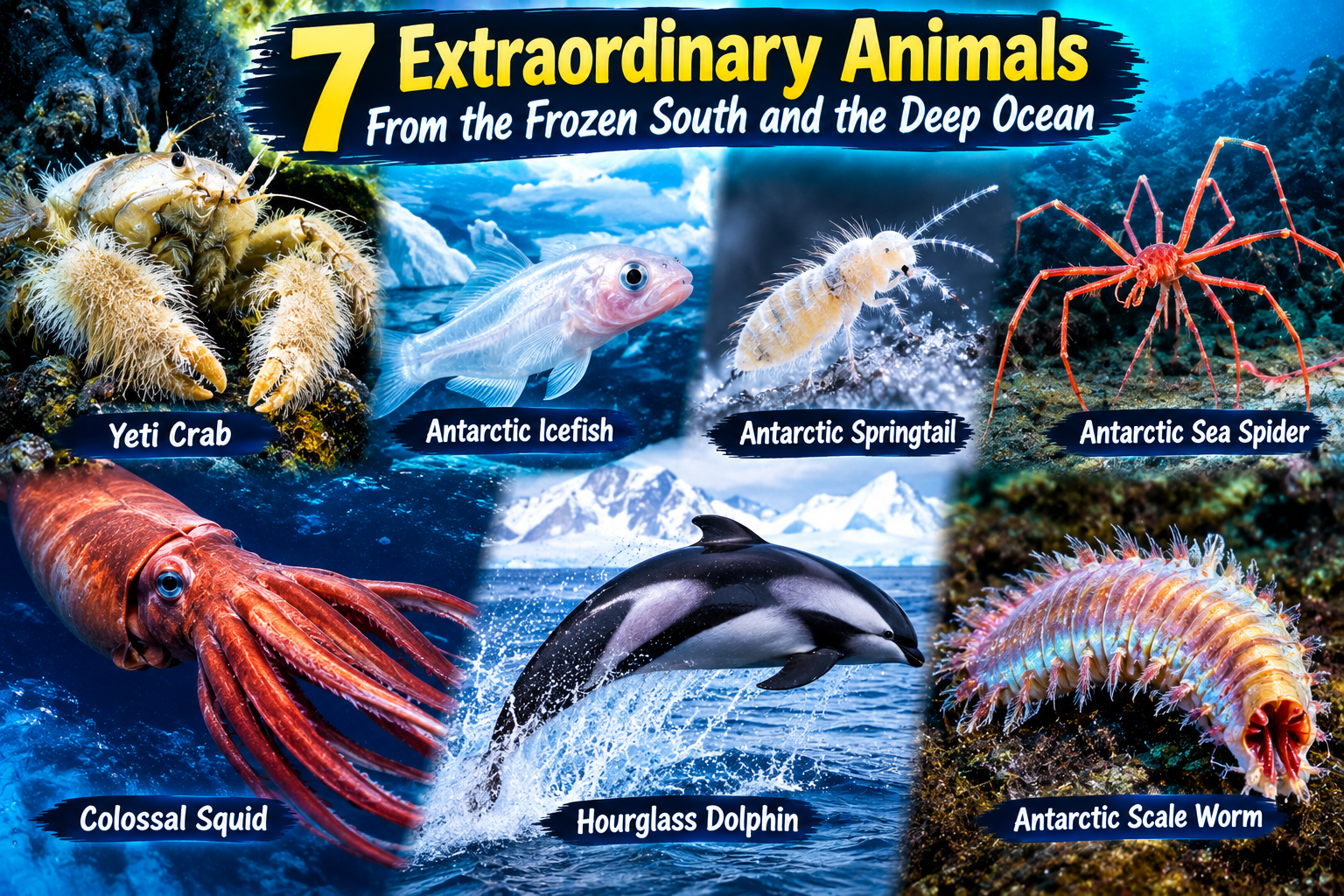
7 Extraordinary Animals From the Frozen South and the Deep Ocean
Updated: 2026
Explore seven bizarre animals from Antarctica and the deep ocean and discover the remarkable adaptations that allow them to survive freezing temperatures, darkness and extreme pressure.
Introduction: Where Survival Takes an Extreme Turn
Some of Earth’s strangest animals live far away from cities, forests and familiar landscapes. They inhabit places where sunlight barely reaches, temperatures can fall below the freezing point of freshwater, and food may be scarce.
The Southern Ocean around Antarctica and the deep seas beyond the continental shelves are particularly remarkable. These environments may appear empty at first glance, yet beneath the surface is a world filled with animals that have evolved extraordinary ways to survive.
This article explores seven fascinating creatures: the Yeti Crab, Antarctic Icefish, Antarctic Springtail, Antarctic Sea Spider, Colossal Squid, Hourglass Dolphin, and Antarctic Scale Worm.
They are very different animals. One is a tiny land-dwelling arthropod, another is a warm-blooded marine mammal, while others live hundreds or thousands of meters beneath the waves.
Together, they reveal an important lesson about nature: extreme environments do not necessarily mean lifeless environments. They can produce some of the most specialized animals on Earth.
1. Yeti Crab: The Hairy Crab of the Deep
The Yeti Crab is one of the most unusual crustaceans ever discovered.
The species Kiwa hirsuta was discovered in 2005 near a hydrothermal vent south of Easter Island. Smithsonian Ocean notes that the animal was so unusual that scientists established not only a new species but also a new genus, Kiwa.
Its nickname comes from its strange appearance. The crab has hairy-looking structures covering its claws and body, giving it an almost furry appearance.
But the hairs are not simply decoration.
The structures are associated with bacteria, and scientists have proposed that the crab cultivates or harvests microbial growth around its body and claws. This relationship is connected with the unusual chemical environment surrounding deep-sea vents.
Hydrothermal vents form where seawater interacts with hot material associated with Earth’s crust. They can support ecosystems without sunlight because microorganisms can obtain energy through chemical processes called chemosynthesis.
Interestingly, Yeti crabs are not restricted to one small area. Related Kiwa crabs have also been documented around hydrothermal systems in the Southern Ocean, including the Australian-Antarctic Ridge. Research reported Kiwa crabs living around vent fields there, suggesting connections among distant Southern Ocean vent ecosystems.
The Yeti Crab is therefore a perfect example of how life can flourish in environments that initially seem completely hostile.
Image alt text:Yeti crab Kiwa living near a deep sea hydrothermal vent
2. Antarctic Icefish: The Fish With Almost Invisible Blood
5
Imagine swimming through water that is cold enough to freeze ordinary body fluids.
That is the challenge faced by Antarctic icefish.
The Southern Ocean surrounding Antarctica can remain below the normal freezing point of freshwater. Yet icefish are specially adapted to this environment.
One of their most remarkable characteristics is their lack of normal red blood cells and hemoglobin. British Antarctic Survey explains that icefish transport oxygen through their blood plasma instead.
Smithsonian Ocean also describes how Antarctic icefish use antifreeze proteins to prevent damaging ice crystals from growing inside their bodies.
This is a remarkable evolutionary solution.
In most vertebrates, hemoglobin is essential for transporting oxygen. Icefish have taken a very different path.
Their unusual blood works especially well in Antarctic water because cold water contains relatively high amounts of dissolved oxygen.
Their bodies are also adapted to a slow, cold-water lifestyle.
Scientists continue to study icefish because their biology can teach us about adaptation to extreme temperatures. Their antifreeze molecules are especially interesting because similar biological compounds may have potential applications in areas such as preservation and biotechnology.
The icefish proves that surviving extreme cold does not always require thick fur or feathers. Sometimes the solution is hidden inside the bloodstream.
Image alt text:Antarctic icefish adapted to survive freezing Southern Ocean water
3. Antarctic Springtail: A Tiny Survivor on Frozen Land
4
Antarctica is usually associated with penguins, seals and enormous glaciers.
But one of the continent’s most fascinating animals is only about 1–2 millimeters long.
The Antarctic springtail, including species such as Cryptopygus antarcticus, is a tiny terrestrial arthropod that survives on ice-free areas of the continent.
British Antarctic Survey describes this springtail as one of the most successful terrestrial arthropods to colonize Antarctica.
Its biggest challenge is obvious: freezing.
Unlike large Antarctic marine animals, springtails cannot simply swim away from cold conditions. They live on exposed ground, beneath rocks and around patches of vegetation, algae and organic material.
Research has shown that Cryptopygus antarcticus has sophisticated cold-survival strategies. Its ability to avoid freezing is influenced by its water balance and physiological state. British Antarctic Survey research found that changes associated with molting can increase cold hardiness in this species.
That means this tiny animal’s life cycle itself can contribute to its survival strategy.
Springtails may be small enough to overlook completely, but they are part of the Antarctic terrestrial food web and help process organic material.
Their existence is an excellent reminder that Antarctica is not biologically empty.
There is life on the rocks, in the soil and around melting snow—even when that life is almost invisible.
Image alt text:Tiny Antarctic springtail surviving extreme cold on ice-free Antarctic ground
4. Antarctic Sea Spider: An Animal With Enormous Legs
6
The name sea spider sounds like something from a science-fiction movie.
These marine arthropods really can look spider-like, with extremely long legs extending from a relatively small central body.
Antarctic waters are home to an extraordinary diversity of sea spiders. Research expeditions around the Antarctic Peninsula, Scotia Arc and Weddell Sea have documented numerous species and specimens.
Australian Antarctic Program research notes that Antarctic sea spiders can range from tiny juveniles to species with leg spans exceeding 70 centimeters.
Their unusual body proportions are connected to an evolutionary phenomenon sometimes called polar gigantism.
In cold environments, some marine invertebrates can reach larger sizes than closely related species living in warmer regions.
Sea spiders also have an unusual anatomy. Their digestive system extends into their legs, allowing them to process food through structures reaching far into the body appendages.
Many species feed on small marine animals and soft-bodied organisms.
Their long legs help them move across the seafloor while searching for food.
Antarctic sea spiders show how dramatically body shape can change in response to environmental conditions.
To someone standing on an Antarctic beach, they are completely hidden from view.
But on the seafloor beneath the waves, these strange animals are part of a rich and complex ecosystem.
Image alt text:Long-legged Antarctic sea spider on the Southern Ocean seafloor
5. Colossal Squid: The Heavyweight of the Invertebrate World
4
Few animals have generated as much mystery as the colossal squid (Mesonychoteuthis hamiltoni).
It lives in the deep Southern Ocean and has historically been known mainly from specimens recovered by fishing vessels.
That changed dramatically in recent years.
In 2025, scientists operating the remotely operated vehicle SuBastian captured the first confirmed observation of a live colossal squid in its natural environment. The juvenile was approximately 30 centimeters long and observed around 600 meters deep.
Seeing a living animal rather than a damaged specimen gave researchers an entirely new opportunity to study its movement and appearance.
The colossal squid is also famous for its enormous potential size. Smithsonian Ocean reports estimates of up to about 14 meters (45 feet).
It is particularly distinctive because of the hooks on its arms.
These structures help the squid grasp prey in the darkness of the deep ocean.
Unlike a giant squid, which is famous for exceptionally long tentacles, the colossal squid is built with a much heavier, more muscular body.
It is considered the heaviest known invertebrate, making its biology particularly extraordinary.
Yet much about this animal remains unknown.
Scientists still have questions about its complete life cycle, behavior, feeding patterns and population distribution.
The first confirmed live sighting demonstrated just how much remains to be discovered beneath the Southern Ocean.
Image alt text:Live juvenile colossal squid Mesonychoteuthis hamiltoni photographed by a deep sea ROV
6. Hourglass Dolphin: The Black-and-White Dolphin of the Southern Ocean
7
The Hourglass Dolphin (Lagenorhynchus cruciger) is one of the most distinctive dolphins in the Southern Ocean.
Its black-and-white markings form an hourglass-like pattern along its body, giving the species its memorable common name.
Unlike many dolphins familiar from warm coastal waters, hourglass dolphins are associated with the cold waters of the Southern Ocean.
Australian Antarctic Program records list the species among the cetaceans found around Antarctic and sub-Antarctic waters.
Researchers and expedition crews have observed these dolphins from ships traveling through Southern Ocean waters.
Their streamlined bodies allow them to move efficiently through cold, energetic seas.
Like other dolphins, they use sound as an important part of their underwater world. Echolocation helps toothed whales navigate and locate objects and prey.
Hourglass dolphins may travel in groups and can sometimes be seen riding waves or moving alongside vessels.
Their striking appearance is another reminder that Antarctic wildlife isn’t limited to penguins and seals.
There is an entire community of marine mammals moving through the waters surrounding the continent.
Because the Southern Ocean is vast and difficult to study, much remains to be learned about the species’ population size, behavior and movements.
Image alt text:Hourglass dolphin swimming in the cold Southern Ocean near Antarctica
7. Antarctic Scale Worm: A Creature That Looks Almost Alien
5
The Antarctic scale worm (Eulagisca gigantea) may be one of the most visually bizarre creatures in this entire collection.
Its body is covered by overlapping scales, while a prominent retractable mouth structure gives it an almost alien appearance.
The Smithsonian’s National Museum of Natural History has preserved specimens of Eulagisca gigantea collected in the Scotia Sea. One documented specimen was collected at depths of approximately 523–671 meters.
Another Smithsonian specimen came from the South Orkney Islands region at roughly 298–302 meters.
Scale worms belong to the polychaete group of segmented marine worms.
The name “scale worm” refers to the overlapping structures covering much of the back.
These animals are part of benthic communities—the ecosystems living on or near the seafloor.
Their strange appearance has made them popular in photographs and museum collections, but their biology is more important than their unusual looks.
Marine worms contribute to food webs and nutrient cycling, and different species occupy a huge range of ecological roles.
The Antarctic scale worm is particularly interesting because the deep Southern Ocean remains difficult to explore.
Every research expedition has the potential to reveal animals that humans have rarely, if ever, observed alive.
Image alt text:Antarctic scale worm Eulagisca gigantea with its unusual retractable mouth
Although these animals live in dramatically different environments, their adaptations reveal several common themes.
Fighting the cold
The Antarctic icefish uses antifreeze proteins and unusual blood chemistry, while the Antarctic springtail relies on physiological mechanisms that help prevent lethal freezing.
Finding food without sunlight
The Yeti Crab lives around hydrothermal environments where microbial communities can use chemical energy rather than sunlight.
Surviving the deep
The colossal squid and scale worm live in environments where pressure, darkness and limited observations make scientific research extremely challenging.
Adapting body shape
The enormous legs of Antarctic sea spiders demonstrate how unusual body proportions can evolve in polar marine environments.
Moving through cold oceans
The Hourglass Dolphin has a streamlined body adapted to life in the Southern Ocean.
These strategies are completely different, yet they all accomplish the same basic goal: staying alive in an environment with serious challenges.
Why These Animals Matter to Science
Studying unusual animals isn’t just about collecting strange facts.
These species can help scientists understand some of the most important biological questions on Earth.
How does life survive freezing temperatures?
How can animals function under enormous water pressure?
How can organisms obtain energy without sunlight?
How does evolution create new body designs?
And how might animals respond as their environments change?
Antarctica is particularly important because the region is experiencing significant environmental changes. British Antarctic Survey describes the Southern Ocean as a biologically rich ecosystem and notes that Antarctic species have developed striking adaptations to cold conditions.
Some animals may be able to adapt to changing conditions, while others may be more vulnerable.
That makes long-term research extremely valuable.
The creatures in this article are not merely curiosities. They are living examples of evolution working under extreme environmental pressure.
Final Thoughts
The Yeti Crab looks furry but lives around deep-sea vents.
The Antarctic Icefish survives water cold enough to threaten ordinary fish.
The tiny Antarctic Springtail survives on frozen land.
The Antarctic Sea Spider walks on extraordinary long legs across the seafloor.
The mysterious Colossal Squid can grow to enormous proportions while remaining one of the least understood large animals in the ocean.
The Hourglass Dolphin travels through the cold Southern Ocean with a distinctive black-and-white body pattern.
And the bizarre Antarctic Scale Worm looks like something from another planet despite being a real resident of the deep seafloor.
Together, these seven animals reveal a hidden world where survival requires extraordinary specialization.
The colder, darker and more difficult the environment becomes, the more remarkable some of nature’s solutions can be.
📸 WordPress Image SEO — 7 Real Image Suggestions
Image 1 — Yeti Crab
Alt text:Yeti crab Kiwa hirsuta living near a deep sea hydrothermal vent Filename:yeti-crab-kiwa-deep-sea.jpg
Image 2 — Antarctic Icefish
Alt text:Antarctic icefish swimming in freezing Southern Ocean water Filename:antarctic-icefish-freezing-ocean.jpg
Image 3 — Antarctic Springtail
Alt text:Antarctic springtail Cryptopygus antarcticus photographed at microscopic scale Filename:antarctic-springtail-cryptopygus.jpg
Image 4 — Antarctic Sea Spider
Alt text:Long-legged Antarctic sea spider on the Southern Ocean seafloor Filename:antarctic-sea-spider.jpg
Image 5 — Colossal Squid
Alt text:Juvenile colossal squid Mesonychoteuthis hamiltoni observed alive in the deep Southern Ocean Filename:colossal-squid-antarctic-ocean.jpg
Image 6 — Hourglass Dolphin
Alt text:Hourglass dolphin swimming through the Southern Ocean near Antarctica Filename:hourglass-dolphin-southern-ocean.jpg
Image 7 — Antarctic Scale Worm
Alt text:Antarctic scale worm Eulagisca gigantea showing its unusual body and retractable mouth Filename:antarctic-scale-worm-eulagisca.jpg
Image licensing note: Use photographs only when the license permits WordPress publication. The Smithsonian record for Eulagisca gigantea specifically identifies its media as CC0/public domain, while other wildlife photographs may have separate restrictions.
🔎 Complete WordPress SEO Package
New Article Title
7 Extraordinary Animals From the Frozen South and the Deep Ocean
Alternative SEO Title
7 Strange Antarctic Animals With Incredible Survival Adaptations
Focus Keyword
Antarctic animals
Secondary Keywords
Antarctic animals 2026
strange Antarctic animals
unusual Antarctic wildlife
Southern Ocean animals
deep sea animals
Yeti Crab
Kiwa hirsuta
Antarctic icefish
Antarctic springtail
Antarctic sea spider
colossal squid
hourglass dolphin
Antarctic scale worm
Eulagisca gigantea
deep ocean wildlife
polar animals
unusual marine animals
extreme animal adaptations
weird animals
rare ocean creatures
Meta Description
Discover 7 extraordinary Antarctic and deep-sea animals, from the hairy Yeti Crab and bloodless icefish to colossal squid, sea spiders and hourglass dolphins.
Short Description / Excerpt
Explore seven bizarre animals from Antarctica and the deep ocean and discover the remarkable adaptations that allow them to survive freezing temperatures, darkness and extreme pressure.
From nearly invisible icefish blood to hairy Yeti Crabs and mysterious colossal squid, discover seven extraordinary animals that survive in some of Earth’s harshest environments.
8 Extraordinary Animals That Reveal the Wild Side of Nature
Updated for 2026 | Original Wildlife Article | WordPress Ready
5
Nature’s Remarkable Survivors
Wildlife does not follow a single blueprint. Some animals are built for power, others for speed, camouflage, climbing, flying, or simply disappearing into their surroundings. A swamp may hide an armored reptile, while a rainforest canopy can be home to acrobatic monkeys and powerful predators.
In this collection, we explore eight fascinating animals and bird groups: the American Alligator, Black Spider Monkey, Oropendolas and Caciques, Black Mamba, Jaguar, Jesus Lizard, Great Potoo, and Tropical Royal Flycatcher (Onychorhynchus coronatus).
They come from very different environments. Several are associated with tropical forests in the Americas, while the Black Mamba is an African species. Together, they demonstrate how evolution has produced remarkably different answers to the challenges of survival.
1. American Alligator: The Armored Hunter of Wetlands
7
The American Alligator (Alligator mississippiensis) is one of North America’s most recognizable reptiles. Its natural range includes much of the southeastern United States, where it inhabits freshwater rivers, lakes, marshes and swamps.
At first glance, the alligator seems almost perfectly designed for an aquatic ambush. Its muscular tail provides propulsion, its armored back protects its body, and its rounded snout contains powerful jaws.
The Smithsonian’s National Zoo reports that adult males average around 11.2 feet (3.4 meters), while exceptionally large individuals can approach 1,000 pounds.
One of the animal’s most interesting adaptations is the position of its nostrils. They face upward at the end of the snout, allowing an alligator to breathe while much of its body remains underwater.
Its teeth are equally impressive. An alligator normally has between 74 and 80 teeth at one time, but worn or lost teeth are continuously replaced. Over an entire lifetime, an individual can go through thousands of teeth.
The American alligator is also a conservation success story. After populations suffered from hunting and habitat loss, legal protection helped the species recover dramatically.
Alt text:American alligator resting in a freshwater swamp
2. Black Spider Monkey: An Acrobat in the Rainforest Canopy
7
High above the forest floor, the Black Spider Monkey (Ateles paniscus) moves through the canopy with remarkable agility.
This primate occurs in parts of northern South America, including Brazil, French Guiana, Guyana and Suriname. It spends most of its time in dense forests, particularly high in the canopy.
Its body is specialized for life among the branches. Long arms and legs help it swing between trees, while its long prehensile tail acts almost like an additional limb.
Black spider monkeys are primarily fruit eaters. Animal Diversity Web reports that fruit can make up the majority of their diet when it is abundant, with leaves, flowers, seeds and other plant material also contributing.
Their social behavior is particularly interesting. Groups can contain dozens of animals, but they frequently split into smaller feeding and traveling parties. This flexible social organization allows them to search efficiently for scattered fruit.
Unfortunately, black spider monkeys face serious pressures from deforestation and hunting. Their dependence on extensive forest and relatively slow reproduction makes population recovery difficult.
Protecting large areas of connected rainforest is therefore crucial for their future.
Alt text:Black spider monkey moving through the Amazon rainforest canopy
3. Oropendolas & Caciques: The Noisy Architects of Tropical Forests
7
Oropendolas and caciques are members of the New World blackbird family, Icteridae, and are famous for their unusual voices and distinctive nests.
Many species live in tropical forests and woodland habitats across Central and South America.
Oropendolas are especially famous for their long, hanging nests. Instead of placing a simple nest on a branch, females weave pendulous structures that can hang well below the supporting branch.
Cornell’s Bird Academy notes that Montezuma Oropendolas live in colonies and that their hanging nests can extend three feet or more below a branch.
The shape is more than decoration. A long, deep nest may help protect eggs and young from predators and reduce the likelihood that eggs will fall out during strong winds.
Their colonies can become remarkably busy places.
Several birds may occupy the same general area, creating a mixture of calls, wingbeats and courtship displays.
Oropendolas also have distinctive voices. Some calls sound surprisingly liquid or mechanical, giving tropical forests an unmistakable soundtrack.
These birds remind us that architecture is not limited to humans. A small bird using plant fibers can construct a hanging nursery high above the forest floor.
Alt text:Oropendola perched near a long hanging nest in a tropical forest
4. Black Mamba: Africa’s Fast and Highly Venomous Snake
6
The Black Mamba (Dendroaspis polylepis) is included here as a striking example of an animal from a completely different continent.
Despite its name, the Black Mamba is generally brownish, gray or olive rather than black. The name comes from the dark interior of its mouth, which it may display when threatened.
This highly venomous snake occurs across parts of sub-Saharan Africa, particularly savannas, woodland and rocky areas.
It is a long, slender snake capable of moving quickly when necessary.
Black Mambas are predators, feeding mainly on smaller animals such as birds and mammals. Their speed and venom are important parts of their hunting strategy.
Despite the snake’s frightening reputation, its behavior is often misunderstood. Like many wild animals, it generally prefers to avoid unnecessary confrontation.
Its reputation has also been exaggerated by myths and sensational stories.
The most important lesson is simple: a Black Mamba should be treated as a dangerous wild animal and observed from a safe distance.
Alt text:Black Mamba snake in its natural African habitat
5. Jaguar: The Powerful Predator of the Americas
7
The Jaguar (Panthera onca) is one of the great predators of the Americas.
Its range extends from parts of North America through Central America and into South America. Tropical forests, wetlands, grasslands and other habitats can support jaguars when enough prey and cover remain.
The U.S. Fish & Wildlife Service describes the jaguar as the largest cat in the Americas. Its rosette patterns are distinctive, with many rosettes containing additional spots inside them.
The jaguar’s body is compact and muscular compared with some other big cats. This gives it enormous strength.
Unlike many cats, jaguars are also comfortable around water. Smithsonian research has documented their association with rivers, wetlands and tropical forests.
As an apex predator, the jaguar plays an important ecological role. By hunting a variety of prey, it can influence populations throughout its habitat.
But jaguars require space.
Habitat fragmentation, persecution and declining prey can make it difficult for populations to remain healthy. Wildlife corridors that connect isolated forest areas can therefore be extremely important.
The survival of the jaguar is closely linked to the survival of the forests and wetlands it inhabits.
Alt text:Wild jaguar walking through tropical rainforest habitat
6. Jesus Lizard: The Reptile That Can Run Across Water
5
Few animal abilities sound more unbelievable than running across water.
The Green Crested Basilisk (Basiliscus plumifrons), commonly called the Jesus Lizard, can do exactly that.
These lizards live near streams and other water sources in tropical forests. When frightened, they can rise onto their hind legs and sprint across the water’s surface.
The Smithsonian’s National Zoo explains that specialized scales on their feet and their rapid movement allow them to stay above the water for a distance before eventually diving beneath the surface.
Their long toes help increase the surface area of the feet during the sprint.
The lizard can also swim well and remain underwater for more than 10 minutes, providing another escape route when running across the surface is no longer possible.
This is a perfect example of adaptation matching habitat.
A predator chasing a basilisk near a tropical stream faces an animal with three escape options: land, water surface or underwater.
The unusual ability has made the Jesus Lizard one of the most famous reptiles in the tropical Americas.
Alt text:Green crested basilisk Jesus Lizard running across a tropical stream
7. Great Potoo: The Master of Nighttime Camouflage
5
The Great Potoo (Nyctibius grandis) looks like a bird designed by an artist with a particularly wild imagination.
It has enormous eyes, a wide mouth and mottled feathers that resemble bark.
Found across much of tropical Central and South America, the Great Potoo is primarily nocturnal. During daylight hours, it often remains motionless on a tree branch, using its cryptic plumage to blend into its surroundings.
At night, everything changes.
The bird becomes an active hunter, making short flights from perches to capture insects and other flying prey. Animal Diversity Web notes that its diet includes large flying insects and, occasionally, bats.
Its camouflage is particularly effective because it combines color, shape and behavior.
Simply having brown feathers would not be enough. The bird’s ability to freeze and maintain a stiff posture makes it resemble part of the tree.
Great Potoos also have an unusual nesting strategy. Rather than constructing a conventional nest, they lay a single egg in a small notch or depression on a branch.
For a nocturnal predator, remaining invisible during the day is an extremely effective survival strategy.
Alt text:Great Potoo camouflaged against a tropical tree branch
8. Tropical Royal Flycatcher: The Bird With a Hidden Crown
6
The Tropical Royal Flycatcher (Onychorhynchus coronatus) is a small rainforest bird with a spectacular secret.
Most of the time, its crown may not look particularly dramatic. But when the bird raises its crest, brilliant colors can suddenly appear.
This dramatic display is one reason royal flycatchers are so memorable.
The Tropical Royal Flycatcher is associated with forests in tropical South America. Cornell’s Birds of the World lists extensive observational and photographic records for the species, including thousands of observations and thousands of photographs in the eBird/Macaulay Library database.
Like other flycatchers, it is adapted to catching insects.
It can wait quietly on a perch before making a quick flight to capture prey.
Its crown adds another layer to its behavior. The sudden appearance of bright colors can be used in displays and communication, turning an otherwise inconspicuous bird into a spectacular performer.
This contrast is fascinating: camouflage and surprise can be more useful than constantly showing brilliant colors.
Alt text:Tropical Royal Flycatcher Onychorhynchus coronatus displaying its colorful crest
What These Animals Teach Us About Survival
These eight animals may seem to have little in common, but their survival strategies reveal several important themes.
Strength
The American Alligator and Jaguar demonstrate the value of physical power. Both are formidable predators equipped to capture and handle substantial prey.
Movement
The Black Spider Monkey uses long limbs and a prehensile tail to navigate the canopy, while the Jesus Lizard has developed an extraordinary way to escape across water.
Camouflage
The Great Potoo shows that remaining unnoticed can be as valuable as being fast. Its bark-like appearance allows it to virtually disappear during the day.
Communication
Oropendolas and Caciques use complex vocalizations and social displays, while the Royal Flycatcher can reveal a striking crest during visual displays.
Chemical Defense
The Black Mamba represents another strategy entirely: venom. Instead of relying on enormous size, it uses a highly effective chemical weapon for hunting and defense.
Ecological Balance
Predators such as jaguars and alligators are not simply dangerous animals. They are components of larger ecosystems. Their presence can influence populations of other species and help maintain ecological relationships.
Why Protecting Their Habitats Matters
Wild animals cannot survive simply because they are biologically impressive.
They need functioning habitats.
Black spider monkeys need extensive tropical forests. Jaguars require connected areas containing prey and cover. Alligators depend on wetlands and freshwater habitats. The Jesus Lizard needs streams and forest vegetation.
Birds such as oropendolas and royal flycatchers similarly depend on healthy forest ecosystems.
Habitat destruction can therefore affect wildlife even when animals are not directly hunted.
For wide-ranging species, fragmentation can be especially serious. Roads, agriculture and development can divide once-continuous habitat into isolated patches.
Conservation is most effective when it protects not only individual species but also the ecosystems that support them.
Final Thoughts
The natural world is full of animals that seem almost impossible until we understand how they live.
The American Alligator demonstrates the power of an aquatic ambush predator.
The Black Spider Monkey turns the rainforest canopy into a three-dimensional highway.
Oropendolas and Caciques combine social behavior with remarkable nest-building skills.
The Black Mamba shows how venom can compensate for a relatively slender body.
The Jaguar represents the strength and ecological importance of a great American predator.
The Jesus Lizard has evolved one of the most extraordinary escape techniques in the animal kingdom.
The Great Potoo disappears into trees by combining camouflage with stillness.
And the Tropical Royal Flycatcher can transform a seemingly ordinary bird into a spectacular performer with the sudden display of its crown.
Together, they demonstrate one of nature’s most important principles:
There is no single path to survival.
Some animals survive by being powerful. Others hide. Some climb, some swim, some fly, and some use venom. Their differences are precisely what make Earth’s wildlife so fascinating.
📸 WordPress Image SEO — 7 Images
Image 1 — Featured Image
Animals: American Alligator + Black Spider Monkey + Jaguar Alt text:American alligator, black spider monkey and jaguar in a realistic wildlife collage Filename:american-alligator-black-spider-monkey-jaguar.jpg
Image 2 — Oropendolas & Caciques
Alt text:Oropendola and cacique birds in a tropical rainforest near hanging nests Filename:oropendolas-caciques-tropical-forest.jpg
Image 3 — Black Mamba
Alt text:Black Mamba snake in its natural African habitat Filename:black-mamba-african-wildlife.jpg
Image 4 — Jesus Lizard
Alt text:Green crested basilisk Jesus Lizard running across a tropical stream Filename:jesus-lizard-basilisk-running-water.jpg
Image 5 — Great Potoo
Alt text:Great Potoo camouflaged on a tropical rainforest branch Filename:great-potoo-rainforest-camouflage.jpg
Image 6 — Royal Flycatcher
Alt text:Tropical Royal Flycatcher Onychorhynchus coronatus displaying its colorful crest Filename:tropical-royal-flycatcher.jpg
Image 7 — All Animals Featured Collage
Alt text:American alligator, black spider monkey, oropendolas, caciques, black mamba, jaguar, Jesus Lizard, Great Potoo and Royal Flycatcher wildlife collage Filename:8-extraordinary-animals-wildlife-2026.jpg
Important: Search results can include copyrighted commercial wildlife photographs. Before downloading and publishing a photograph on WordPress, verify that its license permits website use. For example, the Smithsonian also provides some wildlife images under CC0/Open Access, including certain American alligator and jaguar records.
🔎 Complete WordPress SEO Package
New Article Title:
8 Extraordinary Animals That Reveal the Wild Side of Nature
SEO Title:
8 Amazing Animals With Incredible Survival Skills | Wildlife 2026
Focus Keyword: amazing animals
Secondary Keywords:
extraordinary animals
incredible animals 2026
unusual wildlife
amazing wildlife
animal survival skills
American alligator
black spider monkey
oropendola
cacique bird
black mamba
jaguar
Jesus Lizard
green basilisk
Great Potoo
Royal Flycatcher
Onychorhynchus coronatus
rainforest animals
tropical birds
wild animals
animal adaptations
Meta Description: Discover 8 extraordinary animals, including the American Alligator, Black Spider Monkey, Jaguar, Black Mamba, Jesus Lizard, Great Potoo and Royal Flycatcher.
Short Description / Excerpt: Explore eight extraordinary animals and discover how strength, camouflage, venom, speed, flight and intelligence help them survive in different environments.
Category: Animals & Wildlife
Subcategory: Amazing Animals
Tags: Amazing Animals, Wildlife, Animal Facts, Animal Adaptations, Rare Animals, Exotic Animals, American Alligator, Black Spider Monkey, Oropendola, Cacique, Black Mamba, Jaguar, Jesus Lizard, Basilisk, Great Potoo, Royal Flycatcher, Rainforest Animals, Tropical Wildlife, Birds, Reptiles, Mammals, Wildlife 2026
Featured Image Title: 8 Extraordinary Animals That Reveal the Wild Side of Nature
Featured Image Alt Text: Eight extraordinary animals including American alligator, black spider monkey, oropendola, black mamba, jaguar, Jesus Lizard, Great Potoo and Royal Flycatcher
Featured Image Caption: Eight remarkable animals showing the extraordinary ways wildlife adapts to different environments.