5 Bizarre Amazon Animals Making Headlines in 2026
The Amazon rainforest has always been a place of surprises, but 2026 has provided another reminder that scientists still have much to learn about the animals living beneath its enormous canopy.
Deep inside the rainforest, some creatures are difficult to find, difficult to identify and sometimes even mistaken for other species for decades. Their unusual colors, secretive behavior and highly specialized habitats make them especially fascinating.
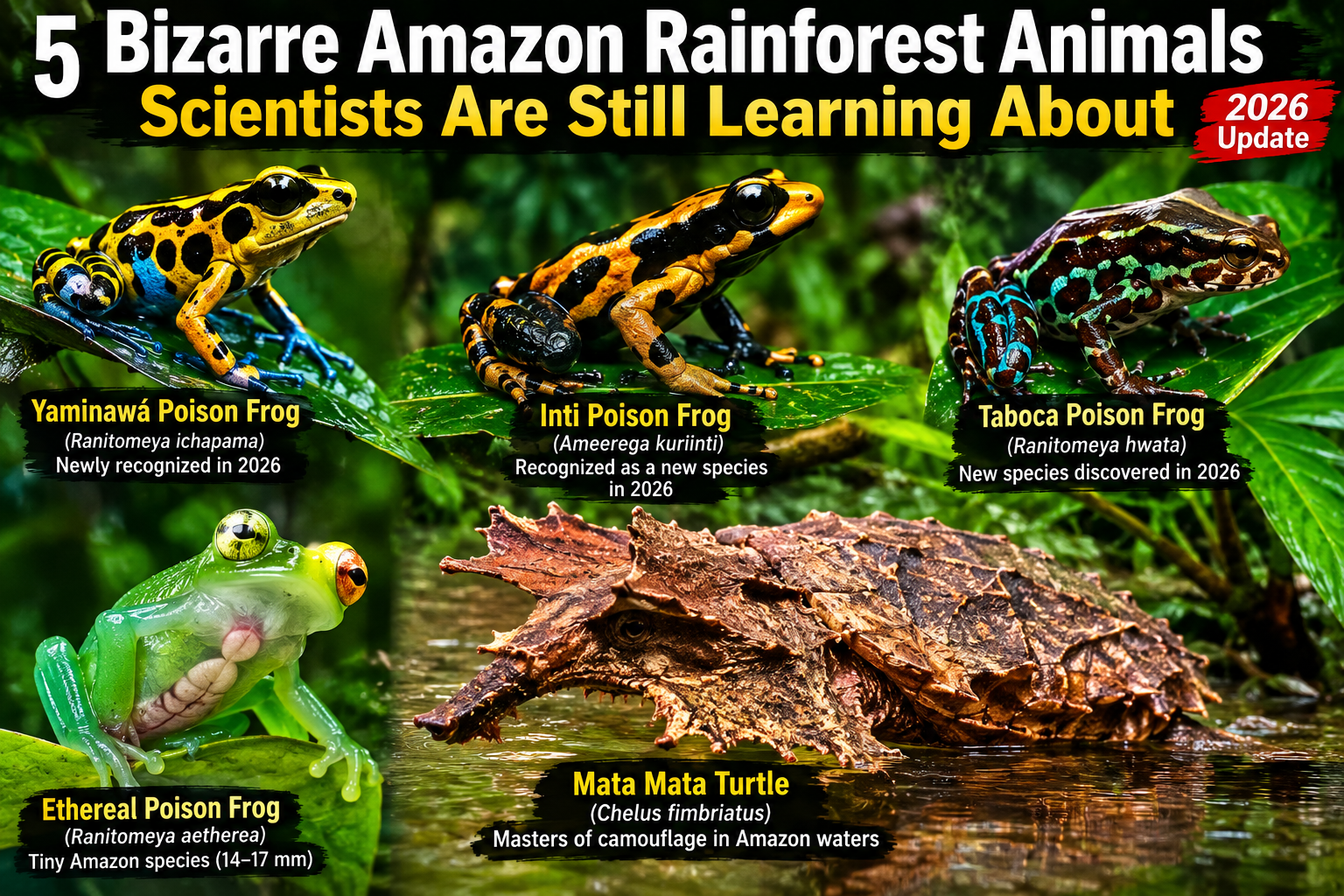
This year, researchers announced or formally recognized several remarkable poison frogs from Amazonian forests. Three species—the Yaminawá Poison Frog, Inti Poison Frog and Taboca Poison Frog—were described as new species in 2026. The discoveries came from rainforest areas of Peru and Brazil and demonstrate how much biodiversity can remain hidden even after years of scientific investigation.
In this new World Animals TV article, we’ll look at five unusual Amazon animals and explain what makes them so special.
🐸 1. Yaminawá Poison Frog — A Tiny Frog That Took Decades to Understand
One of the most fascinating Amazon discoveries of 2026 is the Yaminawá Poison Frog (Ranitomeya ichapama).
Scientists had known about this tiny frog for many years, but identifying it as a separate species proved surprisingly difficult.
The frog is extremely elusive. Researchers had collected only a small number of specimens during biodiversity surveys, making it difficult to determine whether it represented a genuinely separate species or simply an unusual form of another known frog.
Eventually, genetic research provided the evidence scientists needed.
The species is currently known from western Acre in Brazil and neighboring areas of southeastern Peru. The American Museum of Natural History’s Amphibian Species of the World database lists six known localities across those countries.
What makes it bizarre?
The Yaminawá Poison Frog has a distinctive yellow pattern.
One particularly unusual feature is a thin yellow stripe running along the middle of its back. Near the nose, that stripe divides into an oval-like marking.
Researchers also found that its genetic signature is distinct from closely related frogs.
The name ichapama comes from the Yaminawá language and means “rare” or “few,” reflecting how difficult this animal has been to find.
Habitat
It lives in lowland rainforest in western Brazil and southeastern Peru.
Its limited known distribution makes the species especially interesting from a conservation perspective.
Image Alt Text:Yaminawá Poison Frog Ranitomeya ichapama in Amazon rainforest
Suggested filename:yaminawa-poison-frog-2026.jpg
🐸 2. Inti Poison Frog — The Frog Scientists Mistook for Another Species


The Inti Poison Frog (Ameerega kuriinti) has another unusual story.
For roughly half a century, scientists treated this frog as a form—or color variation—of another species called Ameerega bassleri.
That classification has now changed.
Research published in 2026 showed that the frog represents its own distinct species. Researchers examined its physical characteristics, genetics and mating calls to establish its separate identity.
The American Museum of Natural History records Ameerega kuriinti as an endemic species of Peru. Its known distribution includes northern San Martín and the Cordillera Escalera, with populations occurring at elevations of approximately 316 to 1,278 meters.
A unique voice
One of the most interesting features of the Inti Poison Frog is its call.
Male frogs produce calls to attract females, and researchers found that the acoustic characteristics of the Inti frog are statistically distinct.
That means its identity isn’t based only on appearance.
Its DNA, body characteristics and voice all provide evidence that it is a separate species.
Why this discovery matters
The story demonstrates why biodiversity research is so important.
An animal can be sitting in a museum collection—or even appearing in the wildlife trade—and still be scientifically misunderstood.
The Inti frog had a name, but scientists had not yet fully understood its identity.
Now it has its own place in the scientific record.
Image Alt Text:Inti Poison Frog Ameerega kuriinti from the Peruvian Amazon rainforest
Suggested filename:inti-poison-frog-amazon-2026.jpg
🐸 3. Taboca Poison Frog — The Tiny Frog That Uses Bamboo
The third 2026 discovery is the Taboca Poison Frog (Ranitomeya hwata).
This species has a particularly interesting relationship with bamboo.
Researchers discovered that the frogs use Guadua bamboo as part of their reproductive habitat. The hollow stems can hold rainwater, creating tiny natural pools that the frogs can use for reproduction.
The species is found across much of Acre, Brazil, and its distribution extends into parts of southeastern Peru and northern Bolivia. The American Museum of Natural History records populations at roughly 190–356 meters elevation.
Look closely at the throat
One feature that helps distinguish the Taboca Poison Frog is its black throat band.
Its genetics also reveal a separate evolutionary history extending back millions of years.
The frog’s scientific name honors Indigenous knowledge. Researchers explained that “hwata” comes from the language of the Manxineru people and is a general word for bamboo. The common name “Taboca” also refers to the type of bamboo associated with the animal.
A remarkable miniature ecosystem
Think about how small this habitat is.
A giant rainforest may contain thousands of trees, but this tiny frog can depend on a small amount of water trapped inside a bamboo stem.
For a human, the hollow bamboo may look insignificant.
For the frog, it can be a nursery.
Image Alt Text:Taboca Poison Frog Ranitomeya hwata living in Amazon bamboo forest
Suggested filename:taboca-poison-frog-bamboo.jpg
🐸 4. Ethereal Poison Frog — A New Species Smaller Than a Paperclip


Another extraordinary frog recently brought into the spotlight is Ranitomeya aetherea, sometimes described as the ethereal poison dart frog.
Researchers found it in the Juruá River Basin of the western Amazon, where it was first encountered among leaves of wild banana plants during an expedition in 2023. The species was formally described in research published afterward and featured in a 2026 wildlife report.
This frog is extremely small.
Adults measure only about 14–17 millimeters—roughly the length of a small paperclip.
Yet its colors are anything but tiny.
It has reddish-brown and blue coloration above, a bright blue underside with black spots and copper-colored legs.
A frog that uses plants as nurseries
The species has so far been found at one site.
Females lay eggs in tiny pools of water collected inside plant leaves. This is an excellent example of how an animal can use a very specific microhabitat within the rainforest.
The surrounding forest at the known location remains largely intact, which currently provides some protection from deforestation and wildfire. However, researchers have noted that climate change and illegal collection or trade could still present risks.
Why “ethereal”?
The name refers to the almost otherworldly appearance of the tiny animal.
Its vivid colors, tiny body and secretive habitat make it seem almost unreal.
But this is a real Amazon rainforest species—and another reminder that some of the rainforest’s most remarkable animals can be smaller than a human fingernail.
Image Alt Text:Ranitomeya aetherea tiny ethereal poison frog from the western Amazon
Suggested filename:ethereal-poison-frog-amazon-2026.jpg
🐢 5. Mata Mata Turtle — The Living Leaf in Amazon Waters


7
Not every bizarre Amazon animal was newly discovered in 2026.
The mata mata turtle (Chelus fimbriatus) has been known to science for a long time, but it remains one of the rainforest’s strangest-looking animals.
Its rough shell, knobby skin, broad head and long snout make it look more like a piece of floating vegetation than a turtle.
It is a freshwater specialist associated with slow-moving, shallow waters.
The turtle’s appearance is closely connected to its hunting strategy.
Instead of constantly swimming around searching for prey, the mata mata can remain almost motionless among leaves and debris.
When a fish comes close, it suddenly opens its large mouth and draws water and prey inward.
Its appearance therefore isn’t merely unusual.
It is camouflage.
A natural underwater disguise
Amazon rivers and streams are filled with branches, leaves, mud and vegetation.
A predator that looks like part of that environment can be difficult for prey to notice.
The mata mata takes advantage of exactly this environment.
Its long neck and snorkel-like snout also allow it to breathe while keeping much of its body hidden underwater.
This makes the turtle one of the most unusual examples of camouflage in South American freshwater ecosystems.
Image Alt Text:Mata mata turtle camouflaged among leaves in Amazon freshwater
Suggested filename:mata-mata-turtle-amazon-2026.jpg
🌎 Why Are Scientists Still Finding Strange Animals in the Amazon?
The Amazon is enormous.
It contains forests, rivers, wetlands, bamboo stands, mountains, floodplains and countless tiny habitats that can be difficult to access.
A species may live only in a particular valley, along one river system or within a particular type of forest.
That makes some animals extremely difficult to study.
The 2026 discovery of the Yaminawá Poison Frog is a perfect example.
Researchers had encountered the frog before, but it took additional genetic and morphological research to establish that it was genuinely a separate species.
The Inti Poison Frog tells a similar story.
Scientists had known about the animal for decades, but it was classified as another species until detailed research revealed its distinct identity.
This means that biodiversity discoveries aren’t always about walking into the jungle and finding an animal nobody has ever seen.
Sometimes scientists discover something even more interesting:
an animal that humans have seen before but didn’t yet understand.
🔬 2026 Is an Important Year for Amazon Frog Research
The three newly described poison frogs—Yaminawá, Inti and Taboca—were formally recognized through scientific publications in 2026.
The American Museum of Natural History’s Amphibian Species of the World database now lists Ranitomeya ichapama as a species described in 2026.
This work also highlights the importance of Indigenous knowledge.
The names of several newly recognized frogs were chosen to honor Indigenous peoples and languages connected to the regions where these animals occur.
That is an important reminder that scientific discovery does not happen in isolation.
Researchers often work in landscapes where local and Indigenous communities already possess generations of knowledge about plants, animals and the forest.
🌿 What Makes These Animals So Unusual?
Although the five animals in this article are very different, they share one important characteristic:
each has a highly specialized relationship with its environment.
The Yaminawá Poison Frog survives in lowland western Amazon forests.
The Inti Poison Frog occupies forest environments in Peru’s Cordillera Escalera.
The Taboca Poison Frog has a remarkable connection with bamboo.
The ethereal poison frog uses tiny pools of water held by plants for reproduction.
The mata mata uses camouflage to become almost invisible in freshwater.
Their bodies and behaviors demonstrate how evolution can create extraordinary solutions to the challenges of rainforest life.
⚠️ Why Discovering a Species Is Only the Beginning
Giving an animal a scientific name is an important milestone, but researchers still need to learn much more.
For newly recognized species, scientists may need to determine:
- How large the population is
- Where exactly the animal occurs
- What it eats
- How it reproduces
- Whether its habitat is shrinking
- What predators affect it
- Whether it is threatened
- How climate change may affect it
The Yaminawá Poison Frog illustrates this challenge particularly well.
Researchers have described the species, but questions about its population and long-term status remain.
This is why rainforest exploration and biodiversity surveys remain so important.
Scientists cannot protect a species effectively if they don’t know that it exists.
🐾 Why Amazon Biodiversity Matters
Every animal in the Amazon is part of a larger ecological network.
Frogs consume insects and other small organisms.
Predators feed on frogs.
Plants provide food and shelter.
Rivers connect distant habitats.
Bamboo provides miniature pools for some amphibians.
Even a tiny frog measuring less than two centimeters can therefore be connected to a much larger ecosystem.
Protecting Amazon wildlife isn’t simply about saving famous animals such as jaguars and macaws.
It also means protecting the tiny, secretive species that may spend their entire lives in a few hectares of forest.
🌳 The Future of Amazon Wildlife Discovery
The discoveries of 2026 suggest that the Amazon still has many surprises.
Three poison frogs were formally recognized as new species this year, while other recently described Amazonian frogs demonstrate how quickly modern genetic research can change our understanding of biodiversity.
Some discoveries will be colorful.
Some will be bizarre.
Some may be extremely small.
And some may already be sitting in a museum collection, waiting for scientists to realize that they are different from anything previously described.
The rainforest still has secrets.
🐸 Final Thoughts
The Amazon rainforest is often imagined as a world of giant snakes, powerful jaguars and colorful birds.
But the most fascinating animals can be much smaller.
The Yaminawá Poison Frog remained scientifically mysterious for years.
The Inti Poison Frog spent decades under another species’ name.
The Taboca Poison Frog has a remarkable relationship with bamboo.
The tiny Ranitomeya aetherea lives in miniature pools formed by plants.
And the bizarre mata mata turtle uses its strange appearance as an underwater disguise.
Together, these animals tell an important story about the Amazon.
The rainforest isn’t fully understood—not even close.
Every new species provides another piece of the enormous biological puzzle.
As scientists continue exploring Amazonian forests in 2026 and beyond, the next bizarre animal discovery could be hiding somewhere incredibly small, incredibly remote or simply overlooked for decades.
The strangest creatures in the Amazon aren’t monsters from a fantasy story. They are real—and scientists are still discovering their stories.
🌿 NEW 2026 ARTICLE: 5 Bizarre Amazon Rainforest Animals Scientists Are Still Learning About
Updated: September 2026
Website: World Animals TV
Article Type: Wildlife / Nature / Science
Length: Approximately 1,500 words
SEO Title: 5 Bizarre Amazon Animals Making Headlines in 2026
Focus Keyword: bizarre Amazon rainforest animals 2026
Meta Description: Discover five of the Amazon rainforest’s strangest animals, including newly described poison frogs and unusual rainforest creatures with incredible adaptations.
Category: Wildlife
Subcategory: Amazon Rainforest
Tags:
Amazon rainforest, Amazon animals, bizarre animals, strange animals, unusual wildlife, rainforest animals, poison frogs, Yaminawá poison frog, Inti poison frog, Taboca poison frog, Amazon wildlife 2026, South American animals, rare animals, jungle animals, wildlife discoveries
Suggested URL:bizarre-amazon-rainforest-animals-2026
Featured Image Alt Text:Five bizarre Amazon rainforest animals in a realistic tropical forest scene
Focus Keyword:bizarre Amazon rainforest animals 2026
Keyword Variations:
- bizarre animals Amazon rainforest
- strange Amazon animals 2026
- unusual Amazon rainforest wildlife
- Amazon animal discoveries 2026
- new Amazon species 2026
- rare Amazon rainforest animals
- unique jungle animals
- Amazon poison frogs
- strange rainforest creatures
SEO Title:5 Bizarre Amazon Animals Making Headlines in 2026
Meta Description:Meet five bizarre Amazon rainforest animals in this 2026 update, including three newly recognized poison frogs and the strange mata mata turtle.
Slug:bizarre-amazon-rainforest-animals-2026
Category:Wildlife
Subcategory:Amazon Rainforest
Tags:Amazon rainforest, bizarre animals, unusual animals, Amazon wildlife, wildlife 2026, poison frogs, Yaminawá Poison Frog, Inti Poison Frog, Taboca Poison Frog, Ranitomeya aetherea, mata mata turtle, rainforest animals, South American wildlife, rare animals
Featured Image Title:Bizarre Amazon Rainforest Animals 2026
Featured Image Alt:Five bizarre Amazon rainforest animals together in a realistic rainforest scene
Featured Image Description:A realistic wildlife composition showing five unusual animals associated with Amazon rainforest ecosystems, highlighting the remarkable biodiversity discovered and studied in 2026.
Excerpt:From tiny poison frogs newly recognized by scientists to the bizarre mata mata turtle, discover five of the Amazon rainforest's strangest animals and the remarkable adaptations that help them survive.
Open Graph Title:5 Bizarre Amazon Rainforest Animals Making Headlines in 2026
Open Graph Description:Discover five unusual Amazon animals and the remarkable scientific discoveries helping researchers understand them in 2026.
Pinterest Title:5 Bizarre Amazon Rainforest Animals You Need to See
Pinterest Description:Discover five strange and fascinating Amazon animals, including newly recognized poison frogs and the incredible mata mata turtle.
Recommended Article Type:Wildlife / Science / Nature
Update Date:2026
Author:World Animals TV
Recommended Internal Links:
- Amazon Rainforest Animals
- Amazon Rainforest Snakes
- King Cobra vs Amazon Snakes
- Amazon River Animals
- Poison Dart Frogs
- Jaguar in the Amazon
- Giant Anaconda
- Rainforest Birds
2026 News Angle: The strongest current hook is the scientific recognition of three new Amazon poison-frog species in 2026: Ranitomeya ichapama, Ameerega kuriinti and Ranitomeya hwata.