
The Rhinoceros Hornbill: The Incredible Bird That Seals Itself Inside a Tree
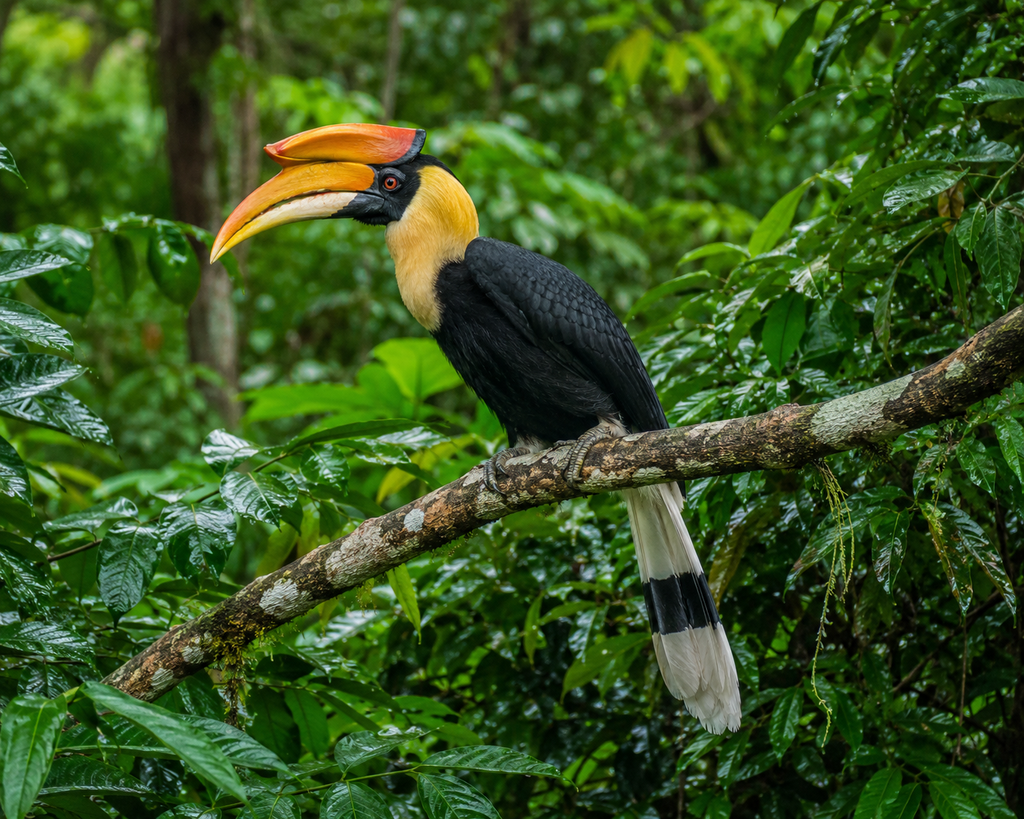
Deep within the tropical forests of Southeast Asia lives a bird that has developed one of the most unusual nesting strategies in the natural world.
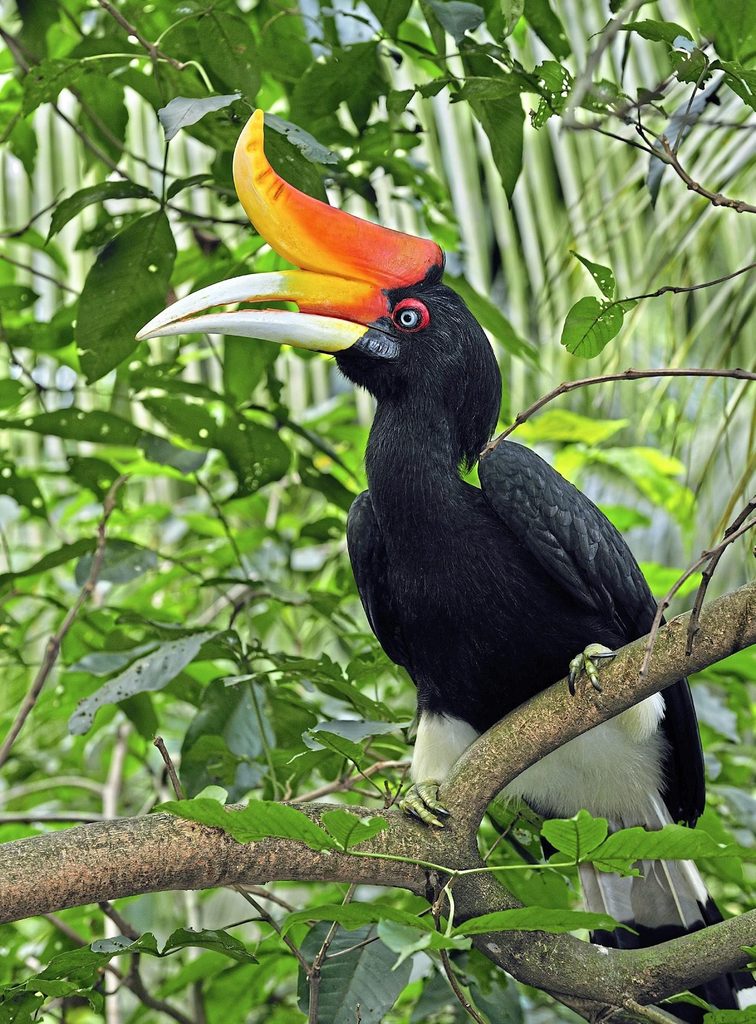
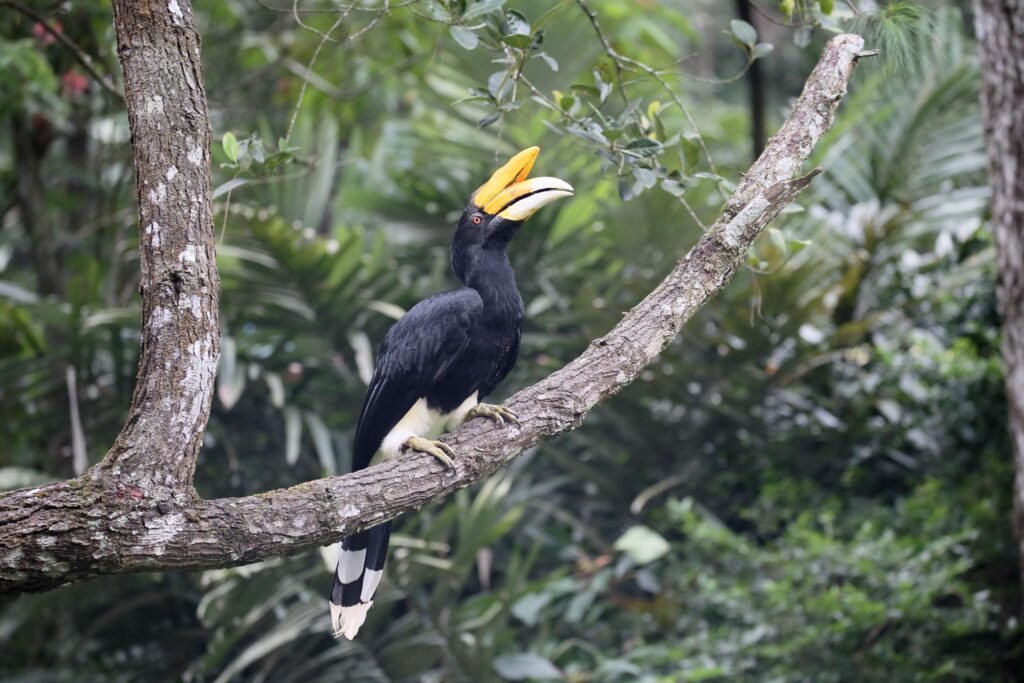
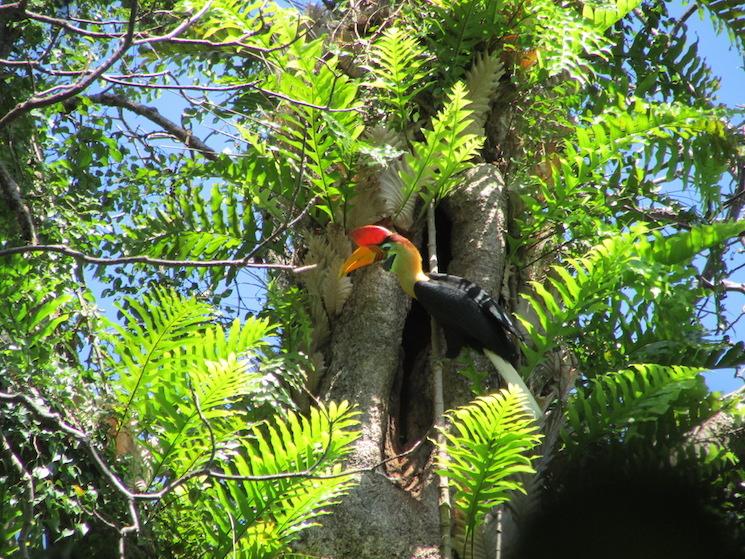
The Rhinoceros Hornbill is a large, powerful forest bird with a huge curved bill, striking black-and-white plumage and a remarkable yellow-orange casque above its bill.
But its appearance is not the most surprising thing about it.
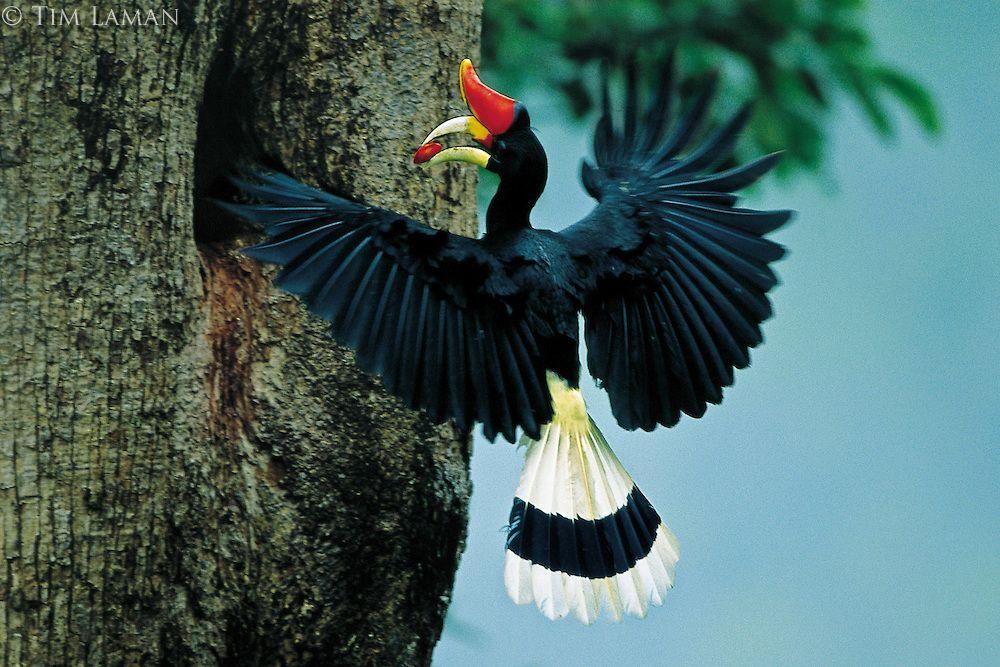
During the breeding season, the female enters a natural cavity in a large tree and seals herself inside.
Only a small opening remains.
Through this narrow gap, the male brings food to his mate and, later, to the chicks.
For weeks, the female remains inside the tree while the male becomes the family’s primary food provider.
It sounds almost impossible.
Yet this extraordinary behavior is well documented in Rhinoceros Hornbills. Animal Diversity Web reports that the female seals herself into a tree cavity using materials including mud, feces and fruit peels, leaving a small slit through which the male can deliver food.
This unusual system provides protection for the mother and young—but it also creates enormous responsibilities for the male.




A Giant Bird of Southeast Asian Rainforests


6
The Rhinoceros Hornbill is found in parts of Southeast Asia, including Borneo, Sumatra and the Malay Peninsula.
Its habitat includes tropical forests where large mature trees provide suitable nesting cavities.
This is an important distinction for readers interested in Amazon wildlife:
Rhinoceros Hornbills are not Amazon rainforest birds.
The Amazon has many spectacular birds—including toucans, macaws, parrots, curassows and hoatzins—but true hornbills belong to the Old World.
The Rhinoceros Hornbill is therefore best described as a Southeast Asian rainforest bird.
It is strongly dependent on forest environments containing large trees.
And that dependence becomes particularly important during breeding season.
An Extraordinary Appearance
The Rhinoceros Hornbill is difficult to confuse with an ordinary forest bird.
It can grow to approximately a meter in length, including its tail, and has a powerful, oversized bill.
Above the bill is a large structure known as a casque.
The casque is one of the most recognizable features of hornbills.
Its yellow-orange color contrasts dramatically with the bird’s black plumage and white tail markings.
When the bird flies through the rainforest, its broad wings and long tail create an impressive silhouette.
But the enormous bill and casque aren’t simply decorative features.
The bill is an important tool for handling food, while the casque is associated with communication and display.
The bird’s impressive appearance may also help pairs recognize one another and communicate during social interactions.
The Nest Begins With a Tree Cavity


6
Unlike woodpeckers, Rhinoceros Hornbills generally do not excavate their own nest cavities.
Instead, they depend on naturally occurring holes in large trees.
Finding the right cavity can therefore be extremely important.
The entrance needs to be suitable for the female, and the cavity must provide enough space for her and the future chicks.
Hornbills may face competition for these valuable cavities from other birds and animals.
Once a suitable cavity has been selected, the female enters.
Then something remarkable happens.
She begins sealing the entrance.
Why Does the Female Seal Herself Inside?
The sealed nest is essentially a natural fortress.
A narrow entrance makes it much harder for predators to reach the eggs and chicks.
According to Animal Diversity Web, Rhinoceros Hornbill females seal themselves into cavities using materials such as mud, feces and fruit peels. A narrow slit remains open so the male can feed the female and eventually the chicks.
From the outside, it may look as though the bird has disappeared.
The tree appears almost empty.
But inside the cavity, an entire family is developing.
The sealed entrance provides physical protection while reducing access for predators such as climbing snakes and monitor lizards.
The strategy comes with a major cost, however.
The female cannot simply fly away whenever she wants.
She depends heavily on her mate.
The Male Becomes the Family’s Food Provider


6
Once the female is sealed inside, the male’s responsibilities become enormous.
He must search the rainforest for food.
He must return to the nest.
He must pass food through the narrow opening.
And he must continue doing this while protecting the nesting area.
Animal Diversity Web reports that a male Rhinoceros Hornbill may bring food to the nest up to 13 times in a single day.
That is an extraordinary workload.
The male has to find enough food for himself and his mate, and eventually for the growing chicks.
This creates a remarkable partnership.
The female provides protection and incubation from inside the cavity.
The male provides food from outside.
Neither parent can easily complete the nesting process alone.
What Does the Rhinoceros Hornbill Eat?
The Rhinoceros Hornbill is primarily a fruit eater.
Fruits, especially those produced by tropical forest trees, form a major part of its diet.
Figs can be particularly important.
But the bird isn’t strictly vegetarian.
It can also consume animal foods such as insects, reptiles, small mammals and other small prey when available.
This flexible diet is useful during the breeding season.
The male needs to find nutritious foods efficiently while making repeated trips back to the nest.
Because tropical forests contain many fruiting trees, the bird can travel through the canopy searching for resources.
The Hidden Female and Her Eggs
Inside the cavity, the female lays her eggs and incubates them.
Rhinoceros Hornbills typically produce a very small clutch, usually one or two eggs.
Their incubation period is approximately 37–46 days, according to Animal Diversity Web.
A small clutch makes every surviving chick particularly important.
There is no large group of offspring to compensate if one chick fails to survive.
The female therefore invests heavily in protecting and caring for the young.
And because she is sealed inside, the male’s role becomes even more important.
What Happens When the Eggs Hatch?


4
Hatching does not immediately end the female’s confinement.
In fact, she remains inside the nest cavity for several more weeks.
Sources report that the female can remain sealed inside for approximately five to seven weeks after hatching.
During this period, the male continues supplying food.
The chicks grow rapidly.
Their demands increase.
The male therefore has an increasingly difficult job.
Eventually, the female leaves the cavity.
But the nesting strategy still isn’t finished.
The young remain protected within the tree cavity while the parents continue bringing them food.
This extended parental investment helps give the young time to develop before they finally leave the nest.
A Built-In Defense Against Predators
The sealed cavity is one of the most effective parts of the hornbill’s breeding strategy.
Rainforest nests are vulnerable places.
Snakes can climb trees.
Monitor lizards can search cavities.
Other predators may investigate exposed nests.
A completely open tree hole would give predators relatively easy access.
By narrowing the entrance to a small slit, the hornbills create a barrier.
The female and chicks remain inside while the male controls access to food.
BirdLife International explains that hornbill females sealing themselves into nest cavities is an important part of their breeding strategy and that the system makes them especially dependent on their mates during this period.
This strategy has evolved because the benefits of protection can outweigh the enormous cost of confinement.
The Dangerous Side of the Strategy
The nesting system is brilliant—but it also creates a vulnerability.
If the male disappears, becomes injured or cannot find enough food, the female and chicks may be placed in serious danger.
They cannot simply leave the nest and search for food themselves.
This is one reason habitat loss and hunting can be particularly serious for hornbills.
BirdLife International has highlighted the vulnerability created by this reproductive system, noting that when a male is lost, an entire brood may be affected because the female is dependent on him for food while confined.
The family’s survival is therefore closely linked.
One bird’s disappearance can affect several others.
Why Old-Growth Forest Trees Matter


7
Protecting Rhinoceros Hornbills means protecting the forest structures they need.
A young plantation may contain plenty of vegetation but still lack suitable nesting cavities.
Large old trees are particularly valuable because natural holes can take many years to develop.
When mature trees disappear, hornbills may lose potential nesting sites even if some forest remains.
This is why conservationists often focus not only on the total amount of forest, but also on its quality and age structure.
A forest filled with mature trees can provide nesting cavities, fruit resources and safe travel routes.
A heavily degraded forest may provide much less.
Hornbills Are Important Seed Dispersers
The Rhinoceros Hornbill’s love of fruit gives it another important ecological role.
When it eats fruit, it can transport seeds from one location to another.
Seeds may pass through the digestive system and eventually reach the forest floor away from the parent tree.
This helps plants spread through the forest.
Hornbills are therefore sometimes described as important seed dispersers or “gardeners of the rainforest.”
BirdLife International highlights the ecological importance of hornbills and their relationships with forest trees.
Protecting a hornbill can therefore help protect the wider forest ecosystem.
The relationship works both ways.
The bird needs the forest for food and nesting cavities.
The forest can benefit from the bird’s movement of seeds.
Why This Bird Is So Special
The Rhinoceros Hornbill’s nesting behavior combines several extraordinary adaptations.
A natural tree cavity provides the basic nest.
A sealed entrance protects the female and young.
A tiny feeding opening allows the male to deliver food.
The male’s foraging behavior keeps the family alive.
The female’s confinement protects her while she incubates and raises the young.
The small clutch encourages enormous parental investment.
Together, these behaviors create one of the most unusual family systems in the bird world.

Is the Rhinoceros Hornbill Endangered?
The conservation status of a species can change as new assessments are made, so website articles should use current authoritative sources when describing status.
More importantly, the species faces conservation pressures associated with forest loss, hunting and the loss of large nesting trees.
The dependence on mature forest makes habitat protection particularly important.
Protecting rainforest isn’t simply about keeping green areas on a map.
It is about maintaining the specific trees, food sources and ecological connections that wildlife needs.
A Lesson From the Hornbill Family
The Rhinoceros Hornbill teaches us something extraordinary about cooperation.
The female takes on one role.
The male takes on another.
For weeks, the female remains hidden inside a tree.
The male works outside.
Neither role is easy.
The female must incubate and protect the developing young.
The male must repeatedly travel through the forest searching for enough food.
Together, they create a highly specialized survival system.
This is one of the reasons hornbills are so fascinating to scientists and wildlife enthusiasts.


Final Thoughts
The Rhinoceros Hornbill may look like a bird from a fantasy story, but its nesting behavior is completely real.
The female enters a natural tree cavity.
She seals herself inside.
A small opening remains.
The male brings food through that opening.
The eggs hatch inside the protected cavity.
The mother continues caring for the young before eventually emerging.
The strategy is strange, risky and remarkably effective.
It also shows why rainforest conservation must protect more than individual animals.
Without mature trees, there may be no suitable nest cavities. Without healthy forests, there may not be enough fruit. Without the male, the sealed female may have no reliable food supply.
Everything is connected.
And although the Rhinoceros Hornbill does not live in the Amazon, its story provides a powerful lesson for rainforest conservation everywhere—from Southeast Asia to the Amazon basin.
The world’s tropical forests contain countless unusual breeding strategies.
Some are easy to see.
Others are hidden inside tree trunks.
For the Rhinoceros Hornbill, one of nature’s greatest secrets is happening behind a tiny sealed doorway high above the forest floor.
Inside that tree, a family is growing—and outside, one devoted parent is working tirelessly to keep them alive.
The Rhinoceros Hornbill: The Incredible Bird That Seals Itself Inside a Tree
Alternative Titles:
- Why This Amazing Hornbill Seals the Female Inside a Tree
- Rhinoceros Hornbill: The Rainforest Bird With a Secret Nesting Strategy
- Inside the Hidden World of the Rhinoceros Hornbill
Focus Keyword:Rhinoceros Hornbill nesting behavior
Secondary Keywords:Rhinoceros Hornbill 2026Buceros rhinoceroshornbill nesting behaviorhornbill sealed nestfemale hornbill nesthornbill eggshornbill chickrainforest birdsSoutheast Asian birdsstrange bird behaviortropical rainforest wildlife
Meta Description:Discover the remarkable Rhinoceros Hornbill and learn how the female seals herself inside a tree cavity while her mate provides food during nesting.
Short Description:The Rhinoceros Hornbill has one of the most extraordinary nesting strategies in the bird world. Discover how a female seals herself inside a tree cavity and raises her young with help from her mate.
Category:Rainforest Birds
Subcategory:Bird Behavior
Tags:Rhinoceros Hornbill, Buceros rhinoceros, hornbill, hornbill nesting, hornbill eggs, hornbill chicks, rainforest birds, tropical birds, Southeast Asian wildlife, bird behavior, unusual birds, wildlife 2026
Suggested URL Slug:rhinoceros-hornbill-nesting-behavior-2026