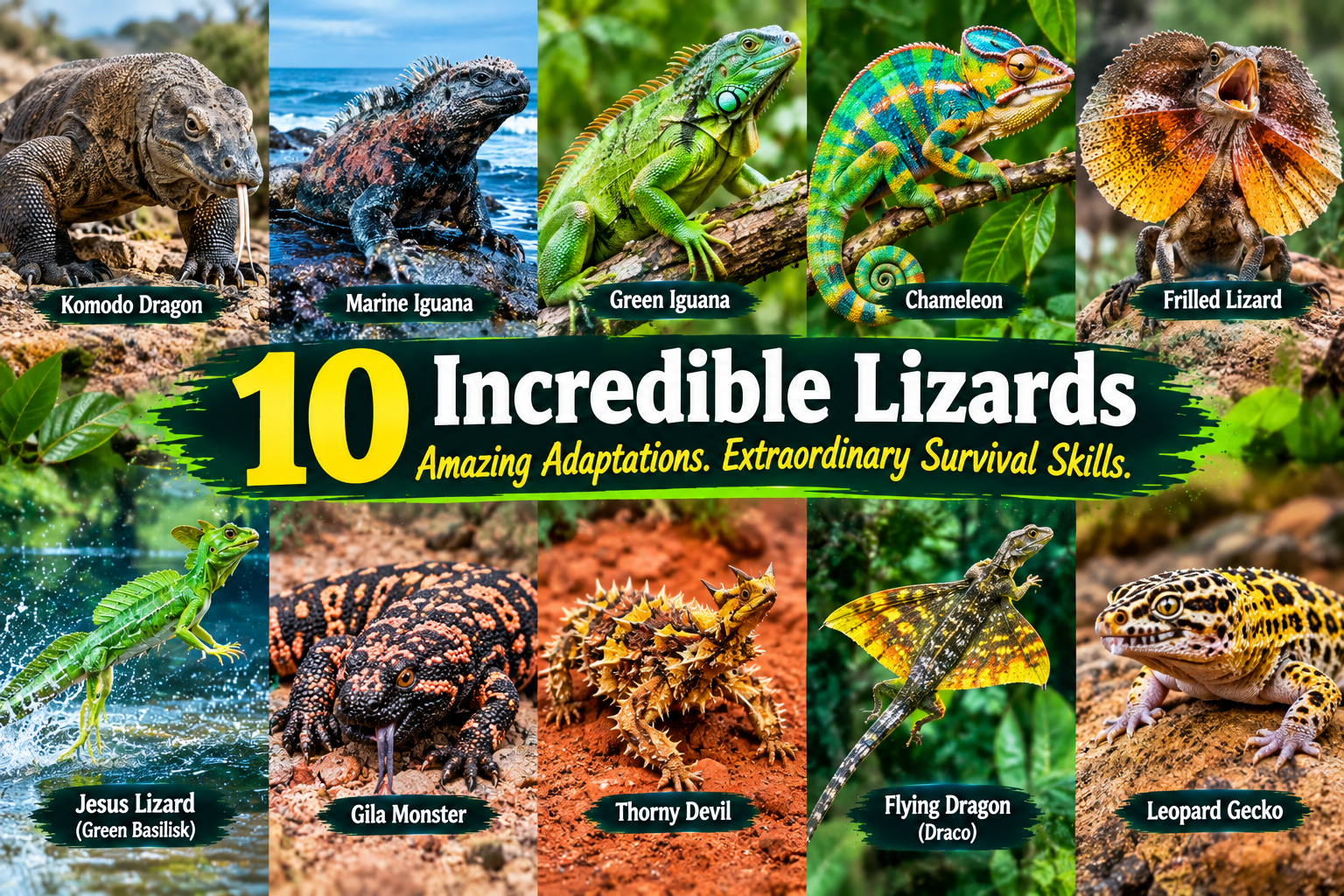
10 Incredible Lizards With Extraordinary Survival Skills
Updated for 2026 | Original Wildlife Article


6
Lizards are among the most diverse reptiles on Earth. They can live in tropical rainforests, deserts, rocky islands, grasslands and even along ocean shorelines. Some are enormous predators, while others are tiny climbers that spend their lives hidden among leaves and branches.
What makes lizards especially fascinating is the extraordinary range of adaptations they have developed. Some can change color, some can run across water, some use venom, and others have specialized bodies that allow them to survive intense heat or scarce water.
In this updated 2026 wildlife guide, we explore 10 remarkable types of lizards and the unusual characteristics that help each one survive.
1. Komodo Dragon — The World’s Largest Living Lizard


7
The Komodo dragon (Varanus komodoensis) is the largest living lizard and one of the most famous reptiles on the planet.
Native to several Indonesian islands, including Komodo, Rinca and Flores, these giant monitor lizards live in tropical savanna forests and can travel across a surprisingly wide variety of terrain. The Smithsonian’s National Zoo records a verified maximum length of about 10.3 feet (3.13 meters) and a weight of 366 pounds (166 kilograms).
Komodo dragons are powerful predators. Their strong limbs, claws and serrated teeth help them capture and consume prey. Their forked tongues are constantly sampling the air, helping them detect scents.
Another remarkable characteristic is their ability to swallow very large meals. According to the Smithsonian, an adult can consume an amount of food equivalent to as much as 80 percent of its own body weight in one meal.
They are a spectacular example of how a lizard can become an apex predator within its ecosystem.

Image alt text: Komodo dragon walking through its natural Indonesian habitat
2. Marine Iguana — The Lizard That Feeds in the Sea


6
The marine iguana (Amblyrhynchus cristatus) may be the strangest member of the iguana family because it spends part of its life feeding in the ocean.
This species is endemic to the Galápagos Islands and is the only lizard in the world known to live and forage at sea. It feeds primarily on algae, diving into cold coastal water and gripping rocks with its powerful claws.
The cold ocean creates a major problem for a reptile because lizards depend on external heat to regulate their body temperature. Marine iguanas therefore spend considerable time basking on volcanic rocks after feeding.
They also have a clever solution to another problem: salt.
Because they consume seawater while eating algae, marine iguanas have specialized salt glands and expel excess salt through their nostrils. Sometimes salt crystals can be seen around their noses.
Their ability to survive both on land and in the sea makes them one of the most specialized lizards in existence.

Image alt text: Marine iguana basking on volcanic rocks in the Galapagos Islands
3. Green Iguana — A Powerful Climber of the Tropics


7
The green iguana (Iguana iguana) is one of the most recognizable tropical lizards.
Despite its common name, green iguanas can display a variety of colors, including shades of green, brown and gray. Their long tails, strong claws and muscular bodies make them excellent climbers.
They are commonly associated with tropical forests and areas near rivers and other water sources. Young iguanas spend much of their time in vegetation, while adults may occupy higher branches.
Their diet is primarily plant-based, making them an important part of tropical food webs.
One of their most useful defensive abilities is swimming. If threatened on land, a green iguana can leap into water and use its laterally compressed tail to propel itself away.
This combination of climbing and swimming gives the animal several ways to escape predators.

Image alt text: Green iguana climbing a tree in a tropical rainforest
4. Chameleon — The Lizard With Extraordinary Eyes and a Lightning-Fast Tongue


6
Few lizards are as famous as the chameleon.
There are more than 200 recognized chameleon species, with many found in Africa and Madagascar. They inhabit forests, savannas and other environments, depending on the species.
Their eyes are extraordinary. Each eye can move independently, allowing the animal to watch different directions at the same time. When hunting, the eyes can also work together to judge distance.
Then comes the tongue.
A chameleon’s projectile tongue can extend rapidly to capture insects. National Geographic describes the tongue as capable of reaching remarkable speeds and catching prey surprisingly far from the animal’s head.
Color change is another famous feature, but there is an important misconception: chameleons do not simply change color to match whatever background they are sitting on.
Color changes can communicate social information, indicate stress or temperature, and play a role in courtship and territorial behavior.
Their gripping feet and prehensile tails are equally useful for life in trees.

Image alt text: Colorful chameleon perched on a branch in a tropical habitat
5. Frilled Lizard — The Reptile That Opens a Giant Collar


7
The frilled lizard (Chlamydosaurus kingii) is an Australian reptile famous for its enormous neck frill.
When relaxed, the frill folds close to the body. When threatened, the lizard suddenly spreads it around its head, creating an intimidating display.
The Australian Museum describes the frill as an important defensive structure. If the display does not scare away a predator, the lizard may rear onto its hind legs, hiss and attempt to escape.
It can also run on two legs.
This unusual running style allows the lizard to move quickly toward the nearest tree, where it can climb using its sharp claws.
Frilled lizards inhabit woodland, forest and open scrub environments in northern Australia and New Guinea.
Their dramatic appearance is not simply for show. The entire defensive routine is designed to make a potential predator hesitate long enough for the lizard to escape.

Image alt text: Frilled lizard displaying its large neck frill in an Australian woodland
6. Green Basilisk — The Famous “Jesus Lizard”


7
The green crested basilisk (Basiliscus plumifrons) has earned the nickname Jesus Lizard because of its extraordinary ability to run across the surface of water.
It lives near streams and other waterways in tropical Central America.
Its long toes and specialized scales help spread its weight and create enough force to support rapid movement across shallow water. The Smithsonian reports that these lizards can sprint on their hind legs at more than 7 miles per hour (11.3 km/h).
Eventually, gravity wins. As the basilisk slows, it becomes partially submerged and switches from running to swimming.
It can also remain underwater for more than 10 minutes, giving it another way to escape predators.
This is an excellent example of how an animal can exploit the physical properties of its environment.
Instead of simply running away from danger, the basilisk can use the water itself as an escape route.
Image alt text: Green basilisk lizard running across the surface of a tropical stream
7. Gila Monster — One of the World’s Venomous Lizards


7
The Gila monster (Heloderma suspectum) looks almost as though it has been painted with orange and black beads.
Native to parts of the southwestern United States and Mexico, it is one of the world’s few venomous lizards.
Unlike venomous snakes, the Gila monster does not rely on hollow fangs to inject venom. Its lower teeth have grooves, and venom moves into a bite through these structures as the animal holds onto its victim.
Gila monsters also have an impressive energy-storage strategy.
They store fat in their bodies and tails, allowing them to survive long periods without eating. The Smithsonian notes that they can consume very large meals relative to their size.
Most of the time, Gila monsters are not chasing prey across the desert. They spend considerable periods underground, emerging more often when conditions are favorable.
Their slow lifestyle is actually part of their survival strategy.

Image alt text: Gila monster moving across rocky desert terrain in Arizona
8. Thorny Devil — The Desert Lizard That Collects Water Through Its Skin


6
The thorny devil (Moloch horridus) looks like a miniature dragon covered in spikes.
It lives in arid regions of central and western Australia, where finding water can be difficult.
Its spines provide protection, but its most amazing adaptation is its skin.
Tiny channels between the scales can collect moisture and move it toward the mouth through capillary action. The Australian Museum explains that the animal can obtain water from rain, dew and even moist sand.
The thorny devil also has an unusual false head on the back of its neck. When threatened, this can confuse a predator about which end of the animal is the real head.
Its diet is dominated by ants, and its specialized mouth is well suited to capturing them.
In a landscape where water may be unpredictable, the thorny devil has essentially turned its entire skin into a miniature water-collection system.

Image alt text: Thorny devil lizard standing on red Australian desert sand
9. Flying Dragon — A Lizard That Glides Between Trees


6
The flying dragons of the genus Draco are small lizards with one of the most unusual forms of locomotion among reptiles.
They do not actually fly like birds.
Instead, they have expandable membranes supported by elongated ribs. When spread, these membranes act like gliding surfaces, allowing the lizards to travel from one tree to another without climbing down to the forest floor.
This is an extremely efficient strategy for an animal living in a tropical canopy.
The forest floor can contain predators and obstacles, while neighboring branches may be relatively close together.
By gliding, a Draco lizard can cross gaps quickly while conserving energy.
When the gliding membranes are folded against the body, the lizard can move normally along branches.
Their ability is another example of evolution transforming an ordinary-looking body structure into a highly specialized transportation system.

Image alt text: Flying dragon Draco lizard gliding between tropical rainforest trees
10. Leopard Gecko — A Small Lizard Built for Harsh Landscapes


7
The leopard gecko (Eublepharis macularius) is smaller than most of the lizards on this list, but its adaptations are just as interesting.
Native to parts of South Asia and surrounding dry regions, leopard geckos are ground-dwelling lizards adapted to rocky and arid environments.
Their spotted bodies provide camouflage against stones and soil.
Unlike many geckos, leopard geckos have movable eyelids. Their eyes are protected while they move through dusty environments, and their vertical pupils are particularly useful in low-light conditions.
They are also known for storing fat in their tails.
That reserve can provide energy when food is less available.
Their nighttime activity is another adaptation to harsh climates. Avoiding the hottest part of the day can reduce water loss and overheating.
Although small, the leopard gecko demonstrates an important principle of reptile survival: sometimes the best strategy is not strength but efficiency.

Image alt text: Leopard gecko resting among rocks in a dry natural habitat
What Makes Lizards Such Successful Survivors?
These 10 lizards demonstrate how differently reptiles can solve the same basic problems.
Komodo dragons rely on size, strength and predatory ability.
Marine iguanas have conquered an environment that seems almost impossible for a lizard—the ocean.
Green iguanas use climbing, swimming and plant-based diets to thrive in tropical habitats.
Chameleons combine specialized eyes, gripping feet and an extraordinary tongue.
Frilled lizards use visual intimidation and speed.
Basilisks have learned to exploit water as an escape route.
Gila monsters use venom and energy storage.
Thorny devils harvest water from their own surroundings.
Flying dragons use gliding to travel through the forest canopy.
And leopard geckos combine camouflage, nocturnal activity and fat storage to cope with dry environments.
The diversity is extraordinary.
Why Lizards Matter to Ecosystems
Lizards are more than fascinating animals for wildlife photographers and nature enthusiasts.
They occupy important positions in food webs.
Some eat insects and help regulate insect populations. Others consume plants, fruit or small vertebrates. At the same time, lizards themselves provide food for birds, snakes, mammals and other predators.
Their presence can therefore influence many other species.
Lizards are also useful indicators of environmental health. Because many species depend on specific temperatures, habitats and food sources, changes in their populations can reveal larger ecological problems.
Habitat destruction, invasive predators, illegal wildlife collection and climate-related changes can all affect reptile populations.
Protecting lizards means protecting the ecosystems in which they evolved.
Final Thoughts
From the enormous Komodo dragon to the tiny leopard gecko, lizards demonstrate an astonishing range of evolutionary solutions.
One can hunt large prey. Another dives into the sea. One can glide between trees, while another can run across water. A desert species can collect moisture through its skin, and a venomous lizard can store enough fat to survive long periods between meals.
These animals show why reptiles deserve a closer look.
They may appear simple when sitting motionless on a rock or branch, but beneath their scales are highly specialized bodies shaped by millions of years of adaptation.
The world of lizards is not just about scales and tails—it is a story of survival, innovation and evolution.
📸 WordPress Image SEO — 7 Image Sets
Image 1 — Giant & Marine Lizards
Animals: Komodo Dragon + Marine Iguana
Alt text: Komodo dragon and marine iguana showing two extraordinary types of lizards
Filename: komodo-dragon-marine-iguana-lizards.jpg
Image 2 — Tropical Lizards
Animals: Green Iguana + Chameleon
Alt text: Green iguana and colorful chameleon in tropical habitats
Filename: green-iguana-chameleon-tropical-lizards.jpg
Image 3 — Australian Lizards
Animals: Frilled Lizard + Thorny Devil
Alt text: Frilled lizard and thorny devil in Australian natural habitats
Filename: frilled-lizard-thorny-devil-australia.jpg
Image 4 — Water & Desert Specialists
Animals: Green Basilisk + Gila Monster
Alt text: Green basilisk and Gila monster showing unusual lizard survival adaptations
Filename: green-basilisk-gila-monster.jpg
Image 5 — Gliding & Ground Lizards
Animals: Flying Dragon + Leopard Gecko
Alt text: Flying dragon lizard and leopard gecko representing unusual reptile adaptations
Filename: flying-dragon-leopard-gecko.jpg
Image 6 — All Ten Lizards
Alt text: Ten incredible lizards including Komodo dragon, marine iguana, green iguana, chameleon, frilled lizard, basilisk, Gila monster, thorny devil, flying dragon and leopard gecko
Filename: 10-incredible-lizards-2026.jpg
Image 7 — Featured Website Image
Alt text: Collage of ten incredible lizard species from deserts, forests, islands and tropical habitats
Filename: incredible-lizards-wildlife-2026-featured.jpg
Recommended featured-image size: 1200 × 675 px
Image licensing: For a WordPress website, use photographs whose licenses permit online publication. For example, Smithsonian has some animal photographs explicitly marked CC0/public domain, including a Komodo dragon image record.
🔎 Complete WordPress SEO Package
New Article Title
10 Incredible Lizards With Extraordinary Survival Skills
SEO Title
10 Incredible Lizards and Their Amazing Survival Skills | Wildlife 2026
Focus Keyword
incredible lizards
Secondary Keywords
- lizards
- lizard species
- amazing lizards
- unusual lizards
- rare lizards
- incredible reptiles
- lizard facts
- reptile facts 2026
- Komodo dragon
- marine iguana
- green iguana
- chameleon
- frilled lizard
- Jesus lizard
- green basilisk
- Gila monster
- thorny devil
- flying dragon lizard
- leopard gecko
- lizard adaptations
- exotic reptiles
- wildlife animals
Meta Description
Discover 10 incredible lizards, from the giant Komodo dragon and marine iguana to the water-running basilisk, thorny devil, chameleon and flying dragon.
Short Description / Excerpt
Meet 10 extraordinary lizards and discover the remarkable adaptations that help them survive in oceans, rainforests, deserts, rocky landscapes and tropical forests.
Category
Animals & Wildlife
Subcategory
Reptiles
Tags
Lizards, Lizard Facts, Reptiles, Amazing Lizards, Komodo Dragon, Marine Iguana, Green Iguana, Chameleon, Frilled Lizard, Jesus Lizard, Green Basilisk, Gila Monster, Thorny Devil, Flying Dragon, Leopard Gecko, Reptile Facts, Wildlife Facts, Exotic Animals, Animal Adaptations, Wildlife 2026
Suggested URL Slug
10-incredible-lizards-survival-skills-2026
Featured Image Title
10 Incredible Lizards With Extraordinary Survival Skills
Featured Image Alt Text
Ten incredible lizards including Komodo dragon, marine iguana, green iguana, chameleon, frilled lizard, basilisk, Gila monster, thorny devil, flying dragon and leopard gecko
Featured Image Caption
Ten remarkable lizards demonstrate the extraordinary ways reptiles adapt to deserts, forests, islands and waterways.
Recommended Schema
Article
Author
World Animals TV
Publication / Update Year
2026
Suggested Internal Links
- Amazing Reptiles
- Rare Animals
- Rainforest Animals
- Desert Animals
- Ocean Animals
- Animal Adaptations
- Wildlife Facts
- World’s Most Unique Animals
Suggested Social Media Description
From Komodo dragons and marine iguanas to water-running basilisks and gliding flying dragons, discover 10 incredible lizards and the amazing adaptations that help them survive.