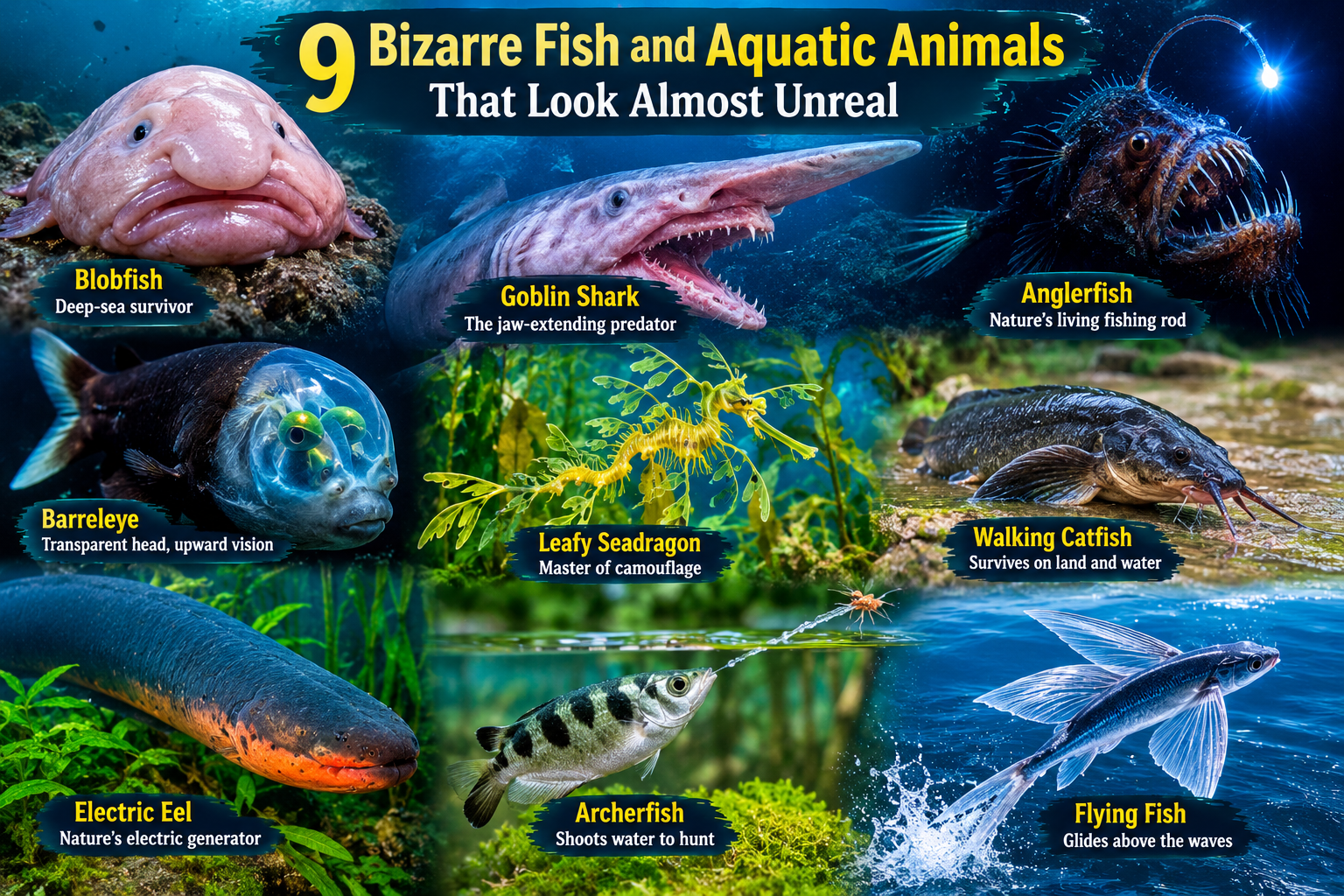
9 Bizarre Fish and Aquatic Animals That Look Almost Unreal
Updated: September 2026
Website: World Animals TV
Some animals look unusual because of their size. Others are strange because evolution has given them extraordinary abilities.
Deep beneath the ocean surface, a fish can hide behind a glowing lure. A shark can launch its jaws forward like a spring-loaded trap. Another fish has a transparent head, while a seadragon disguises itself as floating seaweed. In freshwater, an electric eel can generate powerful electrical discharges, an archerfish can shoot a jet of water at insects above the surface, and flying fish can leap from the sea and glide through the air.
These animals are not monsters or creatures from science fiction. They are real species with remarkable adaptations that help them find food, escape predators and survive difficult environments.
This article explores nine of the world’s strangest aquatic animals, from the deep ocean to tropical rivers and coastal waters.
1. Blobfish — The Deep-Sea Animal That Became an Internet Celebrity


The blobfish is probably one of the most misunderstood animals on this list.
Photographs of a blobfish removed from deep water often show a soft, drooping animal with a strange facial expression. This appearance has made it famous online. But the animal does not normally look quite like that in its natural environment.
Blobfish and related psychrolutid fishes are adapted to living under enormous pressure in the deep ocean. The Australian Museum has documented psychrolutid specimens collected at depths of more than 1,000 meters. Their soft bodies are not designed for life at the surface.
At great depth, the pressure helps support the animal’s body.
At the surface, that pressure disappears.
The result is the famous “blob” appearance.
A survival strategy based on energy conservation
Deep-sea environments can contain very little food compared with shallow coastal ecosystems. Blobfish therefore do not need to behave like fast predators.
Instead, their soft bodies and low-energy lifestyle are suited to waiting and feeding near the seafloor.
The strange-looking body is therefore not a biological failure.
It is an adaptation to an extreme environment.
Image Alt Text: Blobfish living in the deep ocean near the seafloor
2. Goblin Shark — The Shark With a Spring-Loaded Jaw


If there were an award for the strangest shark, the goblin shark would be a serious contender.
Its long, flattened snout gives it an almost prehistoric appearance. Its body is usually pinkish or grayish, and its jaws contain long, narrow teeth.
But its most remarkable feature is hidden inside its mouth.
The goblin shark’s jaws can rapidly extend forward when it attacks prey. Smithsonian Ocean explains that its elongated snout contains sensory organs called ampullae of Lorenzini, which can detect weak electrical fields produced by potential prey in the darkness.
That is particularly useful in deep water.
At the depths where goblin sharks live, sunlight is extremely limited or absent. Instead of depending entirely on eyesight, the shark can use sensory information to locate fish, squid and crustaceans.
Then comes the strike.
Its jaws shoot forward, grabbing prey before it has much chance to escape.
A shark built for darkness
The goblin shark demonstrates how an animal can become highly specialized for an environment that humans rarely see.
There is little need for bright coloration or high-speed pursuit.
Instead, the animal relies on:
- Sensitive electrical detection
- An elongated snout
- Extendable jaws
- Sharp teeth
- Ambush hunting
Its unusual appearance is therefore closely connected to its lifestyle.
Image Alt Text: Goblin shark with extended jaws in the deep ocean
3. Anglerfish — A Living Fishing Rod in the Darkness


Few deep-sea animals are as famous as the anglerfish.
The animal has a small stalk extending from its head, ending in a specialized structure that acts like a lure.
In the darkness of the deep ocean, this can be an extraordinary hunting tool.
NOAA explains that the lure of deep-sea anglerfish can contain light-producing bacteria, creating bioluminescence. The glowing structure helps attract prey toward the predator.
Imagine being a small fish swimming through almost total darkness.
Suddenly, a tiny light appears.
It looks like food.
You move closer.
But the light is attached to a predator.
An energy-saving hunting method
Food can be scarce in the deep sea, so wasting energy chasing prey is risky.
The anglerfish’s strategy is almost the opposite.
Rather than searching constantly, it can use its lure to bring prey within striking distance.
NOAA also notes that anglerfish have flexible bodies and expandable stomachs, allowing some species to consume surprisingly large prey relative to their body size.
There are more than 200 species of anglerfish, so not every species has exactly the same appearance or lifestyle.
Still, their famous glowing lure has become one of the best examples of deep-sea adaptation.
Image Alt Text: Deep-sea anglerfish using a glowing lure to attract prey

4. Barreleye — The Fish With a Transparent Head


The barreleye fish (Macropinna microstoma) looks like it was designed by a science-fiction artist.
Its head contains a transparent, fluid-filled dome.
Inside that dome are two remarkable greenish eyes.
For many years, scientists had only limited opportunities to observe this animal. Modern remotely operated vehicles eventually revealed something especially interesting about how it feeds.
Monterey Bay Aquarium reports that MBARI footage showed the barreleye’s tubular eyes pointing upward to detect potential prey above it. The eyes can then rotate forward when the fish changes from searching to feeding.
Why look upward?
In the deep sea, many organisms produce faint light or become visible as silhouettes against the dim water above.
A fish that specializes in watching the space overhead can detect prey that might otherwise be difficult to see.
The barreleye’s transparent head may also help protect its delicate eyes while maintaining its unusual visual field.
This is another example of evolution producing a solution that looks bizarre to humans but makes perfect sense in the animal’s environment.
Image Alt Text: Barreleye fish with transparent head and tubular eyes in deep ocean
5. Leafy Seadragon — The Fish That Disappears Into Seaweed


The leafy seadragon (Phycodurus eques) may be one of the greatest masters of camouflage in the marine world.
It looks less like a fish and more like a drifting piece of seaweed.
Its body is decorated with leafy appendages that break up its outline, making it difficult to distinguish from kelp and other vegetation.
The Australian Museum says leafy seadragons are endemic to Australian temperate waters and are commonly associated with kelp-covered rocky reefs at depths of roughly 3 to 50 meters.
Camouflage instead of speed
The leafy seadragon is not built for high-speed pursuit.
Its survival depends heavily on remaining difficult to detect.
When currents move nearby vegetation, the animal’s leaf-like appendages can make it appear as though it is simply another piece of drifting plant material.
That can protect it from predators.
But the species has another fascinating reproductive characteristic.
The male carries the eggs.
The Australian Museum notes that male leafy seadragons carry eggs attached to the underside of their tails.
This reversal of the familiar “mother carries the eggs” pattern makes the species even more remarkable.
Image Alt Text: Leafy seadragon camouflaged among Australian seaweed

6. Walking Catfish — The Fish That Can Travel Over Land


The name walking catfish sounds almost impossible.
How can a fish walk?
Several catfish species have remarkable abilities to survive outside normal aquatic conditions. The walking catfish Clarias batrachus, native to Southeast Asia, is a well-known example.
FishBase records that it can breathe air and move short distances over land using specialized adaptations.
This ability becomes useful when water conditions change.
A pond can dry.
A wetland can become fragmented.
A fish may need to reach another body of water.
Instead of simply dying when its habitat becomes temporarily unsuitable, the walking catfish can survive and move across moist land.
An important conservation warning
Its extraordinary survival ability also creates problems outside its native range.
The U.S. Fish and Wildlife Service classified Clarias batrachus as a high-risk invasive species in a 2026 ecological risk assessment. The species can tolerate low-oxygen water and has established non-native populations in several places
The U.S. Geological Survey also tracks its introduced populations and ecological impacts.
So the same adaptation that helps the fish survive naturally can make it difficult to control when humans introduce it to unsuitable ecosystems.
Image Alt Text: Walking catfish moving across wet ground outside water
7. Electric Eel — The Fish That Generates Electricity


The electric eel is one of the Amazon’s most extraordinary freshwater animals.
Despite its name, it is not actually a true eel. It is a specialized freshwater fish with a long, eel-like body.
Its most famous ability is obvious from its name:
It produces electricity.
Electric eels use electrical discharges for hunting, sensing their environment and defense.
This ability becomes especially valuable in muddy Amazonian waters where visibility can be poor.
Electricity as a sixth sense
An electric eel can produce weaker electrical signals to gather information about its surroundings.
It can also produce much stronger discharges when attacking prey or defending itself.
Smithsonian’s National Zoo notes another unusual adaptation: electric eels are obligate air-breathers and periodically surface for air, allowing them to survive in warm, poorly oxygenated waters.
This combination of electricity and air breathing makes the animal extremely well suited to difficult freshwater environments.
A predator adapted to seasonal change
During dry periods, parts of the Amazon floodplain can shrink into isolated pools.
These pools may become warm and oxygen-poor.
The electric eel’s ability to breathe atmospheric air gives it an advantage under these conditions.
Its electrical system then provides a powerful tool for dealing with prey and threats.
Image Alt Text: Electric eel swimming in an Amazon freshwater habitat
8. Archerfish — The Fish That Shoots Water at Insects


The archerfish has one of the strangest hunting techniques in the animal kingdom.
It doesn’t always chase prey underwater.
Instead, it can shoot a concentrated jet of water from its mouth at insects sitting on vegetation above the water.
The insect falls.
The fish eats it.
Smithsonian researchers describe archerfishes as a group famous for using water jets to stun prey
A remarkable underwater marksman
The challenge is obvious.
Water bends light as it passes into air.
That means an underwater fish has to account for the distortion when aiming at an insect above the surface.
Archerfish have evolved behavior that allows them to compensate for this visual problem.
They can also adjust their shooting behavior depending on the distance and position of the target.
Turning water into a weapon
The archerfish doesn’t need teeth powerful enough to crush a large animal.
It uses physics.
A carefully directed jet of water can knock an insect from a branch.
This is a perfect example of an animal exploiting its environment rather than fighting against it.
Image Alt Text: Archerfish shooting a jet of water at an insect above the surface

9. Flying Fish — The Fish That Escapes Through the Air


The flying fish is not actually capable of powered flight like a bird.
But it can do something almost as impressive:
It can launch itself out of the water and glide above the ocean.
Flying fish have enlarged fins that act like wings during their airborne escape.
When threatened by predators, they accelerate toward the surface and break out of the water.
Once airborne, their broad fins allow them to glide.
Escaping one predator by entering another world
The open ocean is dangerous.
Predatory fish can attack from below, giving smaller fish strong reasons to escape quickly.
Flying above the surface can create valuable distance.
But there is an obvious problem.
The air is also home to predators.
A flying fish may escape one hunter only to enter the hunting range of seabirds.
Nevertheless, gliding can provide enough distance to survive an attack.
Why this adaptation is so fascinating
The flying fish demonstrates how evolution can blur the boundaries between environments.
It remains a fish.
It breathes with gills.
It spends most of its life in water.
Yet for short periods, it uses the air as an escape route.
That is a remarkable survival strategy.


Image Alt Text: Flying fish gliding above the ocean surface
What Makes These Animals So Strange?
Although these nine animals look completely different, their unusual characteristics share one important theme:
survival.
| Animal | Amazing Adaptation |
|---|---|
| Blobfish | Soft body adapted to extreme deep-sea pressure |
| Goblin shark | Extendable jaws and electrical prey detection |
| Anglerfish | Bioluminescent lure for attracting prey |
| Barreleye | Transparent head and rotating tubular eyes |
| Leafy seadragon | Leaf-like camouflage |
| Walking catfish | Air breathing and overland movement |
| Electric eel | Powerful electrical discharges and air breathing |
| Archerfish | Shoots water at prey above the surface |
| Flying fish | Glides through the air to escape predators |
None of these adaptations appeared randomly.
Each is connected to a particular ecological challenge.
Deep-sea predators face darkness and limited food.
Reef animals need camouflage.
River fish may encounter muddy water or low oxygen.
Small surface-dwelling fish need ways to escape predators.
Natural selection favors characteristics that improve an animal’s ability to survive and reproduce.
Over enormous periods of time, those small advantages can produce creatures that look almost unbelievable.
The Hidden World Beneath the Surface
Humans have explored only a fraction of Earth’s oceans in detail.
The deep sea remains especially difficult to study because of extreme pressure, darkness, cold temperatures and enormous distances.
Even well-known animals can still surprise researchers.
The barreleye, for example, became much better understood after scientists could observe it alive with remotely operated vehicles. Modern underwater technology allows researchers to see behaviors that cannot be understood from preserved specimens alone.
The same principle applies to freshwater ecosystems.
Rivers, wetlands and seasonal floodplains can change dramatically throughout the year.
An animal that seems perfectly adapted to one season may face completely different conditions several months later.
This is why biodiversity research is so important.
Why These Animals Matter
It is tempting to view bizarre animals simply as entertaining curiosities.
But every species plays a role in its ecosystem.
Predators regulate prey populations.
Fish transport nutrients.
Herbivores influence vegetation.
Scavengers recycle organic material.
Even extremely unusual species contribute to the complex network of life around them.
The walking catfish also demonstrates another important lesson: adaptations that are useful in a native environment can become ecological problems when a species is moved somewhere it does not belong. The 2026 U.S. Fish and Wildlife Service assessment highlights this risk.
Protecting biodiversity therefore means more than protecting attractive animals.
It means protecting ecosystems and the evolutionary diversity contained within them.
Final Thoughts
From the deep ocean to tropical rivers, the aquatic world is filled with animals that challenge our imagination.
The blobfish survives under immense pressure.
The goblin shark launches its jaws toward unsuspecting prey.
The anglerfish carries a natural fishing lure.
The barreleye looks through a transparent head.
The leafy seadragon disappears among seaweed.
The walking catfish can survive outside water.
The electric eel turns electricity into a biological weapon and sensory system.
The archerfish uses a jet of water as a hunting tool.
And the flying fish escapes predators by gliding through the air.
These animals remind us that nature doesn’t follow a single blueprint.
Evolution experiments with countless solutions to the problems of survival.
Some solutions produce familiar animals.
Others produce creatures so unusual that they look imaginary.
But every one of them is real—and every strange feature has a story.
📸 Image SEO Information
1. Blobfish
Alt text: Blobfish living in the deep ocean near the seafloor
Image title: Blobfish Deep Sea Animal
Filename: blobfish-deep-sea-2026.jpg
2. Goblin Shark
Alt text: Goblin shark with extended jaws in the deep ocean
Image title: Goblin Shark Deep Sea Predator
Filename: goblin-shark-2026.jpg
3. Anglerfish
Alt text: Deep-sea anglerfish using a glowing lure to attract prey
Image title: Deep Sea Anglerfish
Filename: deep-sea-anglerfish-2026.jpg
4. Barreleye
Alt text: Barreleye fish with transparent head and tubular eyes in deep ocean
Image title: Barreleye Fish
Filename: barreleye-fish-2026.jpg
5. Leafy Seadragon
Alt text: Leafy seadragon camouflaged among Australian seaweed
Image title: Leafy Seadragon Australia
Filename: leafy-seadragon-2026.jpg
6. Walking Catfish
Alt text: Walking catfish moving across wet ground outside water
Image title: Walking Catfish
Filename: walking-catfish-2026.jpg
7. Electric Eel
Alt text: Electric eel swimming in an Amazon freshwater habitat
Image title: Electric Eel Amazon
Filename: electric-eel-amazon-2026.jpg
8. Archerfish
Alt text: Archerfish shooting a jet of water at an insect above the surface
Image title: Archerfish Hunting
Filename: archerfish-water-shooting-2026.jpg
9. Flying Fish
Alt text: Flying fish gliding above the ocean surface
Image title: Flying Fish Gliding
Filename: flying-fish-2026.jpg
🔎 SEO Package for Your Website
Main Title:
9 Bizarre Fish and Aquatic Animals That Look Almost Unreal
Alternative SEO Title:
9 Strangest Aquatic Animals in the World: Amazing Survival Adaptations
Focus Keyword:strange aquatic animals
Secondary Keywords:
bizarre aquatic animalsweird fish 2026strangest fish in the worlddeep sea creaturesrare aquatic animalsunusual fish factsamazing fish adaptationsblobfish factsgoblin shark factsanglerfish factsbarreleye fishleafy seadragonwalking catfishelectric eelarcherfishflying fish
Meta Description:Discover nine bizarre aquatic animals, from the blobfish and goblin shark to electric eels and flying fish, and learn the amazing adaptations that help them survive.
Short Description / Excerpt:Meet nine of the world's strangest aquatic animals and discover how unusual bodies, senses, hunting techniques and survival strategies help them thrive.
Category:
Animals & Wildlife
Subcategory:
Aquatic Animals / Strange Animals
Tags:Aquatic Animals, Strange Fish, Weird Fish, Deep Sea Animals, Ocean Animals, Freshwater Animals, Blobfish, Goblin Shark, Anglerfish, Barreleye, Leafy Seadragon, Walking Catfish, Electric Eel, Archerfish, Flying Fish, Animal Facts, Wildlife 2026, Marine Life, Amazing Animals
Suggested URL Slug:9-bizarre-aquatic-animals-2026
Featured Image Alt Text:Nine bizarre aquatic animals including blobfish, goblin shark, anglerfish, barreleye, leafy seadragon, electric eel, archerfish and flying fish
Featured Image Title:9 Bizarre Aquatic Animals 2026
Suggested Featured Image Size:1200 × 675 px
Suggested Article Schema:Article
Author:World Animals TV
Updated:September 2026