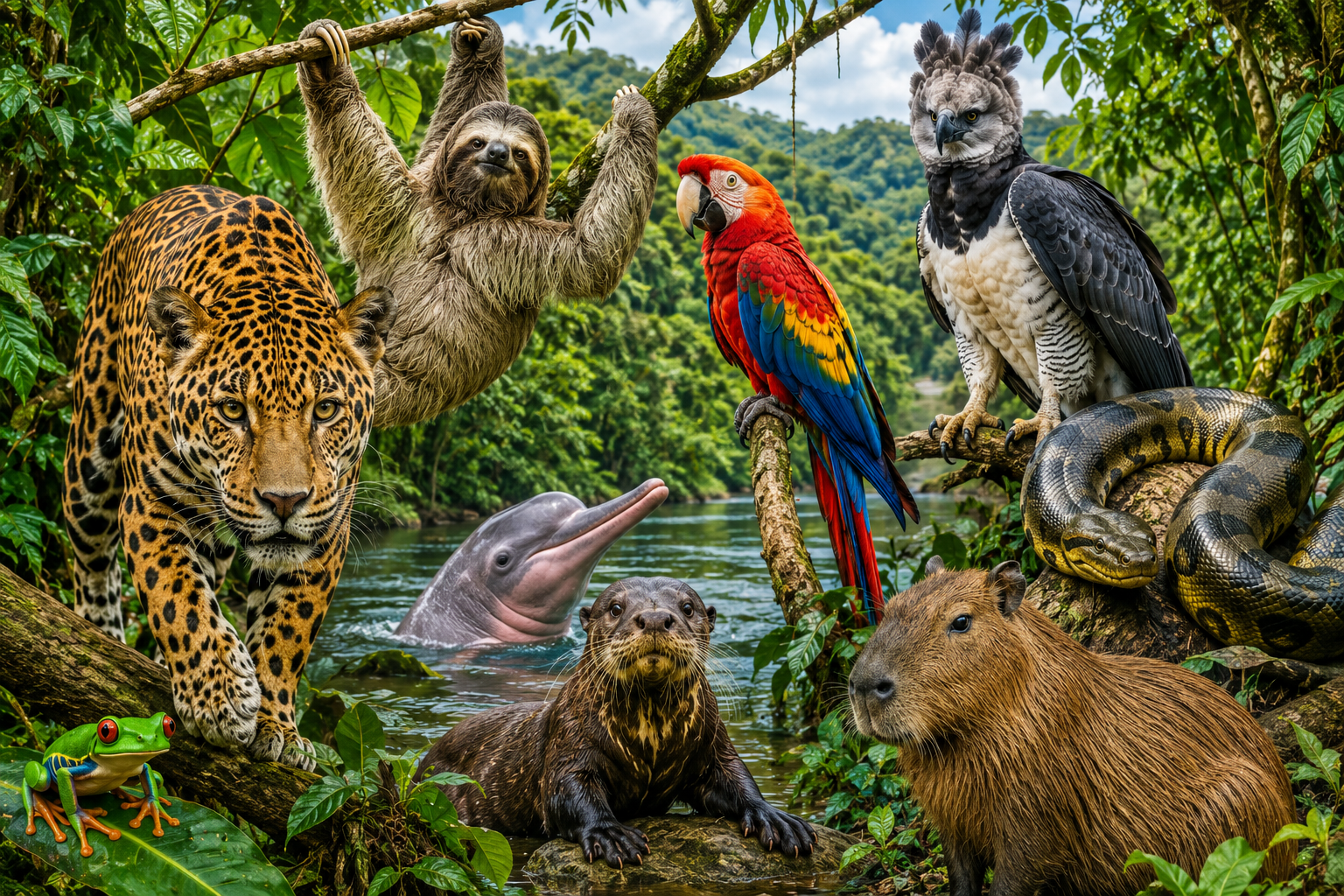
Life in the Amazon: 12 Remarkable Animals Surviving in the World’s Great Rainforest
The Amazon rainforest can seem almost endless. Beneath its enormous canopy are winding rivers, flooded forests, muddy banks, dark wetlands and thousands of trees competing for sunlight. Somewhere among all of this vegetation, animals are constantly feeding, hunting, climbing, swimming, nesting and searching for shelter.
The Amazon is the largest tropical rainforest in the world and supports an extraordinary variety of life. National Geographic describes the region as containing around 40,000 plant species, nearly 1,300 bird species, about 3,000 types of fish, more than 430 mammal species and millions of insects.
But the most interesting part of Amazon wildlife is not simply the number of species. It is how differently these animals live.
Some spend almost their entire lives in trees. Others are specialists of rivers and wetlands. Large predators patrol the forest floor while tiny frogs hide among damp leaves. Above them, powerful birds hunt from the highest branches.
Here are 12 remarkable animals that show just how diverse life in the Amazon can be.
1. Jaguar — The Forest’s Powerful Predator
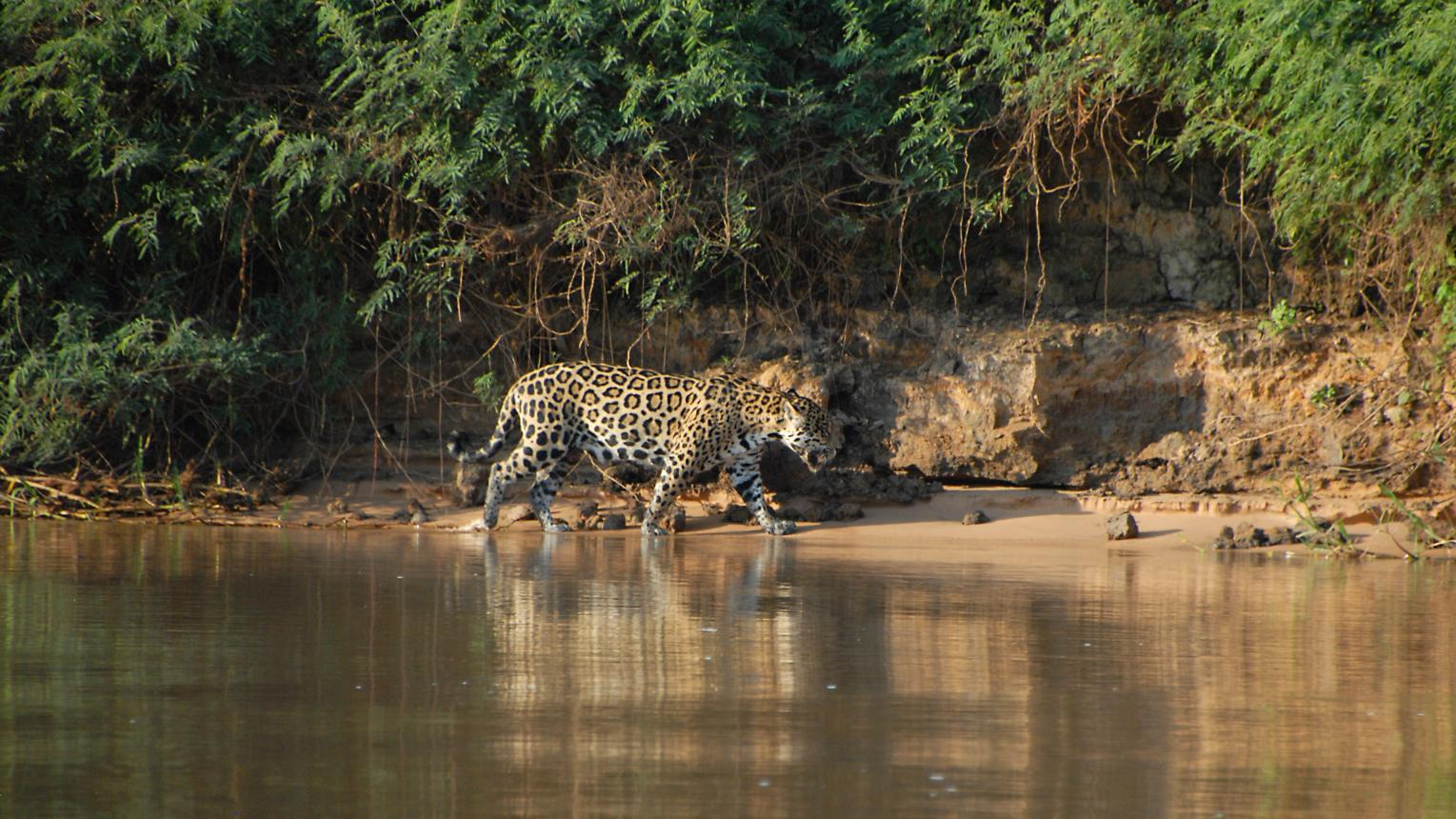
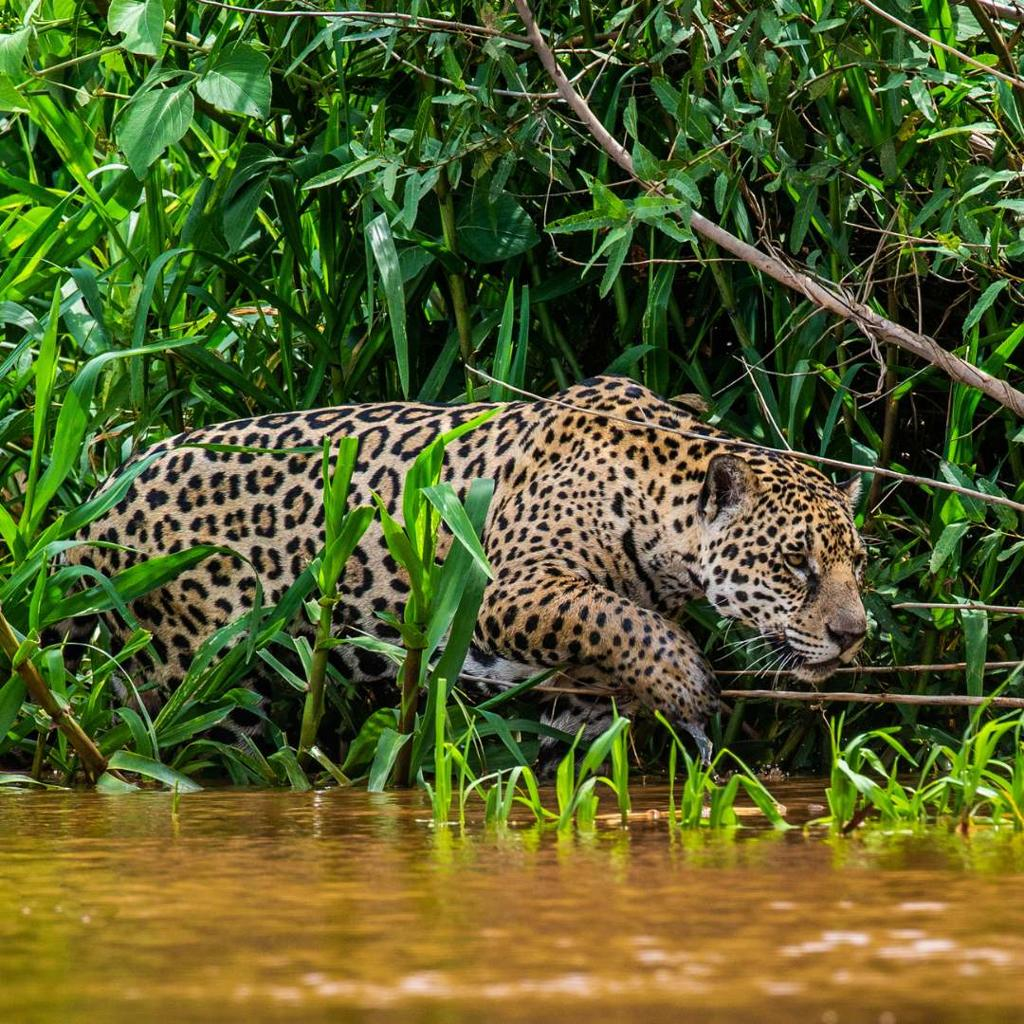
The jaguar is one of the most famous predators of the Amazon.
Its muscular body, large head and distinctive rosette markings make it easy to recognize. Unlike many big cats, jaguars are strongly associated with water and are capable swimmers.
This is useful in the Amazon, where rivers, streams and flooded forests create a complicated landscape.
Jaguars are powerful hunters capable of taking a variety of prey. They are also important to the wider ecosystem because predators can influence the populations and behavior of other animals.
Wild jaguars are notoriously difficult to observe. Dense vegetation gives them plenty of places to disappear, and many are most active when human activity is low.
A real wild jaguar photograph from Brazil’s Three Brothers River is available through Wikimedia Commons.

A real wild jaguar photograph from Brazil’s Three Brothers River is available through Wikimedia Commons.
2. Sloth — An Expert at Conserving Energy


6
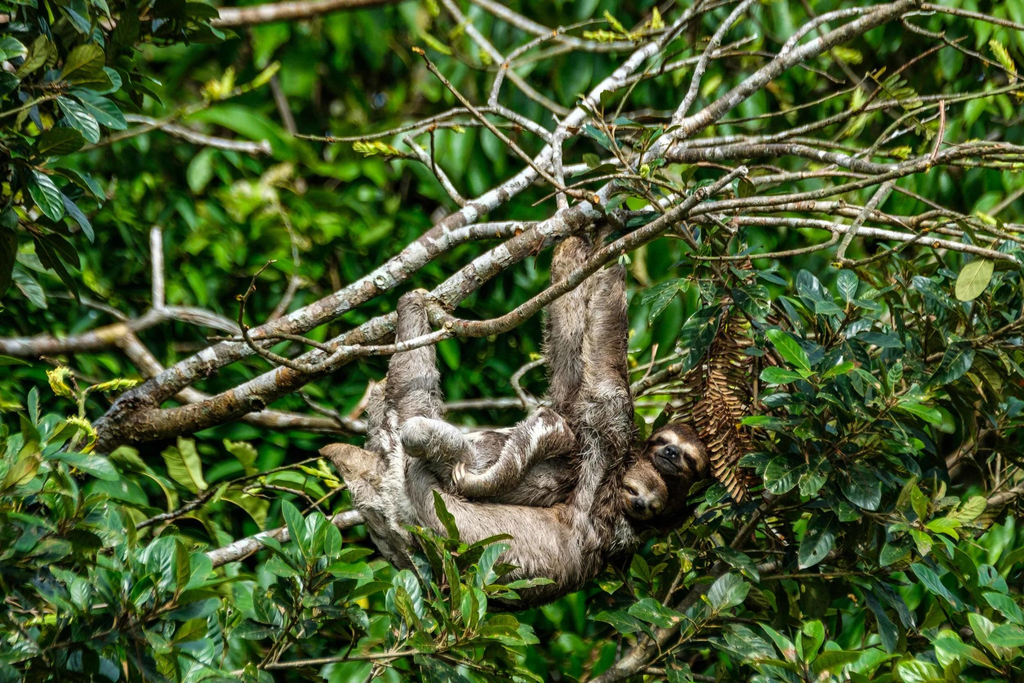
High above the ground, sloths have adopted a completely different approach to survival.
Instead of moving rapidly through the forest, they spend much of their time hanging from branches. Their long claws allow them to maintain a secure grip while feeding and resting.
A leaf-based diet provides relatively little energy, so moving slowly can be an advantage. Sloths have evolved a lifestyle centered around conserving energy rather than constantly searching for new food.
Their fur can also provide a home for algae and tiny organisms, giving some sloths a greenish appearance that can help them blend into their surroundings.
A genuine photograph of a sloth living in the Amazon rainforest near Peru’s Río Marañón is available on Wikimedia Commons.

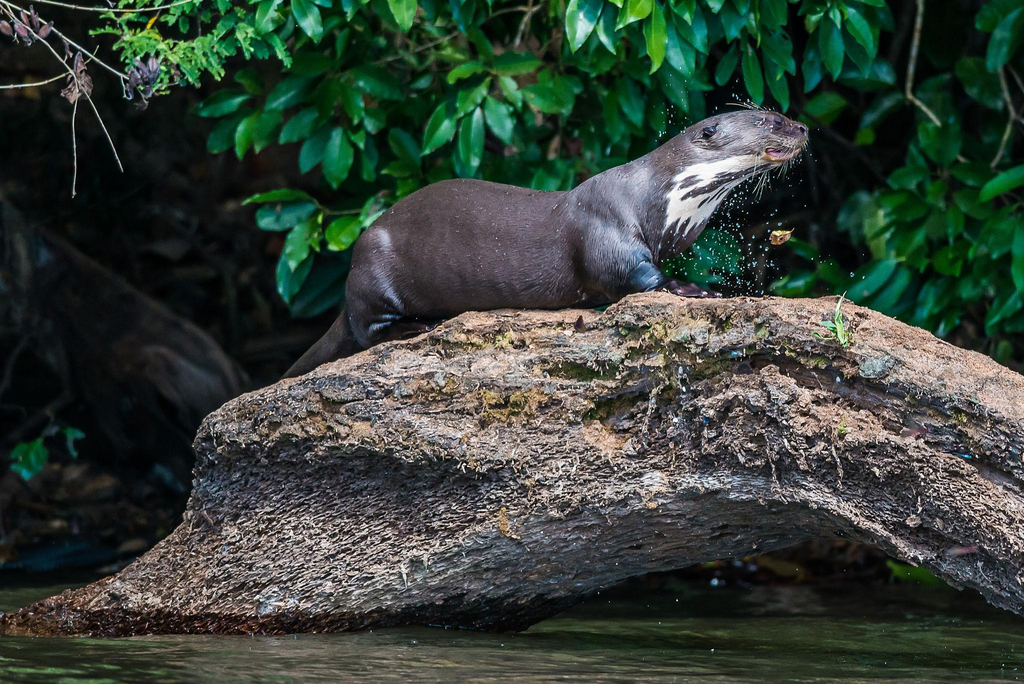
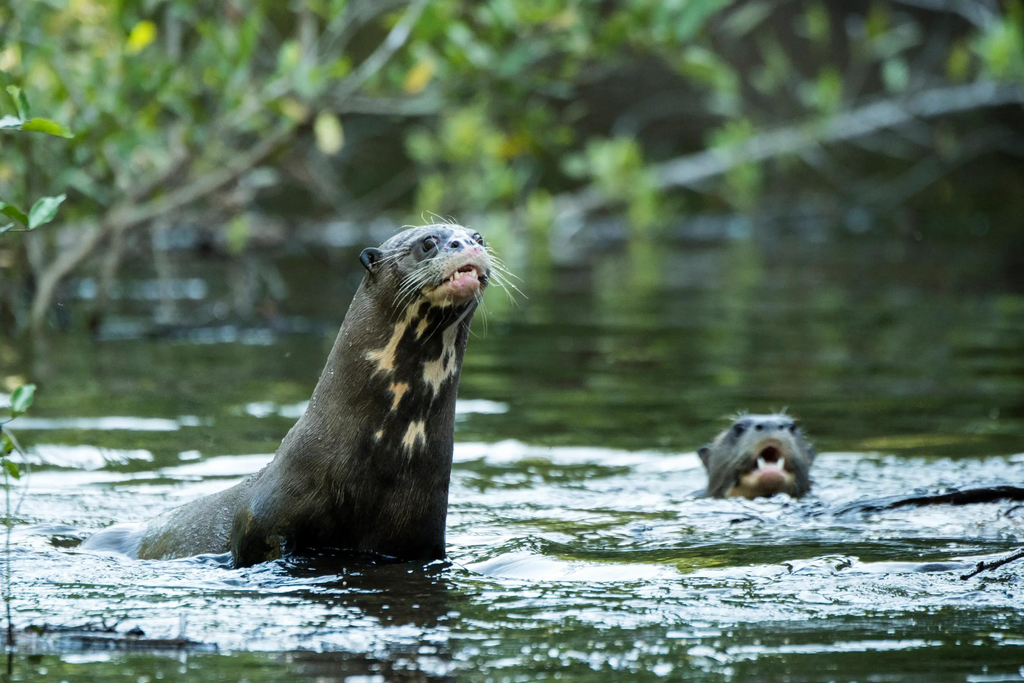
3. Giant River Otter — Life in Amazonian Waterways


8
The giant river otter is one of the Amazon’s most impressive aquatic mammals.
It has a long body, powerful tail and webbed feet that make it an excellent swimmer. Unlike solitary predators, giant river otters are highly social and can live in family groups.
Their lives are closely connected to freshwater environments. They hunt fish and other aquatic prey and communicate with members of their group through calls and other behaviors.
This makes clean, functioning rivers extremely important to them.
A particularly useful real photograph is a giant river otter photographed in Amazonia, Peru,
4. Green Anaconda — A Giant of the Wetlands


7
The green anaconda is one of the animals most strongly associated with Amazonian wetlands.
This enormous constrictor is adapted to spending substantial time in and around water. Its eyes and nostrils are positioned high on its head, allowing it to remain partly submerged while observing its surroundings.
Rather than using venom, anacondas overpower prey with muscular strength.
Although stories about enormous snakes are common, wild encounters are relatively unusual. These animals are much more likely to remain hidden in vegetation and waterways than to seek contact with humans.
A high-resolution green anaconda photograph is available from Wikimedia Commons.
5. Scarlet Macaw — A Flash of Color Above the Trees


6
The scarlet macaw brings brilliant color to the Amazon canopy.
Its combination of red, yellow and blue feathers makes it one of the rainforest’s most recognizable birds. Macaws also have strong, curved beaks that allow them to handle hard seeds and nuts.
Their importance goes beyond appearance. Birds that eat fruits and seeds can help move plant material around the forest, connecting different parts of the ecosystem.
Their loud calls can also travel through the forest, making a flock easier to notice before it becomes visible.
There is a real photograph specifically documented as a scarlet macaw in the Amazon jungle on Wikimedia Commons. It is listed under a Creative Commons Attribution license.
6. Harpy Eagle — Hunter of the Upper Canopy


7
Far above the forest floor lives one of the Amazon’s most impressive birds of prey: the harpy eagle.
Harpy eagles have broad wings and exceptionally powerful talons. They are associated with mature tropical forests and can hunt animals that live among the branches.
Their existence illustrates an important point about rainforest conservation. Large predators need more than a few isolated trees. They depend on extensive habitat, suitable nesting locations and enough prey.
National Geographic identifies large raptors such as harpy eagles as top predators of the rainforest’s upper layers.
A real harpy eagle photograph is available through Wikimedia Commons.
7. Pink River Dolphin — A Mammal of the Amazon Rivers
The Amazon is not only a forest of trees. Its enormous river system contains its own wildlife community.
The Amazon river dolphin is one of the most unusual mammals living in these freshwater environments. Unlike marine dolphins, it has adapted to life in rivers and flooded forest areas.
Changing water levels are an important part of the Amazon environment. During periods of high water, rivers can expand into areas that are normally forest floor.
River dolphins must therefore navigate an environment that can change dramatically through the year.
WWF identifies pink river dolphins among the characteristic wildlife of the Amazon and notes that river development can threaten their habitat.
8. Capybara — The Social Giant Rodent
Capybaras are the world’s largest living rodents and are closely associated with South American wetlands.
They are strong swimmers and often stay near water, where they can feed on vegetation and escape danger when necessary.
Their social behavior is another important feature. Capybaras commonly live in groups, providing opportunities for communication and collective vigilance.
Near Amazonian rivers and wetlands, their presence demonstrates how closely some rainforest animals depend on the boundary between land and water.
9. Poison Dart Frogs — Small but Remarkable
Not every Amazonian animal needs to be large to be fascinating.
Poison dart frogs are tiny amphibians famous for their striking colors. Depending on the species, they can display combinations of blue, yellow, orange, black or red.
Those vivid colors can act as warning signals to predators.
Their small size also makes them easy to miss. A person walking through the rainforest may pass close to one without ever noticing it.
Amphibians are particularly connected to moisture and environmental conditions, making them interesting indicators of changes within tropical ecosystems.
10. Spider Monkeys — Life in the Canopy
Spider monkeys are specialists of the treetops.
Their long limbs and prehensile tails allow them to move through the canopy with impressive agility. Instead of spending most of their time on the ground, they use the interconnected branches as highways through the forest.
They also participate in the movement of seeds after eating fruit.
This illustrates a larger truth about Amazon wildlife: an animal does not need to be a predator to have a major ecological influence.
11. Black Caiman — A Predator of the Water
Black caimans inhabit Amazonian rivers, lakes and flooded forests.
As large aquatic predators, they occupy an important position within freshwater food webs. Their dark coloration and ability to remain partly hidden can make them difficult to spot from the surface.
Young caimans face different dangers from adults, and survival depends on finding suitable habitat while avoiding predators.
The Amazon’s waterways therefore support multiple generations of reptiles, fish, mammals and birds at the same time.
12. Amazonian Fish — A Hidden World Beneath the Surface
Some of the Amazon’s most interesting wildlife never climbs a tree.
Thousands of fish species inhabit the basin, including piranhas, arapaima and many smaller species. National Geographic estimates that the Amazon rainforest is associated with roughly 3,000 types of fish.
During seasonal flooding, fish can move into areas of forest that are temporarily underwater. This creates unusual relationships between aquatic animals and plants.
The result is an ecosystem that changes with the water level rather than remaining the same throughout the year.
Why Amazon Animals Need a Healthy Forest
The Amazon works as a connected system.
A jaguar needs prey. Prey animals need vegetation. Plants depend on soil, water, pollinators and seed dispersers. River animals depend on healthy waterways. Birds depend on nesting trees and food sources.
When one part of the system is damaged, other species can eventually feel the effects.
Deforestation and habitat fragmentation can remove food, shelter and nesting sites. National Geographic notes that removing large trees can eliminate important canopy habitat and contribute to the fragmentation of wildlife populations.
Wildlife trafficking and other environmental crimes are another concern. A major multinational enforcement operation conducted across five Amazon countries , targeted illegal logging, wildlife trafficking, illegal mining and other environmental crimes. Authorities reported rescuing more than 3,000 live animals during the operation.
These events demonstrate that protecting Amazon wildlife requires cooperation across national borders.
The Amazon Is More Than a Jungle
The Amazon rainforest is sometimes described simply as a jungle filled with exotic animals. In reality, it is far more complicated.
It is a collection of habitats stacked vertically and connected by rivers.
At ground level, jaguars, peccaries and other animals move through vegetation. Higher up, sloths and monkeys travel among branches. Birds occupy the canopy, while powerful eagles hunt from above. Beneath the water, fish, caimans, dolphins and otters create another world almost completely hidden from view.
That variety is what makes Amazon rainforest animals so extraordinary.
Protecting them means protecting the forests, rivers and ecological connections that allow them to survive.
The future of the Amazon will not be determined by one species alone. Jaguars, sloths, macaws, otters, frogs, reptiles, fish and countless smaller organisms are all pieces of the same living system.
The Amazon’s greatest story is not about one spectacular animal. It is about millions of living things sharing one remarkable forest.
📸 6 Real Image Plan for Your Website
For your website, I recommend 6 real wildlife photographs rather than AI-generated animal pictures.
| # | Image | Recommended Alt Text | Suggested Caption |
|---|---|---|---|
| 1 | Jaguar | Wild jaguar walking beside vegetation in the Amazon region | A powerful jaguar moves quietly through its rainforest habitat. |
| 2 | Sloth | Sloth hanging from a tree in the Amazon rainforest | Sloths spend much of their lives high in the rainforest canopy. |
| 3 | Giant River Otter | Giant river otter in an Amazonian river in Peru | Giant river otters depend on healthy freshwater habitats. |
| 4 | Green Anaconda | Green anaconda in a South American wetland | The green anaconda is highly adapted to life around water. |
| 5 | Scarlet Macaw | Scarlet macaw in the Amazon jungle | Scarlet macaws add brilliant color to the rainforest canopy. |
| 6 | Harpy Eagle | Harpy eagle flying through a tropical forest | Harpy eagles are powerful predators of the upper forest. |
SEO INFORMATION
Article Title:
Life in the Amazon: 12 Remarkable Animals Surviving in the World’s Great Rainforest
SEO Title:
Amazon Rainforest Animals: 12 Incredible Wildlife Species
Focus Keyword:
Amazon rainforest animals
Secondary Keywords:
- Amazon rainforest wildlife
- animals of the Amazon
- Amazon jungle animals
- rainforest animals
- Amazon wildlife
- animals in the Amazon forest
- South American wildlife
- Amazon River animals
- tropical rainforest wildlife
- endangered Amazon animals
Category:
Wildlife
Subcategories:
Rainforest Animals, Wild Animals, South American Wildlife, Nature
Tags:
Amazon rainforest, Amazon animals, rainforest wildlife, jungle animals, jaguar, sloth, anaconda, macaw, giant river otter, harpy eagle, Amazon River, wildlife, tropical rainforest, South America, animal conservation
Meta Description:
Discover 12 fascinating Amazon rainforest animals, including jaguars, sloths, giant river otters, anacondas, macaws and harpy eagles, and learn how they survive.
Suggested URL Slug:amazon-rainforest-animals-wildlife
Suggested Excerpt:
The Amazon rainforest is a world of extraordinary wildlife. Discover how jaguars, sloths, anacondas, macaws, giant river otters and other animals survive in one of Earth’s richest ecosystems.