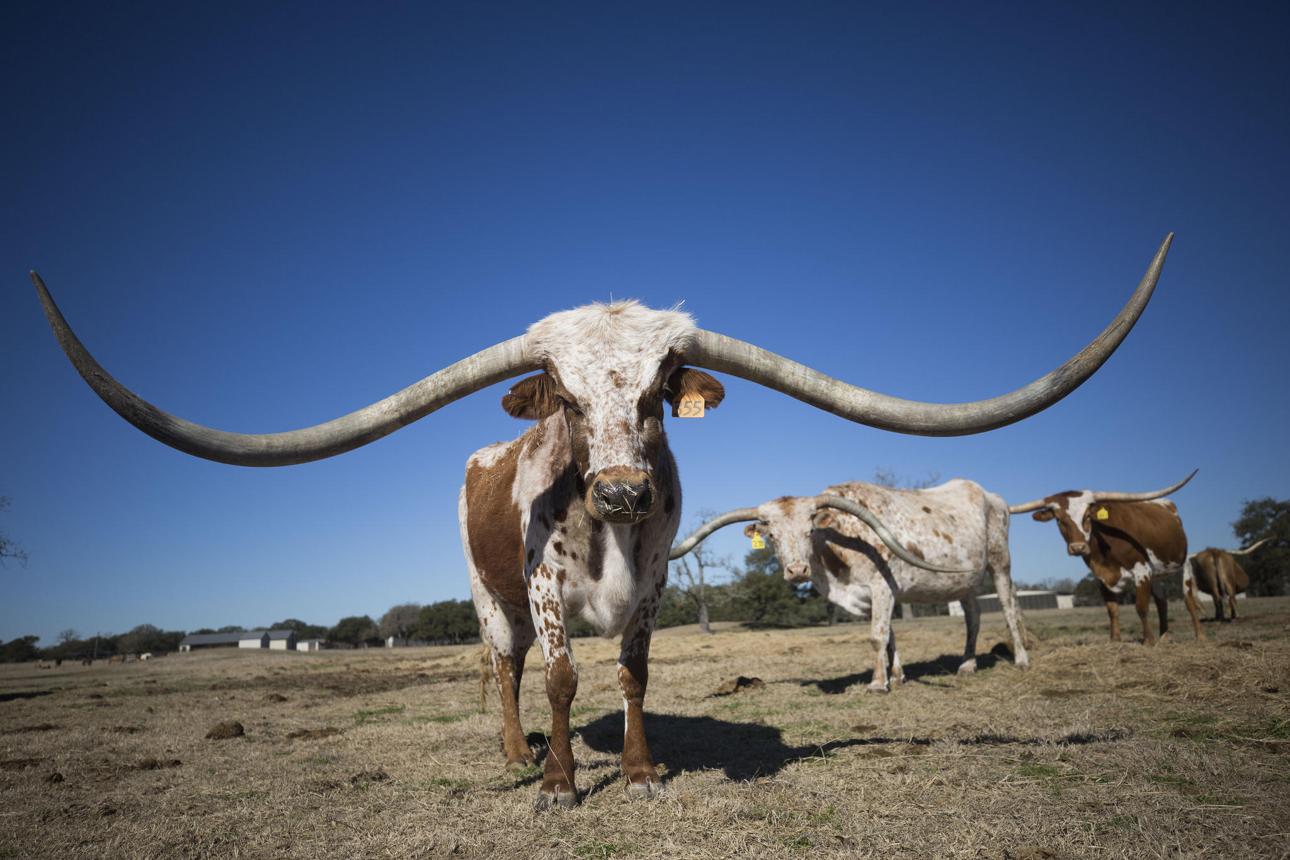
Guinness World Records has documented several remarkable Texas Longhorns. Lazy J’s Bluegrass recorded a horn spread of 297.8 cm (117.25 inches), while Poncho Via reached 323.74 cm (10 feet 7.4 inches) tip-to-tip in 2019
Tag: Animal facts
-
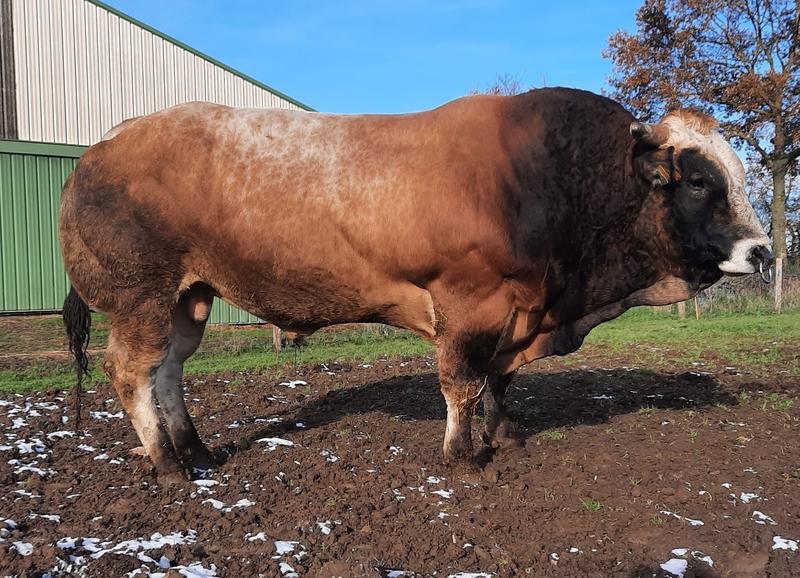
6. Charolais — The Powerful White Beef Bull
6. Charolais — The Powerful White Beef Bull
Charolais cattle originated in France and became internationally famous for their fast growth and strong beef characteristics.
The breed is generally creamy white to wheaten in color. Mature bulls are expected to have strong legs and feet capable of supporting their heavy bodies, along with broad backs, powerful hindquarters, and substantial muscling.
The Charolais is particularly impressive because its size is combined with a strong beef-producing frame. Rather than simply being tall, the breed has a deep and muscular body designed for growth and meat production.
Charolais genetics have also become important in crossbreeding systems around the world. Their growth potential and muscularity can be passed into offspring when breeders select suitable animals.
-

8 Extraordinary Animals That Reveal the Wild Side of Nature
8 Extraordinary Animals That Reveal the Wild Side of Nature
Updated for 2026 | Original Wildlife Article | WordPress Ready
5
Nature’s Remarkable Survivors
Wildlife does not follow a single blueprint. Some animals are built for power, others for speed, camouflage, climbing, flying, or simply disappearing into their surroundings. A swamp may hide an armored reptile, while a rainforest canopy can be home to acrobatic monkeys and powerful predators.
In this collection, we explore eight fascinating animals and bird groups: the American Alligator, Black Spider Monkey, Oropendolas and Caciques, Black Mamba, Jaguar, Jesus Lizard, Great Potoo, and Tropical Royal Flycatcher (Onychorhynchus coronatus).
They come from very different environments. Several are associated with tropical forests in the Americas, while the Black Mamba is an African species. Together, they demonstrate how evolution has produced remarkably different answers to the challenges of survival.
1. American Alligator: The Armored Hunter of Wetlands
7
The American Alligator (Alligator mississippiensis) is one of North America’s most recognizable reptiles. Its natural range includes much of the southeastern United States, where it inhabits freshwater rivers, lakes, marshes and swamps.
At first glance, the alligator seems almost perfectly designed for an aquatic ambush. Its muscular tail provides propulsion, its armored back protects its body, and its rounded snout contains powerful jaws.
The Smithsonian’s National Zoo reports that adult males average around 11.2 feet (3.4 meters), while exceptionally large individuals can approach 1,000 pounds.
One of the animal’s most interesting adaptations is the position of its nostrils. They face upward at the end of the snout, allowing an alligator to breathe while much of its body remains underwater.
Its teeth are equally impressive. An alligator normally has between 74 and 80 teeth at one time, but worn or lost teeth are continuously replaced. Over an entire lifetime, an individual can go through thousands of teeth.
The American alligator is also a conservation success story. After populations suffered from hunting and habitat loss, legal protection helped the species recover dramatically.
Alt text:
American alligator resting in a freshwater swamp
2. Black Spider Monkey: An Acrobat in the Rainforest Canopy
7
High above the forest floor, the Black Spider Monkey (Ateles paniscus) moves through the canopy with remarkable agility.
This primate occurs in parts of northern South America, including Brazil, French Guiana, Guyana and Suriname. It spends most of its time in dense forests, particularly high in the canopy.
Its body is specialized for life among the branches. Long arms and legs help it swing between trees, while its long prehensile tail acts almost like an additional limb.
Black spider monkeys are primarily fruit eaters. Animal Diversity Web reports that fruit can make up the majority of their diet when it is abundant, with leaves, flowers, seeds and other plant material also contributing.
Their social behavior is particularly interesting. Groups can contain dozens of animals, but they frequently split into smaller feeding and traveling parties. This flexible social organization allows them to search efficiently for scattered fruit.
Unfortunately, black spider monkeys face serious pressures from deforestation and hunting. Their dependence on extensive forest and relatively slow reproduction makes population recovery difficult.
Protecting large areas of connected rainforest is therefore crucial for their future.
Alt text:
Black spider monkey moving through the Amazon rainforest canopy
3. Oropendolas & Caciques: The Noisy Architects of Tropical Forests
7
Oropendolas and caciques are members of the New World blackbird family, Icteridae, and are famous for their unusual voices and distinctive nests.
Many species live in tropical forests and woodland habitats across Central and South America.
Oropendolas are especially famous for their long, hanging nests. Instead of placing a simple nest on a branch, females weave pendulous structures that can hang well below the supporting branch.
Cornell’s Bird Academy notes that Montezuma Oropendolas live in colonies and that their hanging nests can extend three feet or more below a branch.
The shape is more than decoration. A long, deep nest may help protect eggs and young from predators and reduce the likelihood that eggs will fall out during strong winds.
Their colonies can become remarkably busy places.
Several birds may occupy the same general area, creating a mixture of calls, wingbeats and courtship displays.
Oropendolas also have distinctive voices. Some calls sound surprisingly liquid or mechanical, giving tropical forests an unmistakable soundtrack.
These birds remind us that architecture is not limited to humans. A small bird using plant fibers can construct a hanging nursery high above the forest floor.
Alt text:
Oropendola perched near a long hanging nest in a tropical forest
4. Black Mamba: Africa’s Fast and Highly Venomous Snake
6
The Black Mamba (Dendroaspis polylepis) is included here as a striking example of an animal from a completely different continent.
Despite its name, the Black Mamba is generally brownish, gray or olive rather than black. The name comes from the dark interior of its mouth, which it may display when threatened.
This highly venomous snake occurs across parts of sub-Saharan Africa, particularly savannas, woodland and rocky areas.
It is a long, slender snake capable of moving quickly when necessary.
Black Mambas are predators, feeding mainly on smaller animals such as birds and mammals. Their speed and venom are important parts of their hunting strategy.
Despite the snake’s frightening reputation, its behavior is often misunderstood. Like many wild animals, it generally prefers to avoid unnecessary confrontation.
Its reputation has also been exaggerated by myths and sensational stories.
The most important lesson is simple: a Black Mamba should be treated as a dangerous wild animal and observed from a safe distance.
Alt text:
Black Mamba snake in its natural African habitat
5. Jaguar: The Powerful Predator of the Americas
7
The Jaguar (Panthera onca) is one of the great predators of the Americas.
Its range extends from parts of North America through Central America and into South America. Tropical forests, wetlands, grasslands and other habitats can support jaguars when enough prey and cover remain.
The U.S. Fish & Wildlife Service describes the jaguar as the largest cat in the Americas. Its rosette patterns are distinctive, with many rosettes containing additional spots inside them.
The jaguar’s body is compact and muscular compared with some other big cats. This gives it enormous strength.
Unlike many cats, jaguars are also comfortable around water. Smithsonian research has documented their association with rivers, wetlands and tropical forests.
As an apex predator, the jaguar plays an important ecological role. By hunting a variety of prey, it can influence populations throughout its habitat.
But jaguars require space.
Habitat fragmentation, persecution and declining prey can make it difficult for populations to remain healthy. Wildlife corridors that connect isolated forest areas can therefore be extremely important.
The survival of the jaguar is closely linked to the survival of the forests and wetlands it inhabits.
Alt text:
Wild jaguar walking through tropical rainforest habitat
6. Jesus Lizard: The Reptile That Can Run Across Water
5
Few animal abilities sound more unbelievable than running across water.
The Green Crested Basilisk (Basiliscus plumifrons), commonly called the Jesus Lizard, can do exactly that.
These lizards live near streams and other water sources in tropical forests. When frightened, they can rise onto their hind legs and sprint across the water’s surface.
The Smithsonian’s National Zoo explains that specialized scales on their feet and their rapid movement allow them to stay above the water for a distance before eventually diving beneath the surface.
Their long toes help increase the surface area of the feet during the sprint.
The lizard can also swim well and remain underwater for more than 10 minutes, providing another escape route when running across the surface is no longer possible.
This is a perfect example of adaptation matching habitat.
A predator chasing a basilisk near a tropical stream faces an animal with three escape options: land, water surface or underwater.
The unusual ability has made the Jesus Lizard one of the most famous reptiles in the tropical Americas.
Alt text:
Green crested basilisk Jesus Lizard running across a tropical stream
7. Great Potoo: The Master of Nighttime Camouflage
5
The Great Potoo (Nyctibius grandis) looks like a bird designed by an artist with a particularly wild imagination.
It has enormous eyes, a wide mouth and mottled feathers that resemble bark.
Found across much of tropical Central and South America, the Great Potoo is primarily nocturnal. During daylight hours, it often remains motionless on a tree branch, using its cryptic plumage to blend into its surroundings.
At night, everything changes.
The bird becomes an active hunter, making short flights from perches to capture insects and other flying prey. Animal Diversity Web notes that its diet includes large flying insects and, occasionally, bats.
Its camouflage is particularly effective because it combines color, shape and behavior.
Simply having brown feathers would not be enough. The bird’s ability to freeze and maintain a stiff posture makes it resemble part of the tree.
Great Potoos also have an unusual nesting strategy. Rather than constructing a conventional nest, they lay a single egg in a small notch or depression on a branch.
For a nocturnal predator, remaining invisible during the day is an extremely effective survival strategy.
Alt text:
Great Potoo camouflaged against a tropical tree branch
8. Tropical Royal Flycatcher: The Bird With a Hidden Crown
6
The Tropical Royal Flycatcher (Onychorhynchus coronatus) is a small rainforest bird with a spectacular secret.
Most of the time, its crown may not look particularly dramatic. But when the bird raises its crest, brilliant colors can suddenly appear.
This dramatic display is one reason royal flycatchers are so memorable.
The Tropical Royal Flycatcher is associated with forests in tropical South America. Cornell’s Birds of the World lists extensive observational and photographic records for the species, including thousands of observations and thousands of photographs in the eBird/Macaulay Library database.
Like other flycatchers, it is adapted to catching insects.
It can wait quietly on a perch before making a quick flight to capture prey.
Its crown adds another layer to its behavior. The sudden appearance of bright colors can be used in displays and communication, turning an otherwise inconspicuous bird into a spectacular performer.
This contrast is fascinating: camouflage and surprise can be more useful than constantly showing brilliant colors.
Alt text:
Tropical Royal Flycatcher Onychorhynchus coronatus displaying its colorful crest
What These Animals Teach Us About Survival
These eight animals may seem to have little in common, but their survival strategies reveal several important themes.
Strength
The American Alligator and Jaguar demonstrate the value of physical power. Both are formidable predators equipped to capture and handle substantial prey.
Movement
The Black Spider Monkey uses long limbs and a prehensile tail to navigate the canopy, while the Jesus Lizard has developed an extraordinary way to escape across water.
Camouflage
The Great Potoo shows that remaining unnoticed can be as valuable as being fast. Its bark-like appearance allows it to virtually disappear during the day.
Communication
Oropendolas and Caciques use complex vocalizations and social displays, while the Royal Flycatcher can reveal a striking crest during visual displays.
Chemical Defense
The Black Mamba represents another strategy entirely: venom. Instead of relying on enormous size, it uses a highly effective chemical weapon for hunting and defense.
Ecological Balance
Predators such as jaguars and alligators are not simply dangerous animals. They are components of larger ecosystems. Their presence can influence populations of other species and help maintain ecological relationships.
Why Protecting Their Habitats Matters
Wild animals cannot survive simply because they are biologically impressive.
They need functioning habitats.
Black spider monkeys need extensive tropical forests. Jaguars require connected areas containing prey and cover. Alligators depend on wetlands and freshwater habitats. The Jesus Lizard needs streams and forest vegetation.
Birds such as oropendolas and royal flycatchers similarly depend on healthy forest ecosystems.
Habitat destruction can therefore affect wildlife even when animals are not directly hunted.
For wide-ranging species, fragmentation can be especially serious. Roads, agriculture and development can divide once-continuous habitat into isolated patches.
Conservation is most effective when it protects not only individual species but also the ecosystems that support them.
Final Thoughts
The natural world is full of animals that seem almost impossible until we understand how they live.
The American Alligator demonstrates the power of an aquatic ambush predator.
The Black Spider Monkey turns the rainforest canopy into a three-dimensional highway.
Oropendolas and Caciques combine social behavior with remarkable nest-building skills.
The Black Mamba shows how venom can compensate for a relatively slender body.
The Jaguar represents the strength and ecological importance of a great American predator.
The Jesus Lizard has evolved one of the most extraordinary escape techniques in the animal kingdom.
The Great Potoo disappears into trees by combining camouflage with stillness.
And the Tropical Royal Flycatcher can transform a seemingly ordinary bird into a spectacular performer with the sudden display of its crown.
Together, they demonstrate one of nature’s most important principles:
There is no single path to survival.
Some animals survive by being powerful. Others hide. Some climb, some swim, some fly, and some use venom. Their differences are precisely what make Earth’s wildlife so fascinating.
📸 WordPress Image SEO — 7 Images
Image 1 — Featured Image
Animals: American Alligator + Black Spider Monkey + Jaguar
Alt text:American alligator, black spider monkey and jaguar in a realistic wildlife collage
Filename:american-alligator-black-spider-monkey-jaguar.jpgImage 2 — Oropendolas & Caciques
Alt text:
Oropendola and cacique birds in a tropical rainforest near hanging nests
Filename:oropendolas-caciques-tropical-forest.jpgImage 3 — Black Mamba
Alt text:
Black Mamba snake in its natural African habitat
Filename:black-mamba-african-wildlife.jpgImage 4 — Jesus Lizard
Alt text:
Green crested basilisk Jesus Lizard running across a tropical stream
Filename:jesus-lizard-basilisk-running-water.jpgImage 5 — Great Potoo
Alt text:
Great Potoo camouflaged on a tropical rainforest branch
Filename:great-potoo-rainforest-camouflage.jpgImage 6 — Royal Flycatcher
Alt text:
Tropical Royal Flycatcher Onychorhynchus coronatus displaying its colorful crest
Filename:tropical-royal-flycatcher.jpgImage 7 — All Animals Featured Collage
Alt text:
American alligator, black spider monkey, oropendolas, caciques, black mamba, jaguar, Jesus Lizard, Great Potoo and Royal Flycatcher wildlife collage
Filename:8-extraordinary-animals-wildlife-2026.jpgImportant: Search results can include copyrighted commercial wildlife photographs. Before downloading and publishing a photograph on WordPress, verify that its license permits website use. For example, the Smithsonian also provides some wildlife images under CC0/Open Access, including certain American alligator and jaguar records.
🔎 Complete WordPress SEO Package
New Article Title:
8 Extraordinary Animals That Reveal the Wild Side of Nature
SEO Title:
8 Amazing Animals With Incredible Survival Skills | Wildlife 2026
Focus Keyword:
amazing animalsSecondary Keywords:
- extraordinary animals
- incredible animals 2026
- unusual wildlife
- amazing wildlife
- animal survival skills
- American alligator
- black spider monkey
- oropendola
- cacique bird
- black mamba
- jaguar
- Jesus Lizard
- green basilisk
- Great Potoo
- Royal Flycatcher
- Onychorhynchus coronatus
- rainforest animals
- tropical birds
- wild animals
- animal adaptations
Meta Description:
Discover 8 extraordinary animals, including the American Alligator, Black Spider Monkey, Jaguar, Black Mamba, Jesus Lizard, Great Potoo and Royal Flycatcher.Short Description / Excerpt:
Explore eight extraordinary animals and discover how strength, camouflage, venom, speed, flight and intelligence help them survive in different environments.Category:
Animals & WildlifeSubcategory:
Amazing AnimalsTags:
Amazing Animals, Wildlife, Animal Facts, Animal Adaptations, Rare Animals, Exotic Animals, American Alligator, Black Spider Monkey, Oropendola, Cacique, Black Mamba, Jaguar, Jesus Lizard, Basilisk, Great Potoo, Royal Flycatcher, Rainforest Animals, Tropical Wildlife, Birds, Reptiles, Mammals, Wildlife 2026Suggested URL Slug:
8-extraordinary-animals-wildlife-2026Featured Image Title:
8 Extraordinary Animals That Reveal the Wild Side of NatureFeatured Image Alt Text:
Eight extraordinary animals including American alligator, black spider monkey, oropendola, black mamba, jaguar, Jesus Lizard, Great Potoo and Royal FlycatcherFeatured Image Caption:
Eight remarkable animals showing the extraordinary ways wildlife adapts to different environments.Recommended Image Size:
1200 × 675 pxRecommended Schema:
ArticleAuthor:
World Animals TVPublication Year:
2026Suggested Internal Links:
Rainforest Animals•Amazing Birds•Rare Animals•Reptile Facts•Big Cats•Animal Adaptations•Wildlife Facts•Tropical Animals -

19 Incredible Animals That Prove Nature Is Stranger Than Fiction
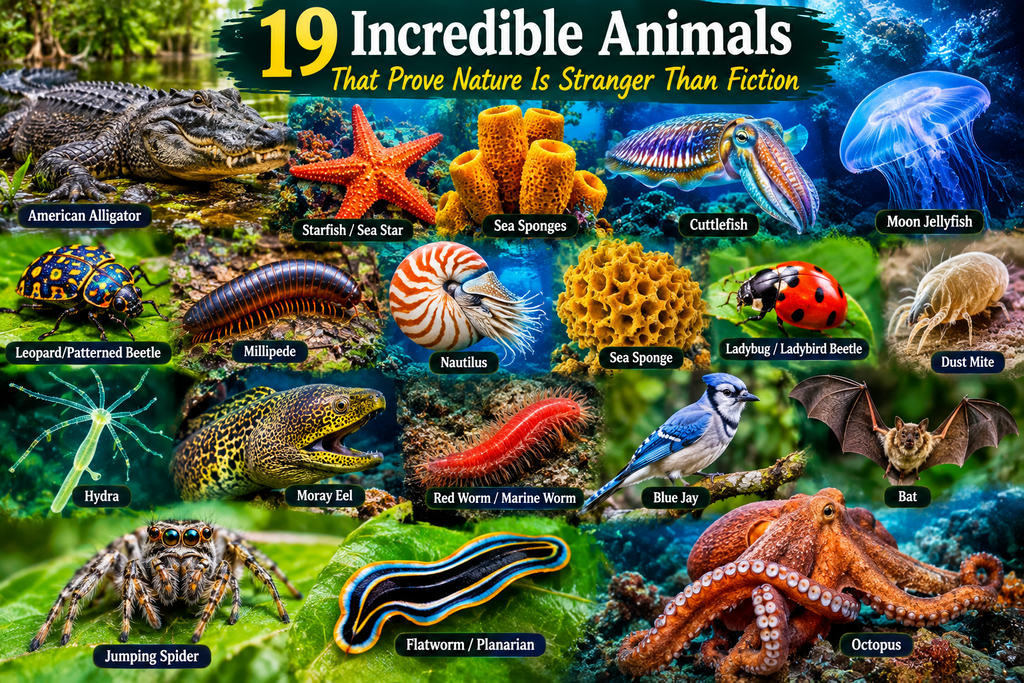
19 Incredible Animals That Prove Nature Is Stranger Than Fiction
Updated: September 2026
Recommended for: WordPress / World Animals TV
Article type: Original Wildlife Feature
Approx. length: 1,500 wordsA Journey Into the Hidden World of Extraordinary Animals
The natural world contains animals that can look almost imaginary. Some have armored bodies, others can regenerate lost body parts, and some are so small that an entire world exists beneath the surface of a pond or on a speck of household dust.
From the powerful American alligator to the delicate moon jellyfish, these animals occupy remarkably different environments. Some live in freshwater rivers and swamps, some inhabit coral reefs and deep oceans, while others spend their lives in forests, grasslands or microscopic freshwater habitats.
What makes them fascinating is not simply their appearance. Their bodies and behaviors reveal how evolution has produced countless solutions to the challenges of survival.
Here are 19 remarkable animals that demonstrate just how creative nature can be.
1. American Alligator — The Ancient Predator of Wetlands
6
The American alligator (Alligator mississippiensis) is a familiar symbol of the southeastern United States, but its biology is anything but ordinary.
This large reptile is equipped with a heavily armored back, powerful tail, short legs and a broad snout. Its nostrils sit near the tip of its snout, allowing it to breathe while much of its body remains submerged.
Alligators are opportunistic predators. Their diet can include fish, turtles, frogs, birds, mammals and invertebrates.
One particularly interesting feature is their ability to replace teeth. The Smithsonian’s National Zoo reports that an alligator can go through approximately 3,000 teeth during its lifetime.
The species was once close to extinction, but conservation measures helped it recover dramatically.
Today, the American alligator is an excellent example of how effective conservation can change the future of a species.
2. Starfish — The Sea Animal That Isn’t a Fish
The animal commonly called a starfish is more accurately known as a sea star.
Despite its name, it is not a fish. Sea stars have no fins, scales or gills. Instead, they belong to a group called echinoderms, alongside sea urchins and sand dollars.
Their most unusual feature is their water vascular system.
Seawater moves through this internal system and helps operate hundreds or thousands of tiny tube feet underneath the animal.
Those tube feet allow sea stars to move, grip surfaces and capture prey.
Some species can also regenerate lost arms.
This ability is especially remarkable because regeneration can range from replacing a single arm to rebuilding much of the body in certain species.
The familiar five-armed shape is not universal either. Some species have many more arms.
So the next time you see a sea star, remember that you’re looking at a very different kind of animal from a fish.
3. Sea Sponges — Animals That Live Without a Nervous System
7
Sea sponges may look like plants, rocks or underwater decorations, but they are animals.
Sponges belong to the phylum Porifera and have an incredibly simple body design. NOAA explains that they have no nervous, digestive or circulatory system. Instead, water flows through their porous bodies, delivering oxygen and food.
Their simplicity is deceptive.
Sponges have survived for hundreds of millions of years and occur in an astonishing variety of forms.
Some resemble barrels.
Others grow like branches, tubes or delicate glass structures.
They also provide shelter for other marine organisms and contribute to nutrient cycling and water filtration.
A reef without its sponge community would therefore be a very different ecosystem.
4. Cuttlefish — The Masters of Color and Disguise
7
The cuttlefish belongs to the cephalopod family, alongside octopuses, squids and nautiluses.
Its body is built for sophisticated movement and camouflage.
Cuttlefish can rapidly alter their appearance using specialized skin structures. They can produce different patterns and colors, helping them communicate, attract mates or blend into their surroundings.
They also possess a structure called a cuttlebone, which helps regulate buoyancy.
The Smithsonian notes that cuttlefish have eight arms plus two specialized feeding tentacles.
This combination of intelligence, vision, camouflage and flexible movement makes the cuttlefish one of the most fascinating animals in coastal seas.
5. Moon Jellyfish — A Transparent Drifter
7
The moon jellyfish is famous for its nearly transparent bell.
Rather than swimming like a fish, it pulses its body and drifts with currents.
Jellyfish are much more diverse than many people realize. NOAA notes that there are more than 200 documented species of true jellyfish, with many additional related stinging animals.
The translucent body can make a jellyfish difficult to see in open water.
Its tentacles and oral structures help capture tiny prey from the surrounding water.
Although jellyfish sometimes receive negative attention because of their stings, they are important parts of marine food webs.
They can provide food for fish, sea turtles and other predators.
6. Patterned Beetles — Tiny Bodies With Huge Variety
Patterned beetles demonstrate how much visual diversity can exist within insects.
Their hardened wing covers can display spots, stripes, metallic colors and intricate patterns.
The patterns may serve different purposes.
Some help insects blend into leaves or bark. Others warn predators that the beetle may taste unpleasant or be difficult to eat.
Beetles occupy almost every terrestrial environment, from forests and grasslands to deserts and gardens.
Their small size allows them to exploit ecological niches that are unavailable to larger animals.
A close-up photograph reveals something easy to miss with the naked eye: an insect’s body is an extraordinarily detailed piece of biological engineering.
7. Millipede — The Forest Floor’s Recycling Crew
6
The millipede is one of nature’s great recyclers.
Most millipedes feed on decaying leaves, wood and other organic material.
Their work helps break down material that would otherwise accumulate on the forest floor.
Despite the name, millipedes do not normally have exactly 1,000 legs. Their bodies contain many segments, with most segments bearing two pairs of legs.
Their slow movement is well suited to a lifestyle based on decomposing vegetation rather than chasing prey.
Some species protect themselves by curling into a spiral when threatened.
Others produce defensive chemicals.
Although they rarely receive the attention given to charismatic mammals, millipedes are essential contributors to healthy soils.
8. Nautilus — A Living Window Into Ancient Seas
6
The nautilus is one of the most recognizable marine animals.
Its spiral shell gives it an appearance that seems to connect the modern ocean with the distant past.
Nautiluses are cephalopods, but unlike octopuses and most squid and cuttlefish, they retain an external shell.
Inside that shell are multiple chambers.
NOAA explains that these chambers work somewhat like ballast tanks in a submarine. The animal can adjust fluid within them to control buoyancy.
Nautiluses also use jet propulsion to move through the water.
The Smithsonian notes that living nautiluses represent one of the last surviving branches of the ancient shelled cephalopods.
Their survival into the modern era makes them especially valuable to scientists studying cephalopod evolution.
9. Ladybug — A Tiny Beetle With a Famous Warning
6
The ladybug, or ladybird beetle, is one of the most recognizable insects.
Its bright red or orange body decorated with dark spots is not merely attractive.
In many species, bright coloration acts as a warning to predators.
Ladybugs can also release defensive chemicals when threatened.
Many species are beneficial in gardens and agricultural systems because they consume aphids and other small insects.
This makes the tiny beetle an important natural predator.
Their cheerful appearance has also given them an unusually positive reputation among humans.
But beneath those colorful wing covers is a highly effective little predator.
10. Dust Mite — An Entire World Too Small to See
Dust mites are among the smallest animals on this list.
They are microscopic relatives of spiders and ticks and are commonly associated with household dust.
They feed primarily on microscopic organic material, including flakes of shed skin.
Because they are so tiny, an ordinary room can contain an ecosystem invisible to the human eye.
Their existence is a reminder that wildlife is not always found in jungles, oceans or mountains.
Sometimes it is living around us without being noticed.
11. Hydra — The Tiny Freshwater Animal That Can Regenerate
5
Hydra is a tiny freshwater animal belonging to the cnidarian group.
It has a simple tubular body with tentacles surrounding its mouth.
The tentacles are equipped with specialized stinging cells that help Hydra capture tiny prey.
But Hydra is especially famous for its regenerative abilities.
Its simple body organization allows it to replace damaged tissue and, under suitable conditions, reproduce asexually by producing buds.
Because of this remarkable biology, Hydra has become an important organism in research into regeneration and aging.
It may be tiny, but it provides scientists with a fascinating window into how animals repair themselves.
12. Moray Eel — The Predator With a Second Set of Jaws
6
The moray eel is one of the ocean’s most unusual predators.
Its long body allows it to hide inside cracks, caves and reef crevices while waiting for prey.
But its strangest feature may be inside its throat.
Moray eels possess a second set of jaws known as pharyngeal jaws.
When a moray captures prey, these internal jaws can move forward and help pull the food deeper into the throat.
This unusual feeding mechanism allows the eel to handle prey in a way that differs dramatically from most fish.
Its narrow body is also perfectly suited to moving through rocky crevices.
Instead of chasing prey across open water, the moray often relies on ambush and surprise.
13. Marine Worms — Hidden Engineers of the Seafloor
Marine worms include an enormous variety of animals with very different body forms and lifestyles.
Some live inside sediments.
Others burrow through mud or sand.
Some build tubes and filter food from the water.
Others are active predators.
Their work is important because burrowing animals continually disturb and mix seafloor sediments.
This process can move oxygen and nutrients into deeper layers and influence the organisms living around them.
What looks like ordinary sand or mud may therefore contain an enormous community of small animals working beneath the surface.
14. Blue Jay — The Clever Voice of North American Woodlands
7
The Blue Jay (Cyanocitta cristata) is one of North America’s most recognizable songbirds.
Its blue, white and black plumage makes it easy to identify, but its intelligence and vocal abilities are equally interesting.
Blue Jays produce a wide variety of calls and can imitate sounds made by other birds.
They also consume a broad range of foods, including seeds, nuts, insects and other items.
Their habit of carrying and caching nuts can have ecological consequences because forgotten seeds may eventually grow into new plants.
A familiar backyard bird can therefore have a much larger role in forest ecology than its size suggests.
15. Bat — The Only Mammal Capable of True Powered Flight
6
Bats are extraordinary mammals.
They are the only mammals capable of true powered flight, rather than merely gliding.
Their wings are modified forelimbs, with elongated fingers supporting a thin membrane of skin.
Many bats use echolocation to navigate and locate prey in darkness.
Their ecological roles are equally important.
Depending on the species, bats may eat insects, fruit, nectar, fish or even small vertebrates.
Smithsonian notes that bats provide important ecosystem services, including pest control, pollination and seed dispersal.
This makes bats much more than mysterious nighttime animals.
They are essential members of many ecosystems.
16. Jumping Spider — A Predator With Incredible Vision
7
Jumping spiders belong to the family Salticidae and are famous for their large forward-facing eyes.
Their excellent vision is unusual among spiders.
Rather than relying primarily on webs to capture prey, many jumping spiders actively hunt.
They stalk prey, approach carefully and then leap.
Their ability to judge distance is particularly impressive for such tiny animals.
Some species also use visual displays during courtship, with males moving their bodies and legs to communicate with females.
The result is a miniature predator that combines exceptional eyesight, stealth and athletic movement.
17. Flatworm / Planarian — The Regeneration Specialist
Planarians are flatworms famous for their remarkable regenerative abilities.
If a planarian is divided, certain species can regenerate missing structures because their bodies contain populations of specialized stem cells.
Their simple appearance hides a surprisingly sophisticated biological system.
Scientists study planarians because understanding how they rebuild tissues can provide clues about regeneration more broadly.
They are also important freshwater organisms and can be found in streams, ponds and other aquatic environments.
Their story shows that extraordinary biological abilities don’t always belong to large or complex animals.
18. Octopus — The Intelligent Master of Disguise
7
The octopus may be one of the most remarkable animals in the ocean.
It has eight arms, highly flexible movement and an extraordinary ability to manipulate its environment.
Smithsonian describes octopuses as highly intelligent animals capable of problem-solving and changing their appearance.
Their bodies are also anatomically unusual.
Octopuses have three hearts and blue blood. Their blood contains hemocyanin, a copper-based molecule that carries oxygen.
They can change color and patterns using specialized skin structures, allowing them to camouflage themselves or communicate.
Some species can squeeze through surprisingly small openings because they lack a rigid skeleton.
An octopus can therefore combine intelligence, flexibility, camouflage and dexterity in a way few other animals can match.
19. The Common Thread: Adaptation
Although these animals seem unrelated, they all reveal the same powerful idea:
survival depends on adaptation.
The alligator’s armored body protects it while its powerful jaws capture prey.
The sea star uses tube feet to move and feed.
Sponges filter water through porous bodies.
Cuttlefish use camouflage to communicate and avoid danger.
Jellyfish drift through the ocean while capturing tiny prey.
Millipedes recycle dead vegetation.
Nautiluses use their chambered shells to regulate buoyancy.
Hydra and planarians demonstrate extraordinary regenerative abilities.
Moray eels use hidden jaws to pull prey into their throats.
Bats transformed their forelimbs into wings.
Jumping spiders rely on sharp vision rather than giant webs.
Octopuses combine intelligence and camouflage to survive in complex marine environments.
There is no single definition of a successful animal.
Some species survive through strength.
Others survive through invisibility.
Some use speed.
Others rely on patience.
Some are enormous.
Others are microscopic.
Evolution has produced all of these solutions over immense periods of time.
Why These Animals Matter
It is easy to focus on the most beautiful or charismatic species, but ecosystems depend on animals of every size.
A sponge filters water.
A millipede processes dead leaves.
A bat controls insect populations or spreads seeds.
A sea star influences marine communities.
A marine worm changes the structure of the seafloor.
A planarian contributes to freshwater ecosystems.
A beetle can affect plant and insect populations.
Even tiny organisms that humans rarely notice can play important roles.
The more scientists study nature, the clearer it becomes that ecosystems are interconnected networks rather than collections of separate species.
Protecting wildlife therefore means protecting habitats and ecological relationships—not just individual animals.
Final Thoughts
From an American alligator waiting quietly in a wetland to an octopus disappearing against a coral reef, the animal kingdom is filled with extraordinary adaptations.
The sea star reminds us that a “starfish” isn’t actually a fish.
The sponge proves that a simple body can survive for hundreds of millions of years.
The cuttlefish demonstrates the power of camouflage.
The nautilus carries a living connection to ancient cephalopods.
The hydra and planarian reveal astonishing regenerative abilities.
The bat demonstrates how mammals conquered powered flight.
The jumping spider turns exceptional vision into a hunting weapon.
And the octopus combines flexibility, intelligence and disguise into one extraordinary package.
These animals may live in completely different worlds, but together they tell one story:
nature is endlessly inventive.
The stranger an animal appears, the more interesting the question becomes—not why does it look like that?, but what problem did that unusual feature solve?
That question opens the door to one of the most fascinating subjects on Earth: the science of survival.
📸 7-Image WordPress Plan
For your WordPress website, I recommend 7 real wildlife images, with each image representing several animals. This keeps the article attractive without making the page too heavy.
Image 1 — Wetlands & Marine Life
Animals: American Alligator, Starfish, Sea Sponge
Alt text:American alligator, sea star and sea sponge representing unusual animals from freshwater and marine habitats
Filename:alligator-starfish-sea-sponge-wildlife.jpgImage 2 — Colorful Ocean Animals
Animals: Cuttlefish, Moon Jellyfish, Moray Eel
Alt text:Cuttlefish, moon jellyfish and moray eel in colorful underwater habitats
Filename:cuttlefish-moon-jellyfish-moray-eel.jpgImage 3 — Ancient & Small Animals
Animals: Nautilus, Millipede, Patterned Beetle
Alt text:Nautilus, millipede and patterned beetle showing unusual animal adaptations
Filename:nautilus-millipede-beetle.jpgImage 4 — Tiny Creatures
Animals: Ladybug, Dust Mite, Hydra, Planarian
Alt text:Ladybug, dust mite, freshwater hydra and planarian representing tiny animal life
Filename:ladybug-dust-mite-hydra-planarian.jpgImage 5 — Forest & Night Wildlife
Animals: Blue Jay, Bat, Jumping Spider
Alt text:Blue Jay, bat and jumping spider representing remarkable terrestrial animals
Filename:blue-jay-bat-jumping-spider.jpgImage 6 — Marine Predators
Animals: Octopus, Moray Eel, Marine Worm
Alt text:Octopus, moray eel and marine worm living in marine ecosystems
Filename:octopus-moray-eel-marine-worm.jpgImage 7 — Featured Image: All Animals Together
Alt text:
Collage of 19 incredible animals including American alligator, sea star, sponge, cuttlefish, jellyfish, nautilus, octopus and other unusual wildlife
Filename:19-incredible-animals-nature-2026.jpgImportant: Real wildlife photographs found through image search are not automatically free to republish. Before uploading to WordPress, verify the photographer’s license or use public-domain/appropriately licensed images.
🔎 Complete WordPress SEO Package
New SEO Title
19 Incredible Animals That Prove Nature Is Stranger Than Fiction
Alternative SEO Title
19 Amazing Animals With Extraordinary Survival Adaptations
Focus Keyword
incredible animals
Secondary Keywords
- incredible animals 2026
- amazing animals
- unusual animals
- strange animals
- bizarre animals
- rare wildlife
- fascinating animal facts
- animal adaptations
- American alligator
- sea star
- sea sponge
- cuttlefish
- moon jellyfish
- nautilus
- moray eel
- octopus
- blue jay
- bats
- jumping spiders
- planarian
- hydra
- millipede
- ladybug
- marine worms
Meta Description
Discover 19 incredible animals, from American alligators and octopuses to nautiluses, bats, jumping spiders and tiny Hydra, and learn their amazing survival adaptations.
Short Description / Excerpt
Explore 19 remarkable animals from oceans, wetlands, forests and microscopic habitats, and discover the unusual adaptations that help them survive.
Category
Animals & Wildlife
Subcategory
Amazing Animals
Tags
Amazing Animals, Incredible Animals, Strange Animals, Unusual Animals, Wildlife, Animal Facts, Animal Adaptations, American Alligator, Starfish, Sea Star, Sea Sponge, Cuttlefish, Moon Jellyfish, Nautilus, Moray Eel, Octopus, Blue Jay, Bat, Jumping Spider, Planarian, Hydra, Millipede, Ladybug, Marine Worm, Wildlife 2026, NatureSuggested URL Slug
19-incredible-animals-2026
Featured Image Title
19 Incredible Animals That Prove Nature Is Stranger Than Fiction
Featured Image Alt Text
Collage of 19 incredible animals from marine, freshwater, forest and microscopic habitats
Featured Image Caption
From powerful alligators to microscopic Hydra, these remarkable animals reveal the extraordinary diversity of life on Earth.
Recommended Image Size
1200 × 675 px
Recommended WordPress Schema
Article
Author
World Animals TV
Suggested Internal Links
Amazing AnimalsRare AnimalsOcean AnimalsFreshwater AnimalsBirds & WildlifeAnimal AdaptationsWildlife FactsEndangered Animals
-

12 Remarkable Forest Animals and the Secrets Behind Their Survival
Updated: September 2026
Recommended website: World Animals TV
Article type: Original Wildlife Feature6
A Journey Through the World’s Forests
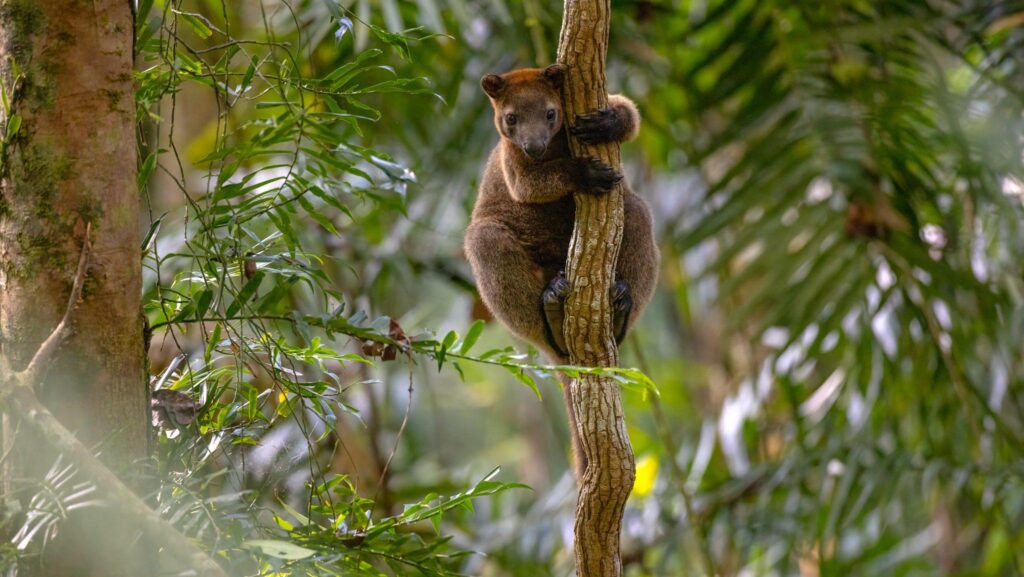
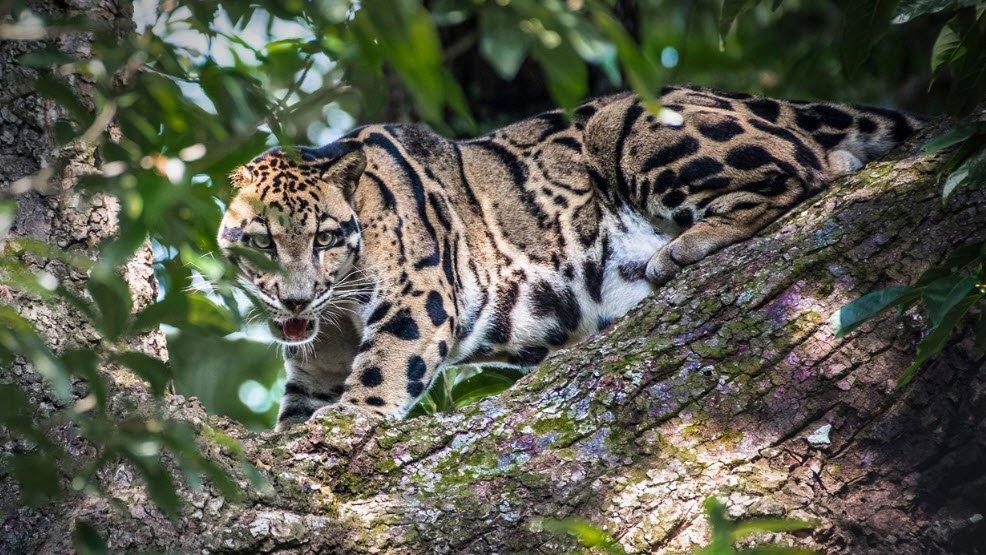
Forests may look similar from a distance, but they are actually some of the most diverse habitats on Earth. A cool North American woodland supports bears and elk, tropical South American forests echo with the calls of howler monkeys, and African rainforests shelter gorillas, cobras and enormous millipedes. In Asia, clouded leopards move almost invisibly through dense vegetation, while Australia’s rainforests are home to the remarkable Lumholtz’s tree-kangaroo.
What makes these animals especially fascinating is not simply their appearance. Each has developed behaviors, body structures or senses that help it survive where it lives.
Some are powerful predators. Others survive by camouflage, cooperation or patience. Some spend their lives high in the canopy, while others rarely leave the forest floor.
Here are 12 remarkable forest animals and the adaptations that make their lives extraordinary.
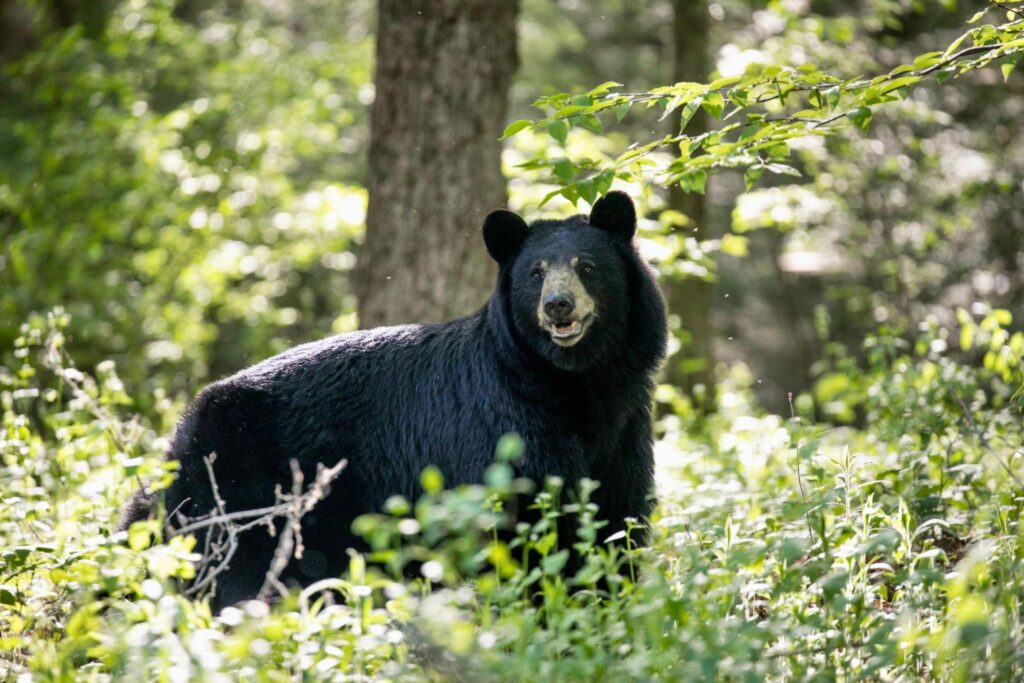
1. American Black Bear — The Forest Generalist
7
The American black bear (Ursus americanus) is one of North America’s most adaptable large mammals. Despite its name, individual black bears can be black, brown, cinnamon, blonde or other shades. The U.S. National Park Service describes them as the most common and widely distributed bear species in North America.
Black bears are omnivores and take advantage of whatever food is available. Their menu can include berries, grasses, insects, fish, nuts, carrion and other foods.
Their exceptional sense of smell is particularly important. Instead of depending entirely on eyesight, a bear can investigate scents from considerable distances and change its movements according to where food is available.
They are also surprisingly good climbers. Short, curved claws help them climb trees, an ability that can provide access to food and refuge.
During autumn, bears enter a period of intense feeding called hyperphagia, building energy reserves before winter denning.
The black bear’s greatest strength may therefore be adaptability. It can live in different forest environments because it isn’t dependent on one particular food source.
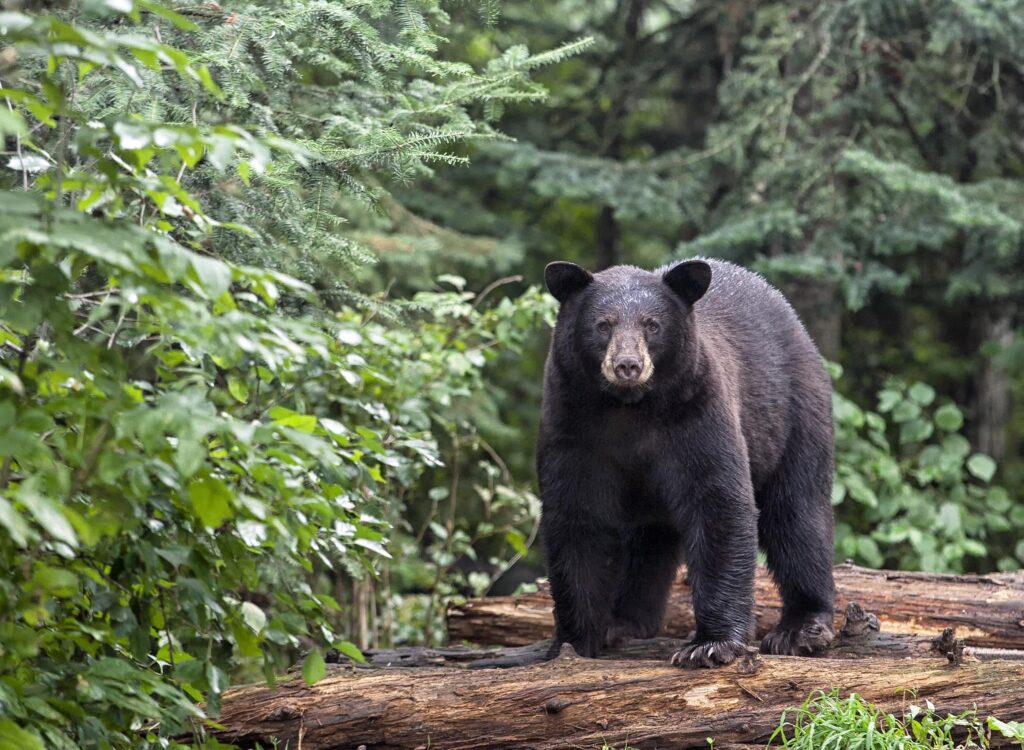
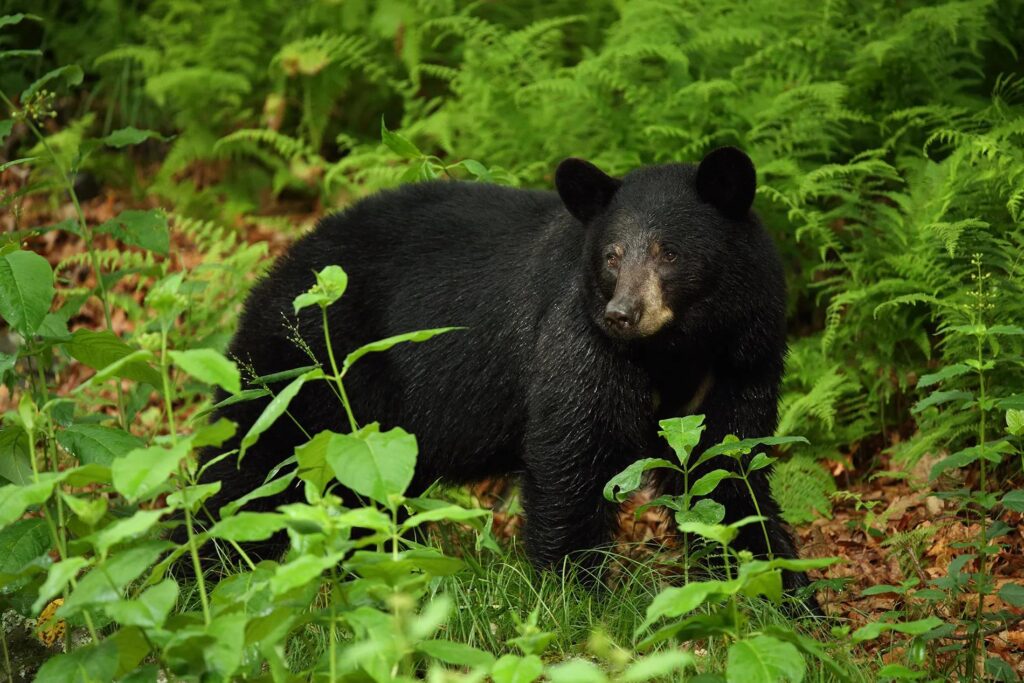
2. Black Howler Monkey — The Voice of the Rainforest
7
The black howler monkey (Alouatta caraya) may be easier to hear than see.
It is famous for its extraordinarily powerful call, which can travel long distances through forest vegetation. Smithsonian’s National Zoo describes black howlers as among the loudest terrestrial animals in the Western Hemisphere.
The species also displays a striking difference between males and females. Adult males have black fur, while females remain blond.
Their loud calls serve an important purpose. Howler groups do not necessarily need to constantly fight over territory. By announcing their presence, males can communicate with neighboring groups and help maintain spacing between troops.
This is an excellent example of energy-efficient communication.
The monkeys mainly eat leaves, flowers and fruit. Because leaves provide relatively low amounts of usable energy, howlers spend substantial periods resting rather than constantly traveling.
Their prehensile tails are also important. The tail can help them grip branches as they move through the canopy.
In the forest, being loud isn’t always a disadvantage.
For howler monkeys, it can be a way of avoiding unnecessary conflict.


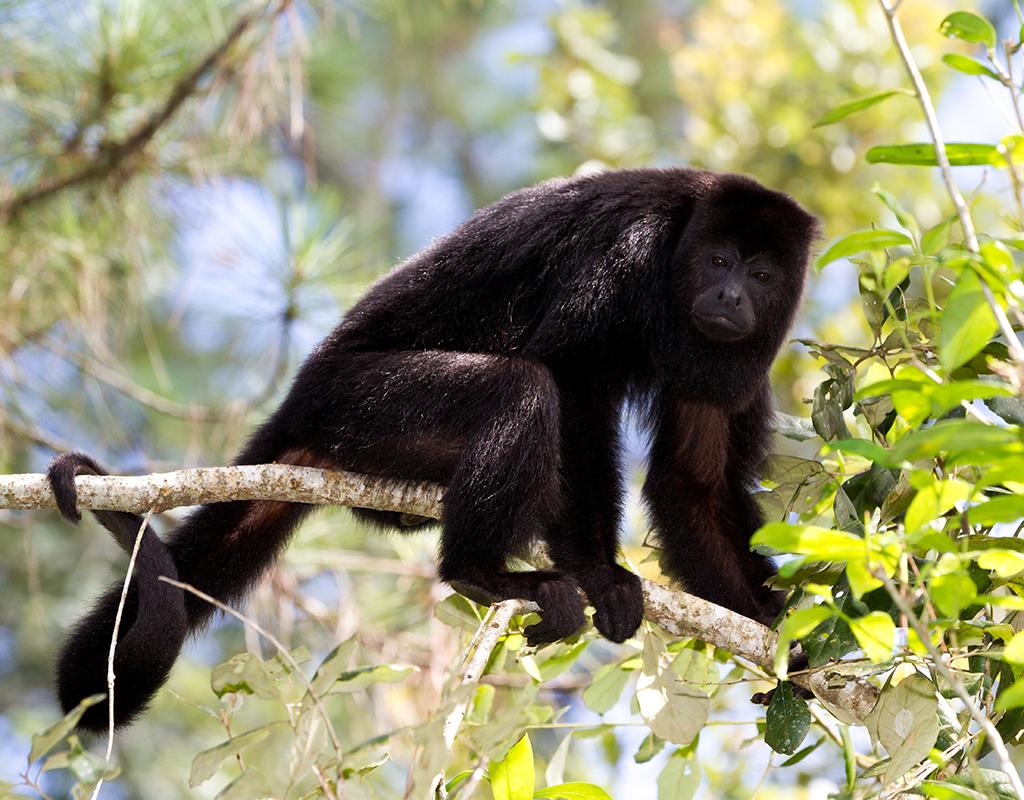
3. Black Woodpecker — The Forest’s Powerful Tree Driller
5
The black woodpecker (Dryocopus martius) is an impressive bird of mature European and Asian forests.
Its almost entirely black plumage is contrasted by a vivid red crown, particularly noticeable in males.
But its most important tool is its bill.
The bird can hammer into tree trunks while searching for insects and their larvae. Powerful neck muscles and a specialized skull help it withstand repeated impacts.
A large woodpecker is not simply eating insects.
It is also changing the forest.
When a woodpecker excavates a cavity, the resulting hole may later become a nesting or shelter site for other birds, mammals and insects.
This makes some woodpeckers important ecosystem engineers.
A mature forest with old trees, dead wood and insects provides the structural variety these birds need.
Their survival therefore depends on more than having trees—it depends on having the right kinds of trees.


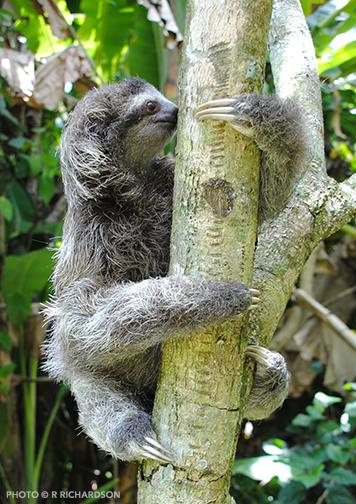
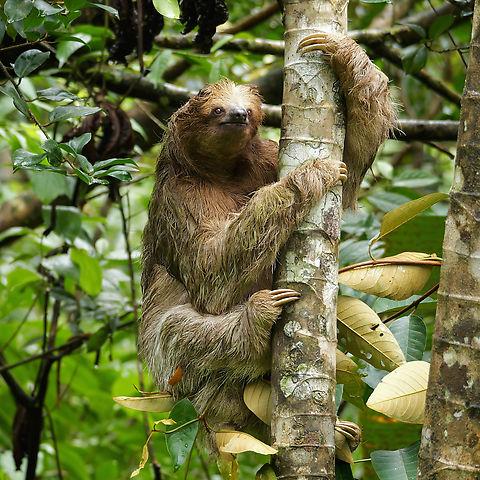
4. Brown-Throated Sloth — Master of the Slow Life
7
The brown-throated sloth (Bradypus variegatus) has built its entire lifestyle around conserving energy.
Instead of racing through the forest, it moves slowly among branches and spends much of its life suspended above the ground.
Its diet is dominated by leaves, which are abundant but relatively difficult to digest and low in energy.
Slow movement therefore makes sense.
Sloths also have long claws that function like natural hooks, allowing them to grip branches while hanging beneath the canopy.
Their fur can host algae and microorganisms, giving the coat a greenish appearance that may improve camouflage among leaves.
This relationship between sloth and forest is remarkably close.
From below, a resting sloth can be extremely difficult to spot.
The animal’s strategy is simple but effective:
move slowly, conserve energy and stay hidden.
5. Clouded Leopard — The Forest’s Acrobat
7
The clouded leopard (Neofelis nebulosa) is one of Asia’s most spectacular forest cats.
Its coat is covered with large cloud-shaped markings that break up its outline among leaves and branches.
But camouflage is only part of its extraordinary toolkit.
Clouded leopards are highly capable climbers. Their strong limbs, long tail and flexible ankles allow them to navigate branches and steep surfaces with impressive control.
A forest canopy can therefore become a hunting environment rather than simply a place to rest.
The species occupies forests across parts of South and Southeast Asia, although populations are affected by habitat loss and hunting.
Its survival demonstrates why connected forest habitat is so important.
A large predator needs enough space to find prey, move between territories and reproduce.
Protecting a clouded leopard means protecting much more than one beautiful cat.
It means protecting the forest ecosystem around it.


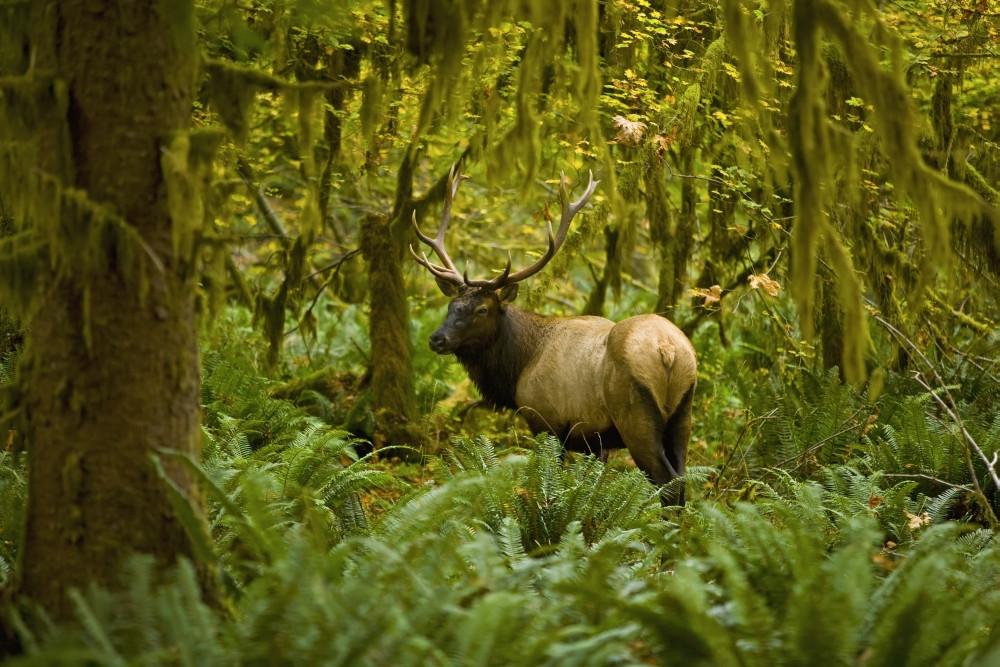
6. Elk — A Giant Shaped by Seasonal Forests
7
The elk is one of North America’s most recognizable large herbivores.
Adult males, known as bulls, develop enormous antlers each year. During the breeding season, bulls use vocalizations, posture and antler displays to compete for access to females.
But elk survival isn’t only about reproduction.
Their movements change with the seasons.
They may use forests for shelter while taking advantage of open areas and productive vegetation for feeding.
In mountain regions, snow can push elk toward lower elevations during winter, while spring and summer provide new vegetation at higher elevations.
This seasonal movement connects different habitats.
Elk also influence forests by grazing on vegetation and serving as prey for large carnivores.
A healthy elk population is therefore part of a much larger ecological network.

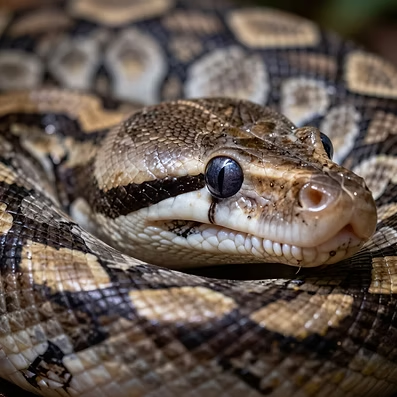
7. Forest Cobra — A Snake Comfortable in Several Worlds
6
The forest cobra (Naja melanoleuca) is a large venomous snake found across parts of sub-Saharan Africa.
Animal Diversity Web describes it as a highly adaptable species associated with forests, woodland, savanna and areas near rivers or streams. It can also climb and swim.
That versatility gives the snake access to a variety of habitats and prey.
When threatened, the cobra can raise the front of its body and spread its neck into the familiar cobra hood.
The display makes the snake appear larger and warns a potential attacker.
Forest cobras also have highly developed chemical senses. Like other snakes, they use their forked tongue to collect scent particles and transfer them to the Jacobson’s organ.
This helps them investigate their surroundings even when visibility is limited.
Their behavior illustrates how a snake can combine several sensory systems—vision, smell and vibration—to understand its environment.
8. Giant African Millipede — The Forest Floor’s Recycling Specialist
5
The giant African millipede (Archispirostreptus gigas) may look intimidating because of its hundreds of legs, but it is actually a gentle decomposer.
San Diego Zoo notes that large individuals can have hundreds of legs, although despite the name “millipede,” they do not normally have 1,000.
These animals feed primarily on dead and decaying plant material.
That makes them extremely useful to the forest.
Leaves and fallen wood contain nutrients that would otherwise remain locked inside organic material. Millipedes help break that material down, returning nutrients to the soil.
When threatened, a giant African millipede can curl into a protective coil. Its hard outer plates shield much of the body, while it can also release an unpleasant defensive fluid.
It is mainly nocturnal, emerging when temperatures are cooler and the forest floor is darker.
The millipede may not be a glamorous animal, but it performs one of the forest’s essential jobs:
recycling the forest’s dead material into new nutrients.
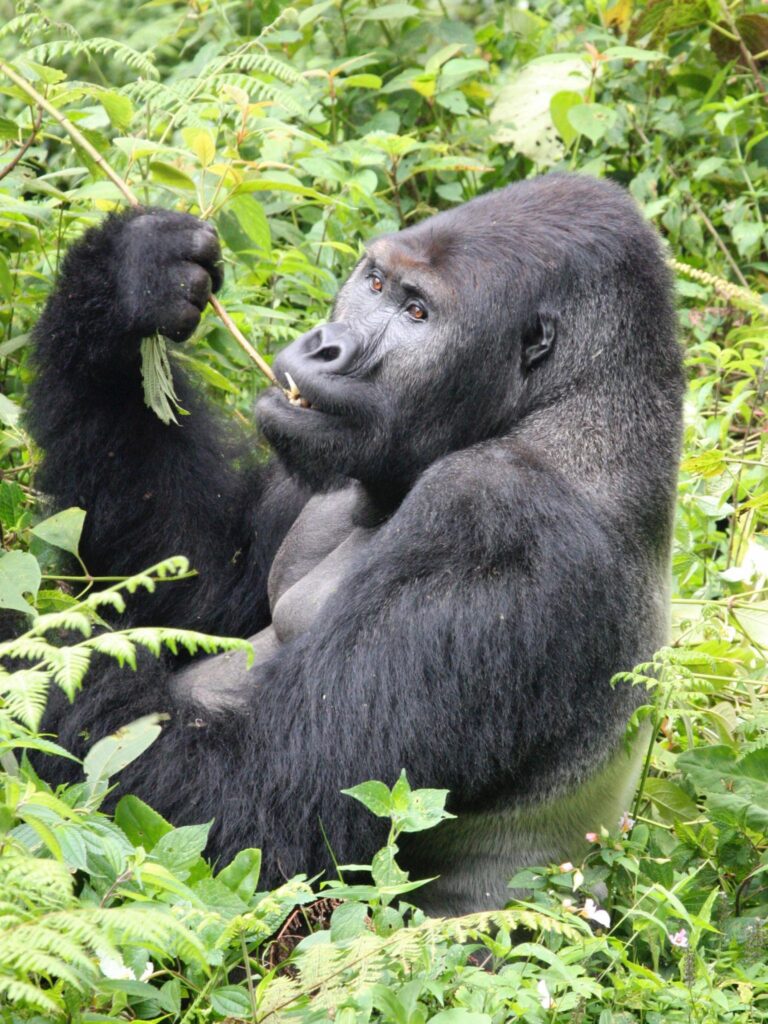
9. Gorilla — A Forest Engineer With a Strong Social Life
6
Gorillas are the largest living primates and inhabit equatorial forests in central and eastern Africa.
They are highly social animals, generally living in family groups led by a dominant adult male known as a silverback. WWF reports that gorilla groups can range from a few individuals to more than 50.
Their diet is mainly vegetarian, including stems, herbs, bark and fruit, although they may also consume insects such as termites.
Gorillas are important to forest ecosystems because they move seeds through their digestive systems and can create small openings in vegetation as they feed and travel.
This makes them more than forest residents.
They are also participants in shaping their habitat.
Their social behavior is equally fascinating. Family members maintain close relationships through grooming, communication and coordinated movement.
Gorilla conservation is especially important because habitat destruction, disease and poaching continue to threaten populations. At the same time, mountain gorilla recovery demonstrates that long-term conservation can produce meaningful results.

10. Great Hornbill — The Forest’s Flying Fruit Carrier
6
The great hornbill is one of Asia’s most spectacular forest birds.
Its enormous yellow-and-black bill and large casque make it instantly recognizable.
Despite the impressive appearance, the bird’s ecological role may be even more interesting.
Great hornbills eat fruit as well as other foods, and their movements can carry seeds away from the parent tree.
That makes them important seed dispersers in tropical forests.
Their nesting behavior is also unusual.
The female seals herself inside a tree cavity during incubation, leaving only a narrow opening through which the male can pass food.
The arrangement provides protection for the female and developing chick.
The great hornbill demonstrates that even reproduction can become closely linked to the architecture of a forest.
Old trees with suitable cavities are not simply scenery.
They can be essential breeding habitat.
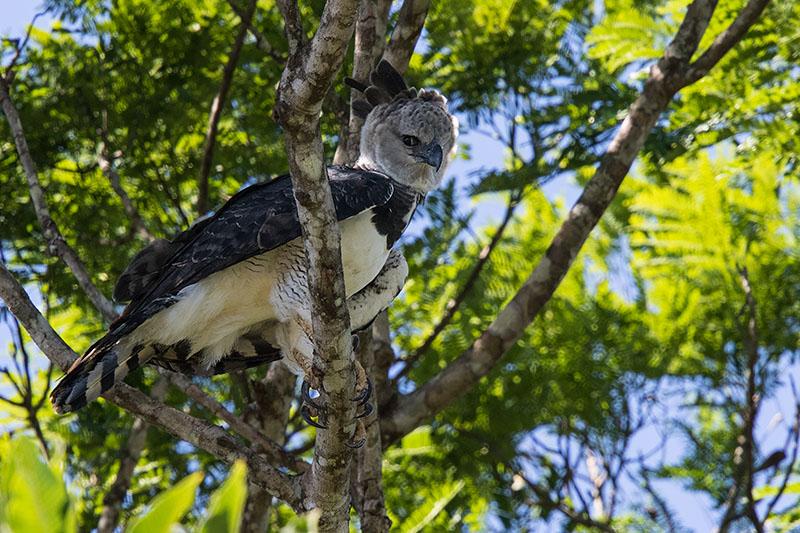
11. Harpy Eagle — A Powerful Predator of the Canopy
7
The harpy eagle (Harpia harpyja) is among the world’s largest and most powerful eagles.
It is a specialized predator of tropical forests, where it can hunt animals living in the canopy.
The Peregrine Fund notes that harpy eagles have exceptionally large rear talons, roughly comparable in size to the claws of a grizzly bear.
Unlike soaring eagles that depend on wide open spaces, harpy eagles are adapted to maneuver through forest.
Their relatively short wings and long tails help them steer between trees.
They can hunt from high perches and descend through vegetation after detecting prey.
Their enormous nests can also become impressive structures, built from large branches high in mature trees.
This creates an important conservation requirement.
A harpy eagle needs both prey and large trees.
Deforestation and shooting have been major threats to the species, particularly in parts of Central America.
Protecting large areas of mature forest is therefore essential to its future.
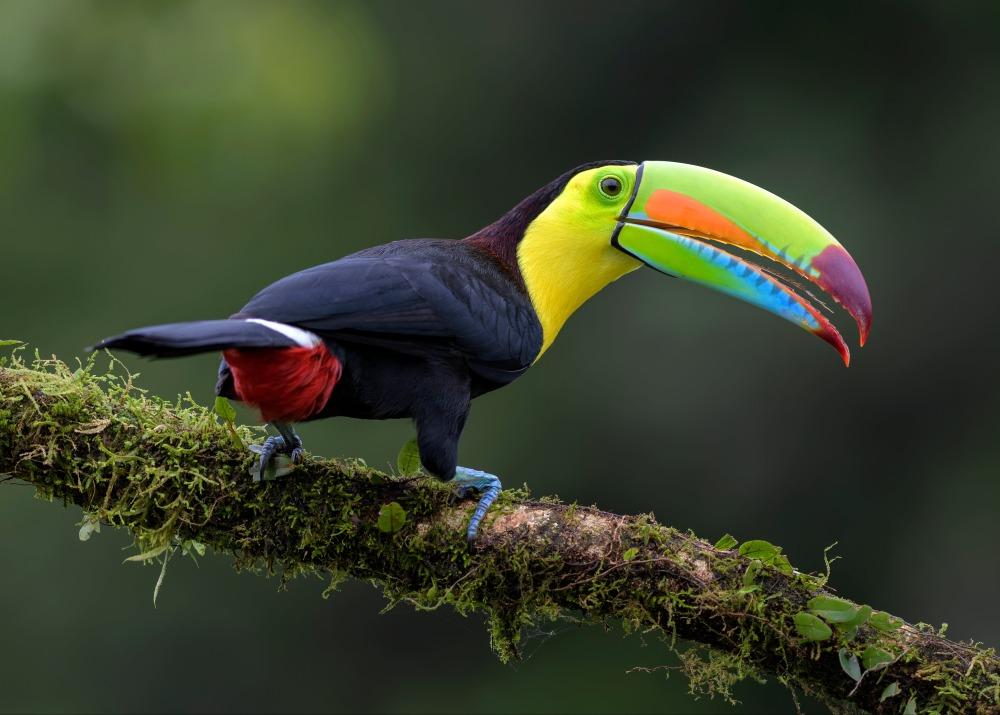
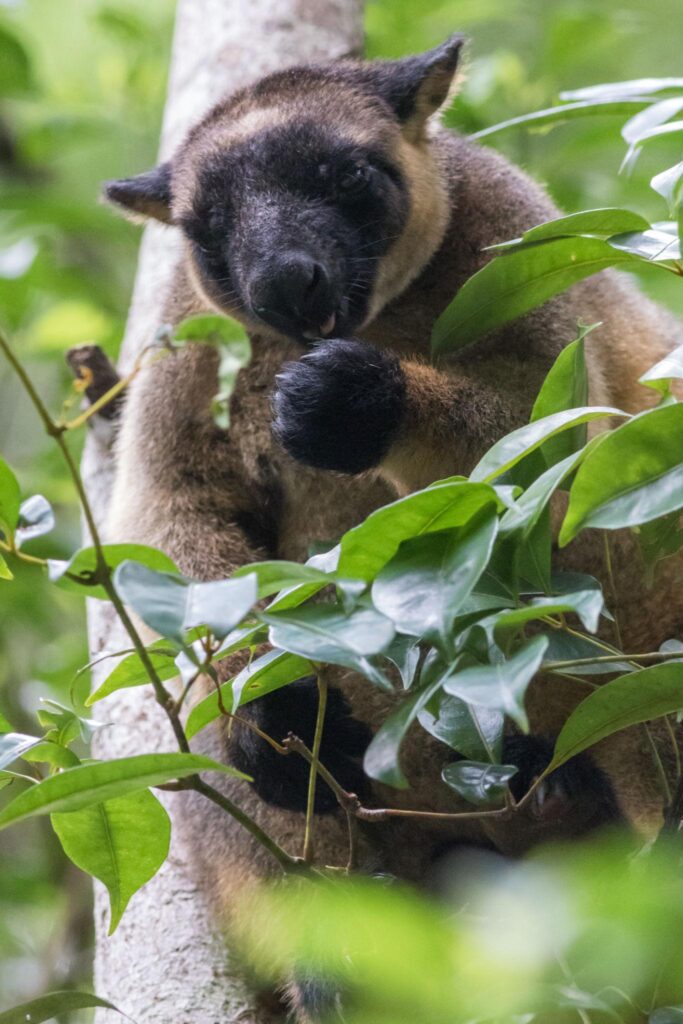
12. Keel-Billed Toucan and Lumholtz’s Tree-Kangaroo — Two Forest Specialists
6
The keel-billed toucan and Lumholtz’s tree-kangaroo live on opposite sides of the world, yet both demonstrate how forest animals can become highly specialized for life among trees.
The keel-billed toucan is famous for its enormous, colorful bill.
The bill looks heavy, but its lightweight structure makes it much more practical than its size suggests. Toucans use their bills to reach fruit on branches that might otherwise be difficult to access.
Fruit also makes them valuable seed dispersers.
The Lumholtz’s tree-kangaroo, meanwhile, is an unusual Australian marsupial that has adapted to climbing.
Unlike its terrestrial kangaroo relatives, it spends much of its time in rainforest trees.
Its compact body, strong limbs and long tail help it balance in an environment where falling can be dangerous.
The species occurs in tropical rainforest areas of northeastern Queensland.
The two animals demonstrate different versions of the same evolutionary principle:
the forest rewards animals that can make effective use of vertical space.
🌳 What These 12 Animals Have in Common
At first glance, a black bear, gorilla, millipede, eagle and tree-kangaroo appear to have almost nothing in common.
But look more closely and several patterns emerge.
Camouflage
Sloths and clouded leopards can blend into vegetation, making them harder for predators or prey to detect.
Specialized senses
Black bears depend heavily on smell, while snakes combine scent detection with other sensory systems.
Powerful communication
Black howler monkeys use exceptionally loud calls to communicate across the forest.
Energy conservation
Sloths and howler monkeys have diets that encourage economical movement and long periods of rest.
Forest engineering
Woodpeckers create cavities, gorillas influence vegetation and millipedes recycle dead plant material.
Canopy specialization
Harpy eagles, hornbills, toucans and tree-kangaroos all exploit different parts of the forest’s vertical structure.
These strategies show why forests are more than collections of trees.
They are three-dimensional ecosystems containing countless ecological niches.
🛡️ Why Forest Protection Matters
When a forest disappears, animals do not simply lose a place to live.
They can lose nesting trees, food sources, migration routes, breeding areas and relationships with other species.
The effects can spread throughout an ecosystem.
For example, protecting gorilla habitat also protects other plants and animals sharing Congo Basin forests. WWF describes gorillas as an umbrella species because conservation measures designed around them can benefit many other organisms.
Harpy eagles provide another example. They require mature forest and large nesting trees, meaning their protection encourages preservation of an entire forest structure.
Even an animal as small as a millipede has an ecological role. By processing decaying vegetation, it contributes to nutrient cycling on the forest floor.
This is why biodiversity conservation cannot focus only on the most famous animals.
A healthy forest needs all of its parts.


Final Thoughts
From the enormous American black bear to the tiny giant African millipede, forests support animals with an extraordinary range of lifestyles.
The black howler monkey turns sound into a communication network.
The black woodpecker transforms tree trunks into feeding grounds and nesting opportunities.
The brown-throated sloth survives through patience and energy conservation.
The clouded leopard turns the canopy into a hunting landscape.
The elk follows seasonal changes across forests and open country.
The forest cobra combines powerful venom with impressive sensory abilities.
The millipede quietly recycles the forest floor.
Gorillas shape vegetation while living within complex families.
Hornbills and toucans help move seeds through tropical forests.
The harpy eagle rules portions of the canopy.
And the Lumholtz’s tree-kangaroo has taken the familiar kangaroo body plan into the treetops.
These animals remind us that there is no single recipe for surviving in a forest.
Some species need strength.
Others need camouflage.
Some need extraordinary senses.
Others simply need the ability to conserve energy and wait.
Together, they form the living machinery of the world’s forests.
Protecting these habitats means protecting not just individual species, but the intricate relationships that allow entire ecosystems to function.
📸 Image SEO Information
For your WordPress article, I recommend 7 real wildlife photographs rather than trying to place 12 separate images. Each image can represent a group of animals while keeping the page visually clean.
Image 1 — North American Forests
Animals: American black bear + elk
Alt text:American black bear and elk living in North American forest habitat
Filename:black-bear-elk-forest-wildlife.jpgImage 2 — South American Forest
Animals: Black howler monkey + brown-throated sloth
Alt text:Black howler monkey and brown-throated sloth in tropical rainforest
Filename:howler-monkey-sloth-rainforest.jpgImage 3 — Asian Forest
Animals: Clouded leopard + great hornbill
Alt text:Clouded leopard and great hornbill in Asian tropical forest
Filename:clouded-leopard-great-hornbill.jpgImage 4 — African Forest
Animals: Gorilla + forest cobra
Alt text:Gorilla and forest cobra representing African forest wildlife
Filename:gorilla-forest-cobra-africa.jpgImage 5 — Forest Floor
Animal: Giant African millipede
Alt text:Giant African millipede moving across the rainforest floor
Filename:giant-african-millipede-forest.jpgImage 6 — Forest Canopy
Animals: Harpy eagle + keel-billed toucan
Alt text:Harpy eagle and colorful toucan in tropical forest canopy
Filename:harpy-eagle-toucan-canopy.jpgImage 7 — Australian Rainforest
Animal: Lumholtz’s tree-kangaroo
Alt text:Lumholtz's tree-kangaroo in Queensland rainforest
Filename:lumholtz-tree-kangaroo-rainforest.jpgImportant: The image-search results are photographs of real animals, but that does not automatically mean they are free to republish. Check the photographer, agency and license before uploading any image to WordPress. The safest choices are public-domain or appropriately licensed photographs with required attribution.
🔎 WordPress SEO Package
New SEO Title:
12 Remarkable Forest Animals and the Secrets Behind Their Survival
Alternative Title:
12 Amazing Forest Animals With Extraordinary Survival Adaptations
Focus Keyword:
forest animalsSecondary Keywords:
forest animals 2026amazing forest animalswild forest animalsrare forest animalsunique forest wildlifeforest animal factsrainforest animalsNorth American forest animalsAfrican forest animalsAsian forest animalsAustralian rainforest animalsMeta Description:
Discover 12 remarkable forest animals, from black bears and gorillas to clouded leopards, harpy eagles and tree-kangaroos, and learn their amazing survival strategies.Short Description / Excerpt:
Explore 12 remarkable forest animals from around the world and discover how camouflage, powerful senses, social behavior and specialized adaptations help them survive.Category:
WildlifeSubcategory:
Forest AnimalsTags:
Forest Animals, Wildlife, Forest Wildlife, Rainforest Animals, American Black Bear, Black Howler Monkey, Black Woodpecker, Brown-Throated Sloth, Clouded Leopard, Elk, Forest Cobra, Giant African Millipede, Gorilla, Great Hornbill, Harpy Eagle, Keel-Billed Toucan, Lumholtz's Tree-Kangaroo, Animal Facts, Rare Animals, Unique Animals, Wildlife 2026Suggested URL Slug:
12-remarkable-forest-animals-2026Featured Image Alt Text:
Twelve remarkable forest animals from around the world in their natural habitatsFeatured Image Title:
12 Remarkable Forest Animals 2026Recommended Featured Image:
1200 × 675 pxRecommended Article Schema:
ArticleAuthor:
World Animals TVUpdated:
September 2026Suggested internal links:
Amazon Rainforest Animals•Rare Animals•Rainforest Wildlife•Amazing Birds•Wild Cats•Endangered Animals•Animal Adaptations -

6 Extraordinary Animals That Look Like They Belong on Another Planet
6 Extraordinary Animals That Look Like They Belong on Another Planet

Nature has produced animals in almost every imaginable shape and size. Some are built for speed, others for camouflage, and some have developed such unusual characteristics that they seem almost impossible.
A giant lizard stalks dry islands in Indonesia. A flightless parrot walks through the forests of New Zealand at night. A primate spends much of its life grazing on grass in the Ethiopian highlands. On the volcanic Galápagos Islands, a lizard dives into the ocean to eat algae. New Zealand’s mysterious kiwi searches through leaf litter after dark, while a brilliant golden frog carries one of the most powerful natural toxins known in the animal kingdom.
These animals may live thousands of kilometers apart, but they share something important: each has evolved extraordinary solutions to the challenges of survival.
This 2026 wildlife guide explores six of the world’s most fascinating animals and the behaviors that make them so unusual.
1. Komodo Dragon — The Giant Lizard That Hunts With Patience


7
The Komodo dragon (Varanus komodoensis) is one of the most intimidating reptiles alive today. It is the largest living lizard and can reach around 3 meters in length and more than 130 kilograms. Wild Komodo dragons are found on several Indonesian islands, including Komodo, Rinca and parts of Flores.
Despite its enormous size, the Komodo dragon does not need to chase everything it eats.
Patience is one of its greatest weapons.
The dragon can wait among vegetation for an opportunity to attack. When suitable prey comes close, it can move rapidly, using powerful legs, claws and sharp, serrated teeth.
Its hunting system is particularly remarkable. Komodo dragons possess venom glands, and their bites can combine tissue damage with toxins that promote blood loss and shock. They can also use their exceptional sense of smell to locate carrion or follow wounded prey.
This combination makes the Komodo dragon an efficient predator and scavenger.
A surprising survival strategy
Young Komodo dragons face a completely different world from adults. They are vulnerable to larger dragons, so juveniles spend considerable time in trees, where their smaller bodies allow them to climb more easily.
As they grow, their lifestyle changes.
Eventually, the young lizard becomes a huge ground-dwelling predator.
Habitat
Komodo dragons live in tropical forests, savannas and other habitats across Indonesia’s Lesser Sunda Islands. Their environment can become extremely dry during parts of the year, making water and food valuable resources.
Image Alt Text:
Wild Komodo dragon walking through dry forest in Indonesia
2. Kākāpō — The Parrot That Cannot Fly
6
Few birds are as unusual as the kākāpō (Strigops habroptilus).
It is a large, green, flightless parrot with an owl-like face, strong legs and a distinctive waddling walk. It is also nocturnal.
And there is remarkable news about the species in 2026.
On September 1, 2026, New Zealand’s Department of Conservation announced that the official kākāpō population had reached 325 birds, including 90 chicks from the 2026 breeding season. This was described as a recovery-era high and the first time the population had exceeded 300 in roughly 75 years.
That makes 2026 an especially significant year for this extraordinary bird.
Why did the kākāpō become flightless?
New Zealand’s wildlife evolved for millions of years in an environment with relatively few land predators.
The kākāpō evolved toward a ground-based lifestyle.
Instead of flying away from danger, it relies on camouflage, hiding and its ability to move through dense vegetation.
Its green feathers blend remarkably well with forest plants.
A bird that comes alive at night
During daylight hours, kākāpō generally rest in ground or treetop roosts. At night, they become active.
They walk through forests searching for plant material, fruit, seeds and other food.
Males also have one of the strangest courtship behaviors among birds.
They gather at traditional display areas and produce deep booming calls to attract females.
The kākāpō is also the world’s only known lek-breeding parrot.
Conservation success
Kākāpō recovery depends on predator-free islands and carefully managed sanctuaries because introduced mammals such as rats, cats and stoats historically devastated the species.
Modern conservation teams monitor birds with transmitters, manage nests and provide supplementary food when necessary. In 2026, scientists have also been using high-resolution aerial imagery and deep-learning technology to identify important tree species in kākāpō habitat.
The species’ progress shows what long-term conservation can accomplish.


Image Alt Text:
Kākāpō flightless green parrot resting in New Zealand forest
3. Gelada — The Grass-Eating Primate With a Dramatic Chest
7
The gelada (Theropithecus gelada) is sometimes casually called a “gelada baboon,” although it is a distinct primate.
It lives in the highlands of Ethiopia, where steep cliffs and open grasslands create a very different environment from the tropical forests where many other primates live.
One of its most unusual characteristics is its diet.
A primate that prefers grass
Most people picture monkeys and baboons eating fruits, insects or other varied foods.
Geladas are specialists.
They spend much of their day feeding on grasses and other vegetation, using their hands to pull food toward their mouths. Smithsonian describes them as unusual among primates because they graze primarily on grass.
Their bodies and behavior are closely connected to this lifestyle.
Instead of spending most of their time high in trees, they spend hours on the ground.
The red chest
Another unforgettable feature is the bare patch of skin on the chest.
In males and females, the coloration can communicate information about social and reproductive condition. Males may have particularly vivid red coloration.
The markings give the animal a striking appearance and are one reason the species is sometimes nicknamed the “bleeding-heart” baboon.
A highly social animal
Geladas live in complex social groups.
Large gatherings can contain hundreds of animals, while smaller social units form the core of their relationships.
Communication is extremely important.
Geladas use many different calls, facial expressions and body signals to maintain social relationships, warn others and manage conflicts.
At night, the animals retreat toward steep cliffs.
These rocky sleeping sites provide protection from predators and make it difficult for large predators to approach them.
Their survival strategy is therefore based on both social cooperation and geography.


Image Alt Text:
Gelada primate with red chest in Ethiopian highlands
4. Marine Iguana — The Lizard That Goes Underwater
7
Imagine seeing a lizard walk toward the ocean and disappear beneath the waves.
That is exactly what the marine iguana does.
The marine iguana (Amblyrhynchus cristatus) is found only in the Galápagos Islands and is the only lizard in the world adapted to feed in the sea.
This makes it one of the clearest examples of evolution adapting an animal to an extraordinary food source.
Diving for dinner
Marine iguanas feed primarily on marine algae.
They can dive into cold seawater and scrape algae from rocks.
Their flattened tails act like paddles, helping them move through the water, while their claws allow them to grip rocks.
But the ocean presents another problem:
cold temperatures.
After feeding, marine iguanas return to land and bask in the sun to restore their body temperature.
The salt problem
Eating marine algae means swallowing salt.
Marine iguanas have special salt glands associated with their nostrils that help remove excess salt from their bodies.
You may sometimes see one sneeze or forcefully expel salty material near the nose.
It isn’t simply a strange behavior.
It is part of the animal’s adaptation to marine life.
An extraordinary response to El Niño
Food availability can change dramatically during powerful El Niño events.
Marine iguanas can suffer severe food shortages when ocean conditions reduce the growth of algae.
Researchers have documented an extraordinary response: some adults can actually shrink in length during severe shortages and later grow again when food becomes abundant.
That makes the marine iguana one of the most unusual vertebrates when it comes to coping with environmental changes.
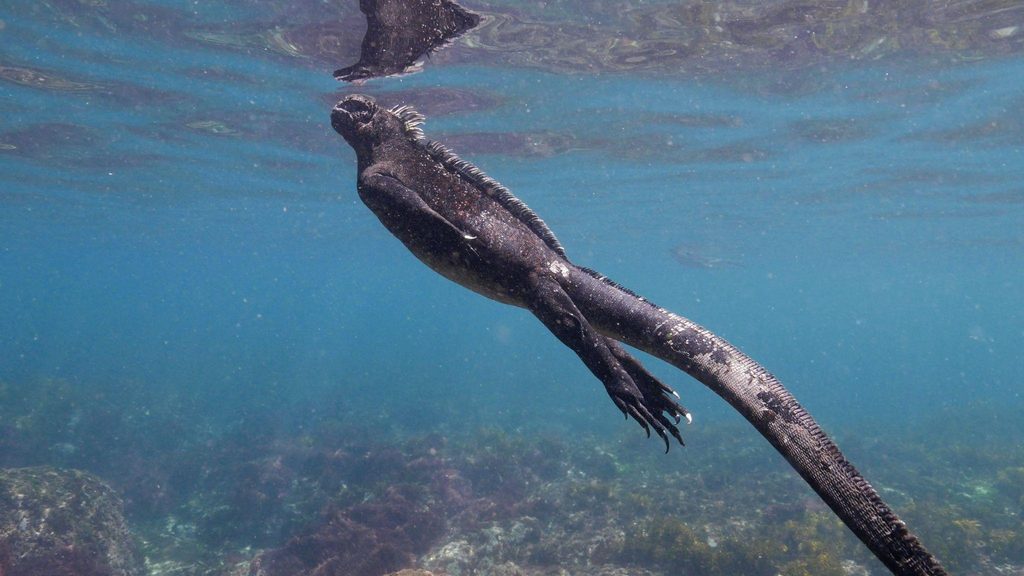
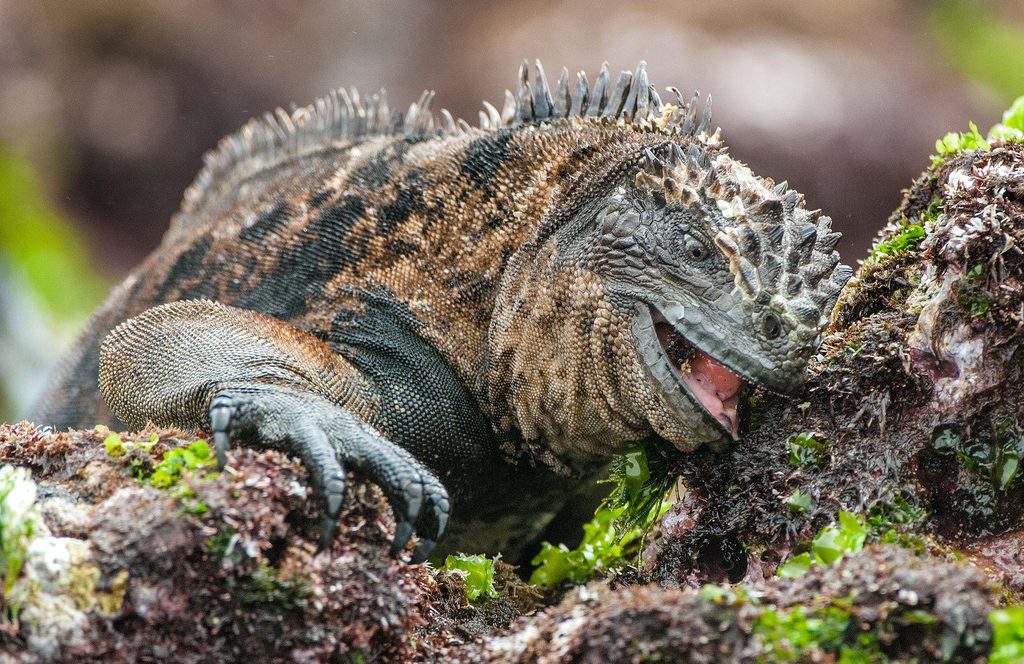
Image Alt Text:
Marine iguana resting on volcanic rocks beside Galapagos ocean
5. Kiwi — New Zealand’s Nocturnal Bird With Nostrils at the End of Its Bill
6
The kiwi is one of New Zealand’s most recognizable animals.
It is also one of the strangest birds alive.
Kiwi cannot fly. Their feathers are loose and hair-like, their wings are extremely reduced and they have strong legs.
But their most unusual feature may be their bill.
Unlike most birds, kiwi have nostrils located near the tip of the bill.
This gives them an exceptional ability to investigate scents in the soil.
A bird that hunts like a mammal
Kiwi are generally active at night.
They walk through forest floors and use their bills to probe leaf litter and soil while searching for insects, worms and other small organisms.
Their strong legs help them move through dense vegetation.
Instead of flying from tree to tree, the kiwi has become a ground specialist.
A huge egg
For its body size, the kiwi produces an unusually large egg.
The chick that emerges is already feathered and relatively independent compared with many other birds.
New Zealand’s Department of Conservation reports that kiwi chicks leave the nest to feed at about five days old and are not fed by their parents.
Why kiwi need protection
Introduced predators are a major threat.
Stoats are especially dangerous to chicks, while dogs can kill adult kiwi.
New Zealand’s conservation programs use predator control, fenced sanctuaries, offshore islands and community-led projects to protect populations.
The kiwi is therefore much more than a cute national symbol.
It represents an entire conservation effort to protect New Zealand’s unique wildlife.

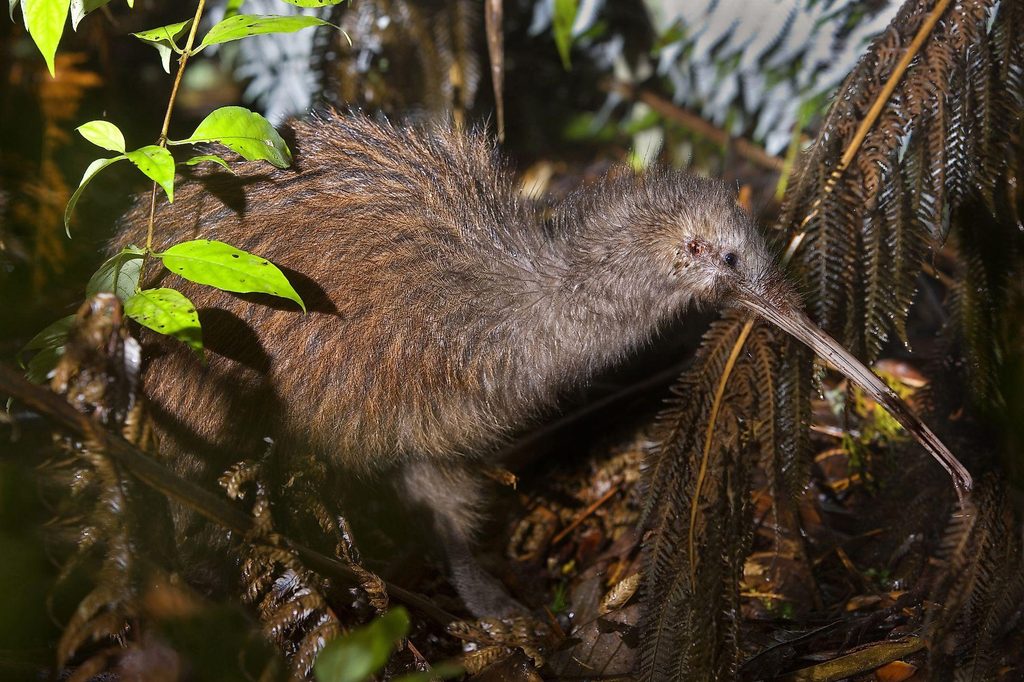
Image Alt Text:
Brown kiwi searching through forest leaf litter in New Zealand
6. Golden Poison Frog — A Tiny Animal With a Powerful Defense
6
The golden poison frog (Phyllobates terribilis) may look harmless because of its tiny size.
It is not.
This brilliantly colored frog is native to humid rainforest environments in Colombia and is regarded as one of the most toxic frogs known.
Its bright yellow coloration is an example of warning coloration, signaling potential predators that attacking it could be dangerous.
Smithsonian’s National Zoo explains that the golden frog is the most toxic of the documented poison-arrow frog species and produces the alkaloid toxin batrachotoxin.
Where does the poison come from?
An especially interesting mystery surrounds its toxicity.
Golden poison frogs acquire their toxins through their natural diet.
In human care, frogs fed a different diet do not develop the same toxic skin chemistry.
This suggests that the frog’s extraordinary chemical defense is closely connected to what it eats in the wild.
A bright warning
The frog doesn’t need to hide.
Instead, its bright coloration can advertise its toxicity.
This is called aposematic coloration.
Predators that learn to associate the bright colors with an unpleasant or dangerous experience may avoid similar-looking frogs in the future.
Why tiny doesn’t mean defenseless
The golden poison frog demonstrates one of nature’s most interesting principles:
survival doesn’t always depend on size.
A tiny animal can discourage predators through chemistry rather than strength.
That is an extraordinary evolutionary solution.

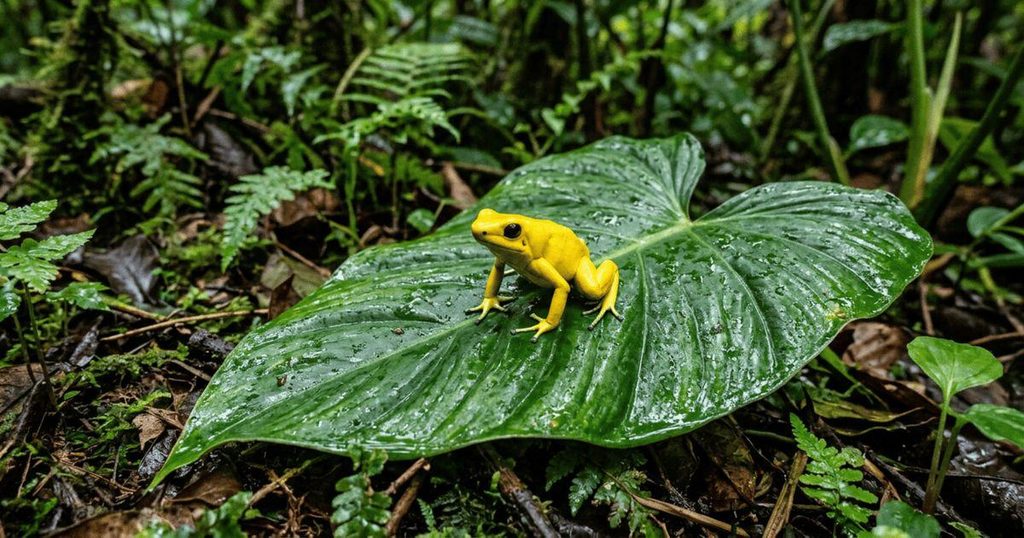
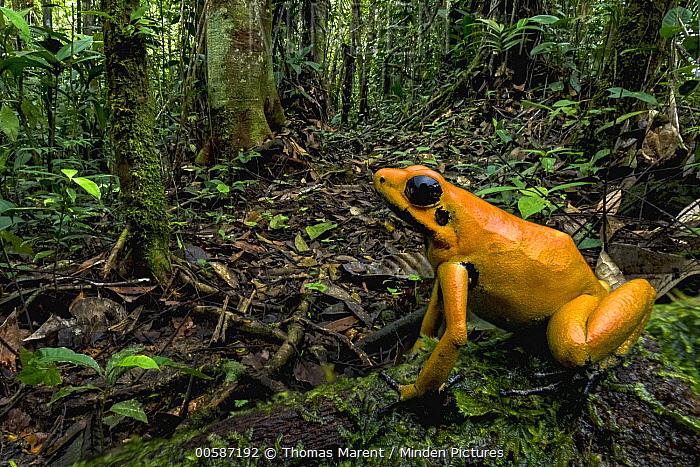
Image Alt Text:
Golden poison frog Phyllobates terribilis in Colombian rainforest
🌎 Six Animals, Six Extraordinary Survival Strategies
These six animals demonstrate how different environments can produce radically different solutions to survival.
Animal Environment Extraordinary Adaptation Komodo dragon Indonesian islands Venom, powerful bite and patient ambush hunting Kākāpō New Zealand forests Flightlessness, nocturnal lifestyle and camouflage Gelada Ethiopian highlands Grass-based diet and complex social behavior Marine iguana Galápagos Islands Diving into the ocean to feed on algae Kiwi New Zealand forests Nocturnal ground foraging and highly sensitive bill Golden poison frog Colombian rainforest Powerful chemical defense and warning coloration What makes these animals so fascinating is that none of them is simply “weird” by accident.
Their unusual characteristics have practical purposes.
The Komodo dragon’s powerful hunting system helps it exploit large prey.
The kākāpō’s ground-based lifestyle developed in an environment where flying was less important.
The gelada’s teeth, hands and social behavior suit its grassland existence.
The marine iguana transformed a terrestrial lizard body into an animal capable of exploiting marine algae.
The kiwi became a nocturnal ground forager.
And the golden poison frog developed an extraordinary chemical defense.
🔬 What These Animals Teach Us About Evolution
Evolution doesn’t have a single design plan.
Instead, animals respond to the pressures of their individual environments over countless generations.
An island without many mammalian predators can produce a flightless parrot.
A volcanic island surrounded by nutrient-rich ocean water can produce a swimming lizard.
A highland landscape covered in grass can favor a primate that spends hours grazing.
A rainforest full of predators can favor an animal that advertises its toxicity with brilliant colors.
This is why isolated ecosystems are so scientifically important.
When populations become separated by mountains, oceans, islands or changing habitats, they can follow different evolutionary paths.
Eventually, those differences can produce animals that seem completely unlike their relatives.
🛡️ Why Conservation Matters in 2026
Several of the animals in this article face serious conservation challenges.
The kākāpō is classified as critically threatened in New Zealand, but its recovery provides one of the most encouraging wildlife stories of 2026. The population reached 325 birds on September 1, 2026, after 90 chicks from the year’s breeding season were added to the official count.
Kiwi also remain vulnerable to introduced predators, while marine iguanas face environmental pressures including invasive species, pollution and climate-related changes.
The golden poison frog illustrates another conservation challenge.
Amphibians around the world are vulnerable to habitat loss and disease. Related golden frog conservation programs demonstrate how scientists are increasingly using captive breeding, disease research and carefully managed reintroduction efforts to protect endangered amphibians.
Protecting unusual animals means protecting the environments that made their unusual adaptations possible.
🌿 Final Thoughts
The natural world is full of animals that challenge our expectations.
The Komodo dragon looks like a survivor from the age of dinosaurs.
The kākāpō is a parrot that gave up flight and became a nocturnal forest wanderer.
The gelada is a primate that spends much of its life eating grass.
The marine iguana is a lizard that dives into the ocean.
The kiwi is a bird that searches for food on the ground at night.
And the golden poison frog carries an extraordinary chemical defense inside a body smaller than many people’s palms.
Their differences are exactly what make them valuable.
Every strange body shape, unusual behavior and specialized survival technique tells a story about the environment in which an animal evolved.
And in 2026, the story of wildlife conservation is still being written.
The recovery of the kākāpō shows that determined conservation can make a measurable difference. At the same time, the threats facing many other unusual species remind us that protection cannot stop.
The strangest animals on Earth are not mistakes of nature. They are masterpieces of adaptation—and each one is worth protecting.
📸 IMAGE SEO PACKAGE
1. Komodo Dragon
Alt Text:
Wild Komodo dragon walking through dry forest in Indonesia
Image Title:Komodo Dragon Wildlife 2026
Filename:komodo-dragon-wildlife-2026.jpg2. Kākāpō
Alt Text:
Kākāpō flightless green parrot resting in New Zealand forest
Image Title:Kakapo New Zealand Wildlife 2026
Filename:kakapo-new-zealand-2026.jpg3. Gelada
Alt Text:
Gelada primate with red chest in Ethiopian highlands
Image Title:Gelada Ethiopian Highlands Wildlife
Filename:gelada-ethiopia-wildlife-2026.jpg4. Marine Iguana
Alt Text:
Marine iguana resting on volcanic rocks beside Galapagos ocean
Image Title:Marine Iguana Galapagos Wildlife
Filename:marine-iguana-galapagos-2026.jpg5. Kiwi
Alt Text:
Brown kiwi searching through forest leaf litter in New Zealand
Image Title:Kiwi Bird New Zealand Wildlife 2026
Filename:kiwi-bird-new-zealand-2026.jpg6. Golden Poison Frog
Alt Text:
Golden poison frog Phyllobates terribilis in Colombian rainforest
Image Title:Golden Poison Frog Colombia Wildlife
Filename:golden-poison-frog-colombia-2026.jpgFeatured Image
Alt Text:
Six extraordinary animals including Komodo dragon, kakapo, gelada, marine iguana, kiwi and golden poison frog
Filename:six-extraordinary-animals-2026.jpgImage licensing note: The image-search results above are examples of real wildlife photographs, but many are copyrighted. Before downloading and uploading any photograph to your website, check its license and attribution requirements. For a commercial website, use properly licensed images.
6 Extraordinary Animals That Look Like They Belong on Another Planet | 2026
Meta Description: Discover six extraordinary animals from around the world: Komodo dragon, kākāpō, gelada, marine iguana, kiwi and golden poison frog, with their unique habitats, behaviors and survival adaptations.
Focus Keyword:
unique animals in the world 2026Secondary Keywords:
strange animals 2026, unusual animals, rare animals, Komodo dragon, kakapo, gelada, marine iguana, kiwi bird, golden poison frog, unique wildlife, endangered animals, amazing animal adaptationsCategory: Wildlife
Subcategory: Rare & Unique Animals
Tags:
Komodo Dragon, Kākāpō, Gelada, Marine Iguana, Kiwi, Golden Poison Frog, Unique Animals, Strange Animals, Rare Wildlife, Endangered Animals, Wildlife 2026, Animal Facts, Amazing Animals, Conservation, World AnimalsSuggested URL Slug:
6-extraordinary-unique-animals-2026Featured Image Alt Text:
Six extraordinary animals including a Komodo dragon, kakapo, gelada, marine iguana, kiwi and golden poison frog -

Explore Amazon Animals
Exploring Endangered Species in the Amazon Rainforest

Category: Amazon Wildlife & Conservation
Tags: Amazon rainforest, endangered species, Amazon wildlife, wildlife conservation, rainforest animals, endangered animals, Amazon biodiversity, jaguar, giant armadillo, tapir, harpy eagle, spider monkey
Focus Keyphrase: Endangered species in the Amazon rainforest
Suggested URL Slug:endangered-species-amazon-rainforest
Meta Description: Explore endangered and threatened wildlife in the Amazon rainforest and discover how habitat loss, hunting, climate change and conservation efforts are shaping their future.
Exploring Endangered Species in the Amazon Rainforest: Wildlife Fighting to Survive
The Amazon rainforest is one of the greatest wildlife habitats on Earth.
Behind its walls of green vegetation are rivers, wetlands, forests and enormous tree canopies supporting thousands of species. Some are familiar to people around the world, while others are so secretive that scientists rarely see them.
But the Amazon’s incredible biodiversity is facing growing pressure.
Deforestation, habitat fragmentation, illegal hunting, pollution, fires and climate change can make survival increasingly difficult for wildlife.
The International Union for Conservation of Nature, or IUCN, uses categories such as Vulnerable, Endangered and Critically Endangered to describe different levels of extinction risk.
In this article, we explore several remarkable Amazon species and the challenges they face.
1. The Jaguar: The Ghost of the Amazon
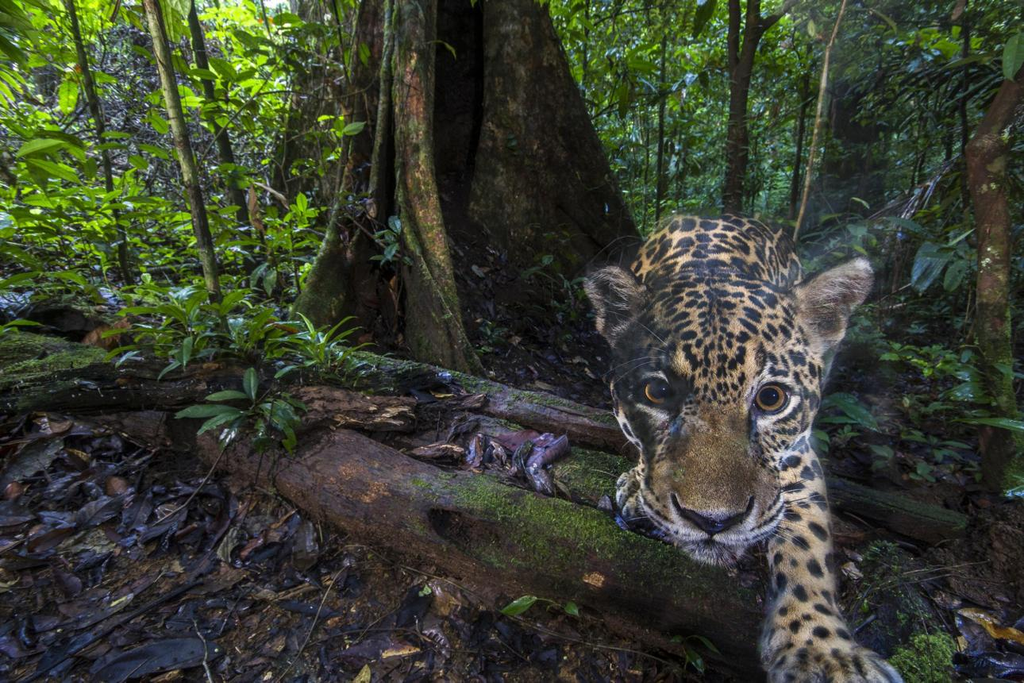
Few animals represent the Amazon more powerfully than the jaguar.
With its golden coat and dark rosettes, this large cat is one of the rainforest’s top predators. Jaguars need extensive territories where they can find prey, water and places to reproduce.
The problem is that forests are increasingly divided by roads, agriculture, mining and other human activities.
A jaguar may survive in one isolated patch of forest, but fragmented habitat can make movement and reproduction more difficult.
Protecting connected forests is therefore essential.
Camera traps have become an important conservation tool because they allow researchers to document jaguars without constantly disturbing them. Amazon Conservation says its monitoring programs have captured thousands of wildlife images and documented threatened and vulnerable species across the western Amazon.
Picture 1 — Alt Text: “Jaguar walking through dense Amazon rainforest habitat”
2. The Giant Armadillo: A Rare Forest Engineer

The giant armadillo is one of the Amazon’s most unusual mammals.
It is enormous compared with other armadillo species and possesses powerful claws designed for digging.
Yet despite its size, it is difficult to see.
Giant armadillos are generally solitary and can spend much of their time away from human observers.
Their digging behavior also gives them an ecological role beyond their own survival. Burrows can provide shelter for other animals, meaning one armadillo can indirectly create habitat for several other species.
Habitat destruction is a major concern because these animals need large areas of suitable forest.
Protecting remote forest landscapes can therefore benefit the giant armadillo and many other species living alongside it.
Picture 2 — Alt Text: “Giant armadillo searching for food on the Amazon rainforest floor”
3. The Lowland Tapir: A Giant Seed Disperser
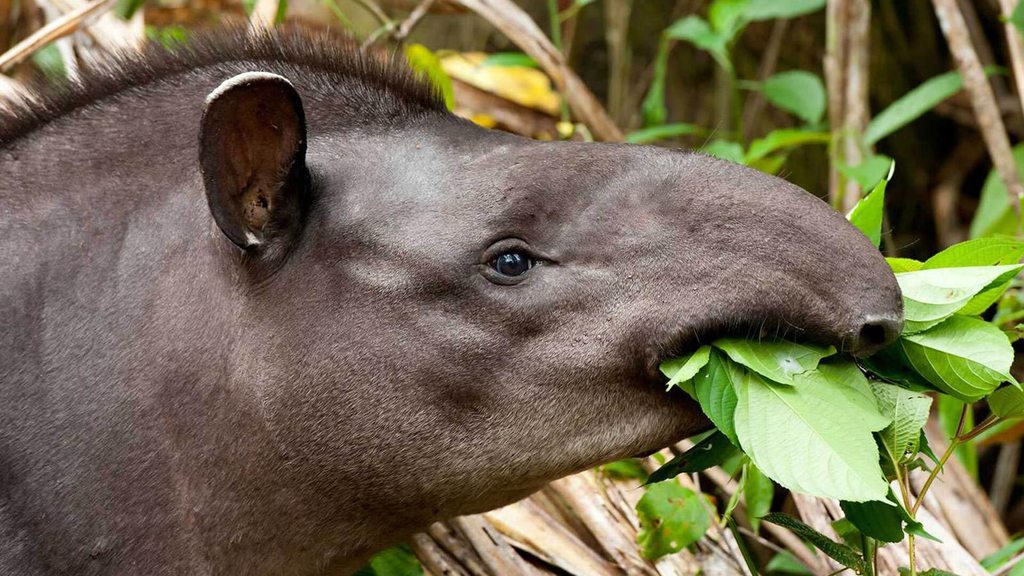
The lowland tapir may look slow and peaceful, but it plays an important role in the Amazon ecosystem.
Sometimes described as a forest gardener, the tapir eats large quantities of vegetation and fruit.
As it travels through the forest, it can transport seeds from one location to another.
This makes the animal part of the rainforest’s natural regeneration system.
Tapirs also use rivers and other water sources, making healthy forest and freshwater environments important to their survival.
When forests become fragmented or heavily disturbed, tapirs can lose access to important feeding and shelter areas.
Protecting large connected habitats is therefore one of the most important ways to help them.
Picture 3 — Alt Text: “Lowland tapir foraging beside a river in the Amazon rainforest”
4. The Harpy Eagle: A Predator of the Canopy

Far above the forest floor, another threatened Amazon icon watches from the trees.
The harpy eagle is among the largest and most powerful eagles in the Americas.
Its enormous talons are adapted for catching prey in the forest canopy.
But an animal at the top of the food chain needs a healthy ecosystem beneath it.
Large predators require suitable habitat and enough prey to survive.
When forests are cleared, the problem does not stop with the trees. The loss of vegetation can reduce prey populations and eliminate nesting areas.
The harpy eagle therefore represents an important conservation principle: protecting predators often means protecting the entire ecosystem supporting them.
Picture 4 — Alt Text: “Harpy eagle perched high in an Amazon rainforest tree”
5. The Black Spider Monkey and the Importance of the Canopy

The Amazon canopy is a world of its own.
Among its residents are spider monkeys, agile primates that move through branches searching for fruit and other foods.
Their long limbs and gripping tails help them travel through the treetops.
But canopy animals can be particularly vulnerable when forests are fragmented.
A road or cleared area may create a gap that is difficult or dangerous to cross.
When populations become isolated, animals may have fewer opportunities to interact with other groups.
This is why wildlife corridors are so important.
Keeping forest patches connected gives animals a better chance to move, find food and maintain healthy populations.
Picture 5 — Alt Text: “Black spider monkey moving through the Amazon rainforest canopy”
6. River Wildlife Faces a Different Kind of Threat

Not every endangered Amazon animal lives among trees.
The rivers are home to their own remarkable wildlife.
Fish, turtles, river dolphins and other aquatic species depend on healthy freshwater systems.
Pollution from mining and other activities can introduce contaminants into waterways. Changes to rivers can also affect breeding grounds and food supplies.
The Amazon Assessment Report highlights how deforestation, fires and mining can threaten biodiversity and damage ecosystem services across the basin.
This means rainforest conservation must include both land and water.
Protecting a forest while allowing its rivers to become heavily polluted would leave an important part of the ecosystem unprotected.
Picture 6 — Alt Text: “Amazon River wildlife living in a healthy freshwater ecosystem”

7. Why Camera Traps Are Changing Wildlife Conservation
One of the most exciting developments in Amazon conservation is the use of technology.
Camera traps can remain in forests for long periods and photograph animals automatically when they pass.
This allows researchers to study species that are difficult to observe directly.
Amazon Conservation reports deploying more than 100 camera traps and collecting more than 10,000 photographs and videos of mammals and birds in the western Amazon.
These images can reveal where animals live, how frequently they appear and how wildlife communities change over time.
For rare species, even one photograph can be valuable.
A single image may confirm that an animal is still using a particular forest.
Picture 7 — Alt Text: “Wildlife camera trap monitoring endangered animals in the Amazon rainforest”
What Is Putting Amazon Wildlife at Risk?
The threats facing Amazon animals are interconnected.
Habitat loss
When forests are cleared, animals lose feeding areas, nesting sites and shelter.
Fragmentation
A forest can remain on a map while being divided into isolated pieces. This can make movement and reproduction more difficult.
Hunting
Illegal hunting can reduce populations of large mammals and birds, particularly where wildlife is already under pressure.
Mining and pollution
Mining can damage forests and affect rivers, creating problems for both terrestrial and aquatic animals.
Climate change
Changing temperatures, rainfall patterns, drought and wildfire can alter habitats and food availability.
Amazon Conservation warns that continued deforestation is pushing the rainforest toward a potential ecological tipping point.
There Is Still Hope
The story of endangered Amazon wildlife is not only a story of decline.
Conservation projects are producing important results.
Protected areas can preserve large blocks of habitat.
Wildlife corridors can reconnect fragmented forests.
Indigenous communities play important roles in protecting Amazon landscapes.
Scientists are using camera traps, satellite monitoring and other technologies to understand changes in wildlife populations.
Perhaps most importantly, researchers continue discovering new information about the Amazon.
The more we understand these ecosystems, the better we can design conservation strategies.
What Can We Do?
Protecting Amazon wildlife requires action at many levels.
Governments can strengthen protected areas and environmental enforcement.
Scientists can continue monitoring threatened species.
Local communities can participate in sustainable conservation programs.
Consumers can also make choices that reduce pressure on forests, including supporting products and organizations committed to responsible sourcing and conservation.
There is no single solution.
The Amazon is too large and complicated for that.
But thousands of individual conservation efforts can combine to create meaningful protection.
Final Thoughts
The Amazon rainforest is not simply a collection of beautiful animals.
It is a living network.
Jaguars depend on prey.
Tapirs help distribute seeds.
Spider monkeys move through the canopy.
Harpy eagles depend on healthy forests.
Giant armadillos create shelter through their digging.
River animals depend on clean and functioning waterways.
When one part of the ecosystem is damaged, other species can feel the effects.
That is why protecting endangered species means protecting their habitats too.
The Amazon still contains some of the planet’s most extraordinary wildlife, and there is reason to hope.
But hope needs action.
Every protected forest, every wildlife corridor, every successful conservation project and every new scientific discovery can give Amazon animals another chance to survive.
The future of these species is still being written—and the decisions made today will help determine what that future looks like.
Amazing Facts About the Amazon’s Unique Wildlife
Category: Amazon Wildlife
Tags: Amazon Rainforest, Amazon Animals, Wildlife Facts, Rainforest Wildlife, Jaguar, River Dolphin, Electric Eel, Glass Frog, Hoatzin, Giant River Otter, Wildlife Conservation
Focus Keyphrase: Amazing facts about Amazon wildlife
SEO Title: Amazing Facts About the Amazon’s Unique Wildlife: 7 Amazing Animals
Meta Description: Discover amazing facts about Amazon wildlife, including jaguars, river dolphins, electric eels, glass frogs, hoatzins and giant river otters.
URL Slug: amazing-facts-amazon-unique-wildlife
Amazing Facts About the Amazon’s Unique Wildlife
Imagine walking beneath a wall of green so enormous that the sky almost disappears. Somewhere above you, a colorful bird calls from the canopy. Beneath the water, an electric eel is moving silently through the darkness. A jaguar may be resting several hundred meters away, while a tiny frog clings to a leaf almost impossible to see.
This is the Amazon Rainforest—a place where survival has produced some of the most remarkable animals on Earth.
The Amazon is considered one of the world’s richest ecosystems. The western Amazon alone is home to hundreds of mammal species, about 1,300 bird species, hundreds of reptiles and more than 400 amphibian species. Scientists are still discovering species and documenting wildlife in areas that remain difficult to explore.
Here are seven amazing facts that reveal why Amazon wildlife is so special.
1. Jaguars Are Surprisingly Comfortable Around Water

The jaguar is one of the Amazon’s most powerful predators, but its strength is not its only advantage.
Unlike many cats, jaguars are excellent swimmers. Rivers, streams and flooded forests do not necessarily form barriers for these animals. Instead, water can become part of their hunting environment.
Their muscular bodies, strong jaws and powerful limbs allow them to tackle prey that would be difficult for many other predators.
Jaguars also need large areas of connected habitat. Conservation organizations use camera traps to monitor them because their presence can provide valuable information about the condition of the surrounding ecosystem.
📸 Picture 1: Jaguar walking through dense Amazon rainforest near a river.
Alt text: Jaguar walking through the Amazon rainforest beside a river
2. Pink River Dolphins Live in a Completely Different World

The Amazon river dolphin is one of the most recognizable animals of South American rivers.
Its pinkish color is one of its most famous characteristics, although individuals can vary in appearance. More importantly, the dolphin is specially adapted to freshwater environments.
During periods of flooding, Amazon rivers can expand into surrounding forests. Trees that normally stand on dry ground may become surrounded by water, creating an enormous temporary underwater landscape.
River dolphins can move through these changing environments while searching for food. Their flexible bodies and necks help them maneuver through complicated waterways.
The seasonal transformation of the Amazon demonstrates something important: the lives of many animals are closely connected to the rhythm of rising and falling water.
📸 Picture 2: Pink river dolphin swimming through Amazonian freshwater.
Alt text: Pink Amazon river dolphin swimming through freshwater rainforest habitat
3. Electric Eels Have Their Own Biological Power System
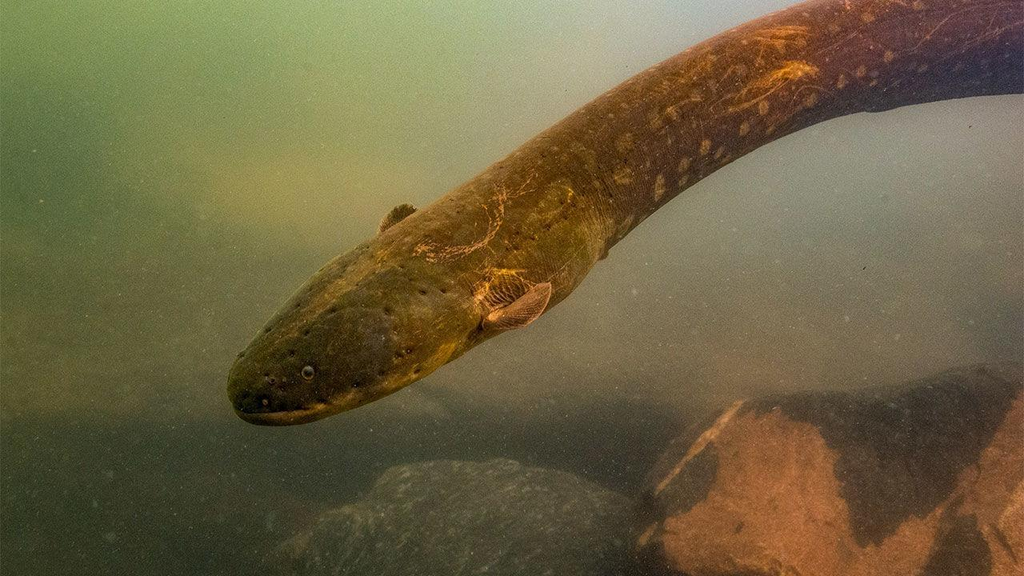
Few Amazon animals sound as extraordinary as the electric eel.
Electric eels can produce electrical discharges using specialized organs in their bodies. Electricity can help them hunt, defend themselves and sense their surroundings.
This ability becomes particularly useful in dark or muddy water where visibility is limited.
Instead of relying entirely on eyesight, an electric eel can interact with its environment using electrical signals. It is an incredible example of evolution producing a highly specialized survival strategy.
The animal’s name can also be misleading: despite being called an eel, electric eels are actually knifefish rather than true eels.
📸 Picture 3: Electric eel moving through dark Amazon river water.
Alt text: Electric eel swimming through dark Amazon freshwater
4. Glass Frogs Can Make Themselves Difficult to See

Deep in the rainforest, survival sometimes means becoming almost invisible.
Glass frogs are famous for their translucent bodies. In several species, parts of the underside can appear remarkably transparent, making these tiny amphibians difficult to detect against leaves and vegetation.
Their unusual appearance isn’t just beautiful—it can provide camouflage.
Many glass frogs are associated with vegetation near streams. Their small size and ability to blend into their surroundings demonstrate how even tiny rainforest animals can possess highly specialized adaptations.
When you look at a green leaf in the Amazon, there may be far more life on it than your eyes can detect.
📸 Picture 4: Tiny glass frog resting on a rainforest leaf.
Alt text: Transparent glass frog resting on a green Amazon rainforest leaf
5. The Hoatzin Looks Like a Bird From Another Era
The hoatzin is one of the strangest-looking birds in the Amazon.
It has a distinctive crest, unusual coloration and a digestive system adapted for a leaf-heavy diet. But the most fascinating feature appears when the birds are young.
Hoatzin chicks have claws on their wings. These claws can help young birds climb through vegetation when they are too small or vulnerable to fly effectively.
As the birds grow, the wing claws disappear.
The hoatzin is therefore a wonderful example of how an animal’s body can change as it moves through different stages of life.
Its unusual biology has fascinated scientists for generations and has helped make it one of the Amazon’s most memorable birds.
📸 Picture 5: Hoatzin perched among Amazon rainforest vegetation.
Alt text: Hoatzin bird perched on vegetation in the Amazon rainforest
6. Giant River Otters Have Strong Family Bonds
The giant river otter is another Amazon animal whose life is closely connected to freshwater.
These large otters are highly social and can live in family groups. They communicate with one another using different vocalizations and spend much of their time swimming, hunting and exploring waterways.
Their streamlined bodies and webbed feet make them excellent swimmers.
Healthy rivers and wetlands are particularly important for these animals. At the Los Amigos conservation area in southeastern Peru, researchers have documented thousands of species across a mosaic of forests, wetlands, oxbow lakes and waterways, including giant river otters.
Seeing a group of giant river otters moving together is a reminder that Amazon wildlife isn’t always about solitary survival. Cooperation can be just as important.
📸 Picture 6: Giant river otters swimming together in an Amazon river.
Alt text: Giant river otter family swimming together in an Amazonian river
7. Scientists Are Still Discovering Amazon Wildlife
Perhaps the most exciting fact about the Amazon is that the wildlife story is far from complete.
New species continue to be discovered, while modern technology is helping scientists find animals that are difficult to observe directly.
Camera traps are particularly valuable. They can operate day and night without requiring researchers to remain in the forest. Amazon Conservation reports that its camera-trap programs have produced more than 10,000 photographs and videos of dozens of mammal and bird species.
Some conservation areas have revealed an astonishing diversity. At the Los Amigos Biological Station in Peru, researchers have recorded more than 4,300 species across numerous taxonomic groups.
That means every expedition into the rainforest can potentially add another piece to our understanding of Amazon biodiversity.
📸 Picture 7: Wide Amazon rainforest scene showing forest canopy, river and wildlife.
Alt text: Amazon rainforest ecosystem with wildlife, river and dense tropical forest
Why Amazon Wildlife Is So Important
The animals of the Amazon are not isolated from one another.
Predators help regulate prey populations. Birds and mammals can spread seeds. Insects pollinate plants. Amphibians respond to changes in environmental conditions. Aquatic animals are connected to the health of rivers and wetlands.
Together, these relationships create a huge ecological network.
That is why protecting individual animals is only part of conservation. Protecting their habitats is equally important.
Conservation organizations are using protected areas, wildlife corridors, scientific research, camera traps and satellite monitoring to help maintain connected habitats. Corridors are particularly valuable because they allow animals to move between areas of suitable forest rather than becoming trapped in isolated patches.
A Rainforest Full of Secrets
The Amazon is often described as a rainforest, but that simple word hides an incredibly complicated world.
It is a place of towering trees, flooded forests, rivers, wetlands, caves, streams and countless smaller habitats. Each environment provides opportunities for different animals to survive.
A jaguar may dominate the forest floor. A hoatzin may occupy the branches. A glass frog may hide on a leaf. An electric eel may patrol the river below.
And somewhere in the enormous forest, there may be species that scientists have not yet documented.
That is what makes the Amazon so fascinating.
Its wildlife isn’t extraordinary because every animal is large or dangerous. It is extraordinary because evolution has produced countless different solutions to the challenge of staying alive.
From electricity and camouflage to swimming, climbing and social cooperation, Amazon animals have developed abilities that seem almost impossible.
Final Thoughts
The Amazon Rainforest remains one of the greatest wildlife treasures on Earth.
Its animals show us that nature does not follow a single formula for survival. Some species use strength. Others use intelligence, camouflage, cooperation or highly specialized biological abilities.
And the story continues.
As scientists explore more of the rainforest and use better technologies to monitor its wildlife, new discoveries are likely to change our understanding of this remarkable ecosystem.
The Amazon still has many secrets hidden beneath its leaves, within its rivers and high above its canopy—and every discovery gives us another reason to protect it.
Documentary Highlights: Conservation Efforts in the Amazon
Category: Amazon Conservation
Tags: Amazon Rainforest, Amazon Conservation, Wildlife Conservation, Rainforest Protection, Indigenous Communities, Wildlife Corridors, Environmental Protection, Amazon Animals, Deforestation, Conservation TechnologyFocus Keyphrase: Conservation efforts in the Amazon
SEO Title: Conservation Efforts in the Amazon: How People Are Protecting the Rainforest
Meta Description: Discover how conservation efforts in the Amazon are protecting wildlife through Indigenous leadership, technology, wildlife corridors, canopy bridges and scientific research.
URL Slug: conservation-efforts-in-the-amazon
A New Story Is Being Written in the Amazon
When people imagine the Amazon Rainforest, they often picture endless green trees, colorful birds, jaguars moving silently through the forest and rivers filled with wildlife.
But behind those beautiful images is another story—one about people working every day to protect this extraordinary ecosystem.
Conservation in the Amazon is no longer based on a single solution. Scientists are using camera traps and satellites. Indigenous communities are protecting their territories. Governments are creating wildlife corridors. Researchers are building bridges that allow animals to cross roads safely.
Together, these efforts are creating a new kind of conservation story—one that combines traditional knowledge, modern technology and practical action.
Here are some of the most interesting conservation developments helping protect the Amazon.
1. Protecting the Amazon Means Connecting Forests

One of the biggest problems facing rainforest wildlife is fragmentation.
A forest may remain standing in one location while roads, farms and other development divide surrounding habitat into smaller pieces. For animals that need large territories, these isolated patches can become difficult or dangerous to navigate.
In July 2026, Ecuador officially recognized the Yasuní–Limoncocha–Cuyabeno Conservation Corridor, connecting more than 173,000 hectares of Amazon rainforest.
The corridor links three important protected areas: Yasuní National Park, Limoncocha Biological Reserve and Cuyabeno Wildlife Reserve. It also includes territories connected with Kichwa, Siona and Siekopai communities.
This approach is important because wildlife does not recognize human boundaries.
A jaguar does not know where one protected area ends. A monkey does not understand a political border. Animals need connected habitats where they can find food, mates and shelter.
📸 Picture 1: Aerial view of Amazon rainforest stretching between protected areas.
Alt text: Connected Amazon rainforest landscape protected for wildlife and local communities
2. Indigenous Communities Are Central to Conservation
One of the most important parts of modern Amazon conservation is the role of Indigenous communities.
For generations, Indigenous peoples have developed detailed knowledge of their forests, rivers, plants and wildlife. Today, conservation programs increasingly combine this knowledge with scientific tools.
In Ecuador’s new corridor, Indigenous territories and communities are part of the broader conservation landscape. The corridor’s development involved consultations with local communities and includes participatory governance.
Elsewhere in the Amazon, Indigenous leaders are also being trained to use drones and other technologies to monitor their territories.
This creates an important shift.
Instead of conservation being something done only by outside researchers, local communities can become active participants in monitoring and protecting their own forests.
The result can be stronger local knowledge, faster responses to threats and greater community involvement.
📸 Picture 2: Indigenous community members walking through Amazon rainforest.
Alt text: Indigenous community members participating in Amazon rainforest conservation
3. Tiny Camera Traps Are Watching the Forest
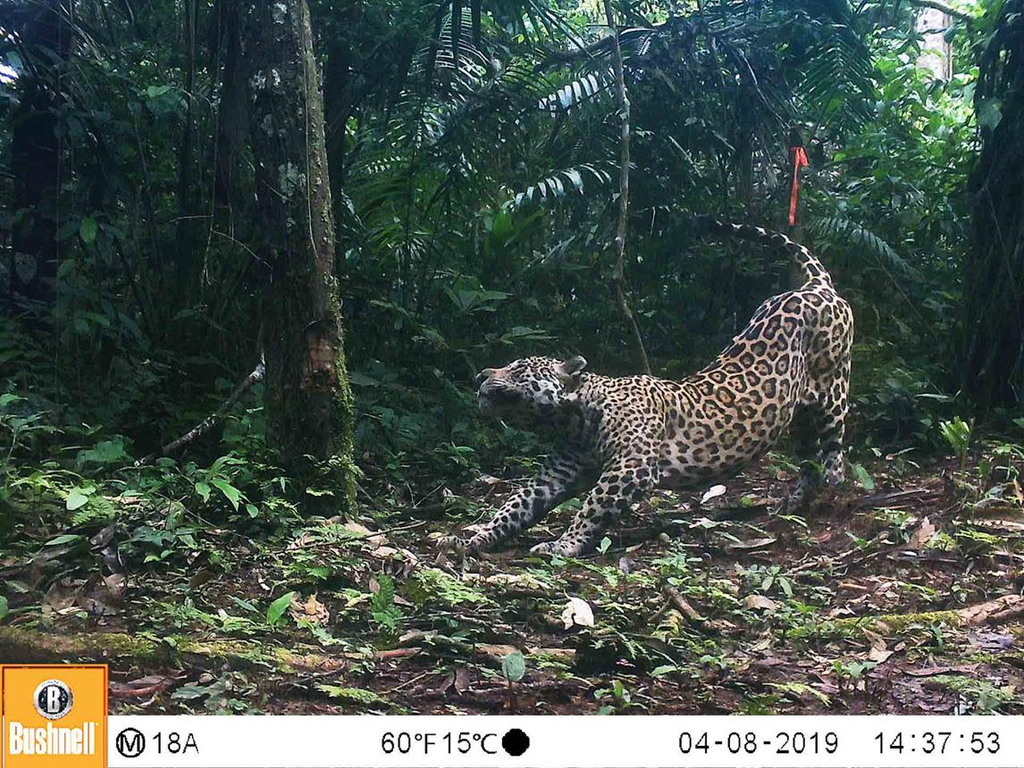
You cannot protect what you cannot understand.
That is why wildlife monitoring has become such an important part of conservation.
Camera traps are small motion-activated cameras that can remain in the forest for long periods. When an animal passes in front of the camera, the device records an image or video.
This allows scientists to study animals without constantly following them through the forest.
Amazon Conservation reports that more than 100 camera traps have been deployed across parts of the western Amazon, producing more than 10,000 photographs and videos involving more than 40 species of mammals and birds.
The images can reveal where animals are living, how frequently they appear and how wildlife populations respond to changes in their habitat.
Sometimes, one photograph can provide valuable evidence that a species is still using an area.
📸 Picture 3: Wildlife camera trap positioned beside an Amazon forest trail.
Alt text: Camera trap monitoring wildlife in the Amazon rainforest
4. Technology Is Giving Conservationists a New Set of Eyes

The Amazon is enormous, and protecting such a huge landscape from the ground alone is extremely difficult.
That is where drones, satellites and remote sensing technology are becoming increasingly useful.
Conservation organizations are using satellite monitoring to identify deforestation and other changes in forest cover. Drones can also help local communities inspect large areas that would otherwise take much longer to survey on foot.
Amazon Conservation’s technology programs combine satellite analysis, drones, camera traps and other tools to improve monitoring and help communities and authorities respond to threats.
The technology itself is not the solution. Its real value comes when people can turn the information into action.
A satellite image can reveal forest loss. A drone can help investigate a location. Local people can then use that information to understand what is happening on the ground.
📸 Picture 4: Conservation worker operating a drone above Amazon rainforest.
Alt text: Conservation worker using a drone to monitor the Amazon rainforest
5. Wildlife Bridges Are Giving Animals a Safer Way Across Roads
Sometimes conservation does not require protecting an enormous new area of forest.
Sometimes it means building a bridge.
In Brazil’s Mato Grosso state, researchers have been testing canopy bridges that allow animals living in trees to cross roads without descending to the ground.
Eight bridges were installed near Alta Floresta in 2024. During the following 15 months, camera traps recorded around 15,000 wildlife crossings, including use by six primate species. No roadkill was recorded at the monitored sites during the study period.
The idea is simple but powerful.
Instead of forcing monkeys and other tree-dwelling animals onto the road, the bridges create a safe route through the canopy.
It demonstrates how relatively small conservation projects can solve very specific problems.
📸 Picture 5: Monkey crossing a rope bridge above a Brazilian Amazon road.
Alt text: Amazon monkey using a wildlife canopy bridge above a road
6. Conservation Is Also About Teaching the Next Generation

Protecting the Amazon cannot depend only on today’s scientists and conservation workers.
Children living in and around the rainforest will eventually become the people making decisions about these landscapes.
That is why environmental education has become part of many conservation programs.
In Ecuador, conservation activities have brought children from Amazonian communities into educational programs focused on understanding local wildlife and the connection between animals, forests and their territories.
One recent program involved children learning about species such as jaguars, harpy eagles, tapirs and other animals associated with Amazon conservation corridors.
These experiences can transform conservation from an abstract environmental topic into something personal.
When a child understands that a forest provides habitat for animals and also supports the community, protecting it can become part of everyday life.
📸 Picture 6: Children learning about Amazon wildlife during an environmental education activity.
Alt text: Children learning about Amazon rainforest wildlife and conservation
7. The Future Depends on Cooperation
Perhaps the most important lesson from current conservation work is that no single organization can save the Amazon alone.
Governments control laws and protected areas. Scientists provide research. Conservation organizations develop projects and technology. Indigenous communities contribute territorial knowledge and leadership. Local residents depend on forests and rivers for their livelihoods.
Successful conservation requires these groups to work together.
Amazon Conservation says its approach combines science, technology, local partnerships and Indigenous leadership. Its alliance across Amazonian countries reports having helped protect more than 14.6 million acres of forest through long-term conservation partnerships.
The challenges remain enormous, but these projects show that conservation is not simply about stopping destruction.
It is also about building better systems for the future.
What a Conservation Documentary Really Shows
A powerful Amazon documentary should not show only beautiful wildlife.
It should show the people behind the protection.
It should show a scientist checking a camera trap before sunrise. A community member examining a drone image. Children learning the names of animals in their forest. A monkey crossing a bridge above a busy road.
These scenes tell a different story about the Amazon.
They show that conservation is not one dramatic event. It is thousands of small decisions repeated over many years.
A protected corridor.
A camera recording a jaguar.
A community monitoring its territory.
A bridge helping a monkey cross a road.
A child discovering why the forest matters.
Each action may seem small on its own, but together they can create something much bigger.
Final Thoughts
The Amazon remains one of the most important wildlife landscapes on Earth, but protecting it requires more than simply declaring forests protected.
The conservation efforts developing across the region show a more connected approach—one that combines science, technology, Indigenous knowledge, education and cooperation.
New corridors can reconnect fragmented habitats. Camera traps can reveal hidden wildlife. Drones and satellites can help detect threats. Canopy bridges can give animals safer routes across roads.
Most importantly, local communities are increasingly becoming part of the conservation story rather than simply observers of it.
The Amazon’s future is still uncertain, but these efforts provide reasons for hope.
The rainforest may be enormous, but its protection begins with individual people, individual communities and individual actions.
And perhaps the most powerful conservation story is not about what we have already saved—it is about what we can still protect.
Image SEO Summary
Image Suggested File Name Alt Text 1 amazon-conservation-corridor.jpgConnected Amazon rainforest landscape protected for wildlife and local communities 2 indigenous-amazon-conservation.jpgIndigenous community members participating in Amazon rainforest conservation 3 amazon-wildlife-camera-trap.jpgCamera trap monitoring wildlife in the Amazon rainforest 4 amazon-conservation-drone.jpgConservation worker using a drone to monitor the Amazon rainforest 5 amazon-wildlife-canopy-bridge.jpgAmazon monkey using a wildlife canopy bridge above a road 6 amazon-environmental-education.jpgChildren learning about Amazon rainforest wildlife and conservation 7 amazon-rainforest-protection.jpgConservation landscape protecting Amazon rainforest habitat and wildlife Strong Alternative Headline
Saving the Amazon: 7 Powerful Conservation Efforts Giving Rainforest Wildlife a Future
Suggested Featured Image Alt Text
Conservation workers protecting Amazon rainforest habitat and wildlife
-

Six Incredible Amazon Animals: Meet the Jaguar, Green Anaconda, Capybara, River Dolphin, Harpy Eagle and Toucan
Six Incredible Amazon Animals: Meet the Jaguar, Green Anaconda, Capybara, River Dolphin, Harpy Eagle and Toucan
Category: Amazon Wildlife
Tags: Amazon Rainforest, Amazon Animals, Jaguar, Green Anaconda, Capybara, Amazon River Dolphin, Harpy Eagle, Toucan, Wildlife Facts, Rainforest Animals, South American Wildlife, Wildlife Conservation
Focus Keyword: Amazon wildlife animals
SEO Title: 6 Amazing Amazon Wildlife Animals You Should Know
Meta Description: Discover six incredible Amazon wildlife animals, including the jaguar, green anaconda, capybara, river dolphin, harpy eagle and toucan.
URL Slug: amazing-amazon-wildlife-jaguar-anaconda-capybara-dolphin-eagle-toucan
Six Incredible Animals That Show the Amazing Diversity of the Amazon
The Amazon Rainforest is more than a vast sea of green trees. It is a living world filled with animals that have evolved extraordinary ways to survive.
From powerful predators moving silently through the forest to giant snakes hiding beneath the water, the Amazon contains wildlife that can seem almost unbelievable.
The region is home to millions of species, including some of the world’s most recognizable animals. Jaguars, harpy eagles and pink river dolphins are among the iconic species associated with this remarkable ecosystem. The Amazon also contains thousands of bird species, hundreds of reptiles and an extraordinary variety of freshwater animals.
In this article, we take a closer look at six fascinating Amazon animals: the jaguar, green anaconda, capybara, Amazon river dolphin, harpy eagle and toucan.
Each one has a different role in the rainforest—and each has a story worth discovering.
1. Jaguar — The Powerful Predator of the Rainforest
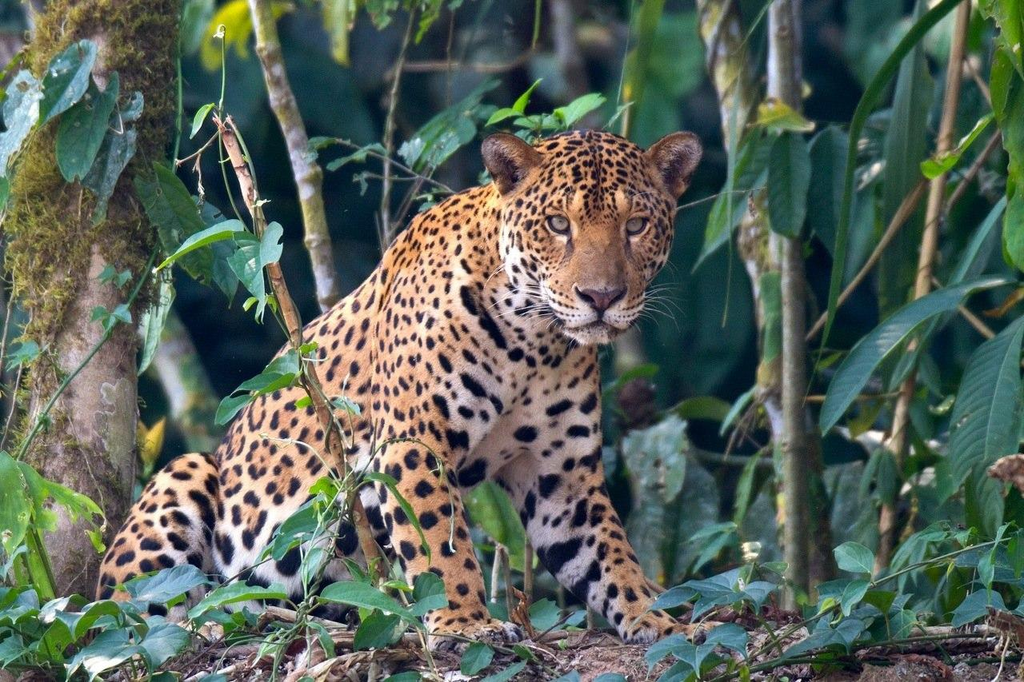
Few animals represent the Amazon as strongly as the jaguar.
The jaguar is the largest cat in the Americas and the third-largest cat species in the world. Its muscular body, powerful jaws and distinctive rosette-patterned coat make it one of the rainforest’s most impressive predators.
But the jaguar has another unusual ability: it is an excellent swimmer.
Many people imagine big cats avoiding water, but jaguars are comfortable around rivers, wetlands and flooded forests. They can hunt a remarkably wide variety of prey, including fish, turtles, peccaries, capybaras and other animals.
Their powerful bite is another important advantage. Jaguars can use their strong jaws to penetrate the tough defenses of some prey.
But their importance goes beyond hunting.
As top predators, jaguars help maintain ecological balance by influencing populations of other animals. Protecting jaguar habitat can therefore benefit many other species sharing the same landscape.
Unfortunately, habitat loss and fragmentation remain major threats. When forests become separated into smaller patches, jaguars can have greater difficulty finding prey, mates and sufficiently large territories.
📸 Picture 1 — Jaguar
Alt text: Powerful jaguar walking through the Amazon rainforest near a river
2. Green Anaconda — The Giant Hunter of Amazon Waters
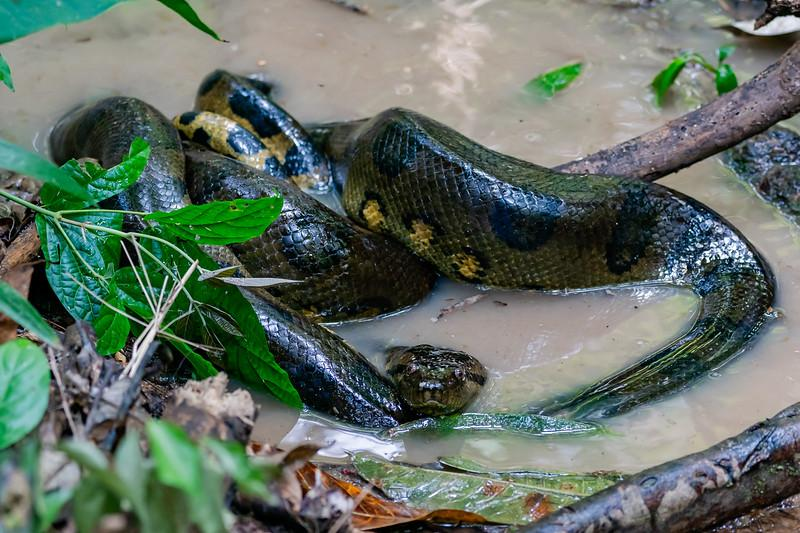
If the jaguar dominates parts of the forest, the green anaconda is one of the Amazon’s most impressive predators in wetlands and slow-moving waterways.
Green anacondas are enormous nonvenomous snakes belonging to the boa family. They are especially well adapted to life in water and are found in swamps, marshes and slow-moving streams across the Amazon and Orinoco basins.
Their bodies may look cumbersome on land, but underwater they become surprisingly stealthy.
Anacondas can remain submerged while waiting for prey to approach. Their diet can include birds, turtles, fish and mammals, including capybaras. They use powerful muscles to constrict captured prey rather than relying on venom.
Another fascinating adaptation is their ability to detect information about their surroundings in several ways. They can use their tongues to collect scent information, sense heat through specialized pits and detect vibrations.
The result is a predator perfectly suited to a watery environment where patience can be more useful than speed.
📸 Picture 2 — Green Anaconda
Alt text: Large green anaconda swimming through Amazon rainforest wetlands
3. Capybara — The World’s Largest Rodent

The capybara may look friendly and relaxed, but this enormous rodent has an important place in Amazonian wetlands.
Capybaras are the largest rodents in the world, with adults averaging around 108 pounds according to WWF. They are closely associated with water and can be found around marshes, ponds, flooded grasslands and other wet habitats.
Their diet consists mainly of grasses and aquatic vegetation.
Water is also extremely important for their survival. Capybaras are strong swimmers and can use water as a refuge when predators are nearby.
And they have plenty of predators to worry about.
Jaguars and other large predators may hunt capybaras, making alertness essential even when these animals appear to be calmly resting near the water.
Capybaras also demonstrate how important wetlands are to Amazon wildlife. When forests and wetlands are converted for agriculture or ranching, the animals that depend on those habitats can lose important feeding and shelter areas.
📸 Picture 3 — Capybara
Alt text: Capybara resting beside a freshwater wetland in the Amazon rainforest
4. Amazon River Dolphin — The Pink Swimmer
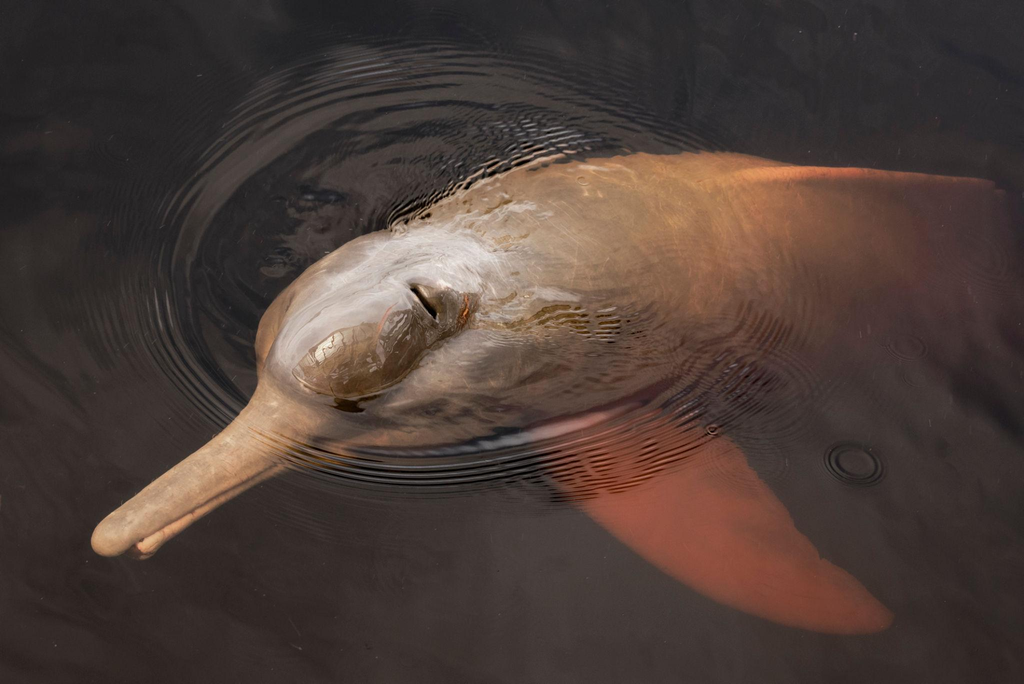
Deep in the Amazon’s enormous freshwater network lives one of its most famous aquatic mammals: the Amazon river dolphin, also known as the boto or pink river dolphin.
Unlike ocean dolphins, this species lives in freshwater. It occurs throughout much of the Amazon and Orinoco river basins.
One of its most recognizable characteristics is its pink coloration, although the exact color can vary between individuals.
The river environment changes dramatically throughout the year. During seasonal flooding, water can spread into forests, lagoons and other areas beyond the main river channels. River dolphins can move between these habitats as water levels and food availability change.
This connection between dolphins and the wider river system is one reason freshwater conservation is so important.
Dams, pollution and other human activities can affect river connectivity and habitat. Conservation programs are using tools such as satellite tagging, river surveys and drones to better understand where these dolphins travel and how their populations are changing.
📸 Picture 4 — Amazon River Dolphin
Alt text: Pink Amazon river dolphin swimming through freshwater rainforest
5. Harpy Eagle — The Powerful Hunter Above the Canopy
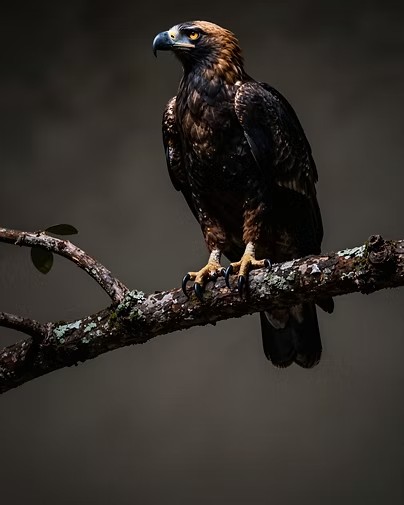
High above the forest floor, another Amazon icon rules the canopy.
The harpy eagle is one of the largest and most powerful eagles in the world. It is especially associated with mature tropical forests and is famous for its enormous talons and powerful build.
Unlike animals that search for food along the forest floor, the harpy eagle uses the rainforest canopy as its hunting environment.
Its strength allows it to capture relatively large tree-dwelling prey. This makes it an important predator in the complex food web of the Amazon.
The species also highlights why protecting mature forests matters. Large birds of prey need suitable nesting and hunting habitat, and changes to forest structure can affect the ecological conditions they depend upon.
The Amazon is one of Earth’s important remaining strongholds for harpy eagles, alongside jaguars and pink river dolphins.
Imagine looking upward through thousands of leaves and suddenly seeing this enormous eagle gliding between the trees. It is one of the rainforest’s most spectacular sights.
📸 Picture 5 — Harpy Eagle
Alt text: Harpy eagle perched high in the Amazon rainforest canopy
6. Toucan — The Colorful Voice of the Forest

Not every famous Amazon animal is a powerful predator.
Toucans bring an entirely different kind of beauty to the rainforest.
With their enormous colorful bills, bright plumage and distinctive calls, toucans are among the easiest Amazon birds to recognize.
The bill may look oversized, but it is surprisingly useful. Toucans use it to reach food and manipulate objects while moving through the forest.
They are closely associated with fruit and play an important ecological role in rainforest ecosystems. Birds that consume fruit can help move seeds from one location to another, contributing to forest regeneration.
The Amazon is home to more than a thousand bird species, including several types of toucans, along with macaws, hoatzins and many other remarkable birds.
A toucan calling from a tree can therefore be more than a beautiful sight. It is part of a much larger ecological system in which plants and animals constantly interact.
📸 Picture 6 — Toucan
Alt text: Colorful toucan perched on a branch in the Amazon rainforest canopy
Six Animals, One Extraordinary Ecosystem
At first glance, these six animals appear completely different.
The jaguar is a powerful land predator.
The green anaconda is a giant aquatic hunter.
The capybara is a water-loving herbivore.
The Amazon river dolphin spends its life navigating freshwater.
The harpy eagle hunts high above the ground.
The toucan moves through the canopy searching for food and helping distribute seeds.
Yet they are all connected.
The health of the forest influences rivers. Rivers influence fish and aquatic mammals. Trees provide food and shelter for birds and mammals. Predators depend on healthy prey populations.
This is why conservation cannot focus on only one species.
A recent WWF-led study mapped areas where jaguars and migratory freshwater species overlap. Researchers identified high-value areas covering about 17% of the Amazon basin, with roughly one-third of those areas still unprotected. The study illustrates how protecting connected land and freshwater habitats can benefit multiple species simultaneously.
Why Protecting These Animals Matters
The Amazon faces multiple pressures, including deforestation, habitat fragmentation, pollution, infrastructure development and climate change.
For animals with large territories, fragmented forests can make movement more difficult.
For river dolphins, changes to freshwater systems can affect migration and habitat.
For birds such as toucans and harpy eagles, the loss of mature forest can remove feeding and nesting opportunities.
And for animals such as capybaras and anacondas, destruction of wetlands can reduce important water-based habitat.
Protecting the Amazon therefore means protecting a network of habitats rather than simply saving individual animals.
Final Thoughts
The jaguar, green anaconda, capybara, Amazon river dolphin, harpy eagle and toucan each represent a different side of Amazon wildlife.
One rules the forest floor.
Another hides beneath the water.
One grazes peacefully beside wetlands.
Another swims through flooded forests.
One dominates the canopy.
And another fills the trees with color and sound.
Together, they reveal why the Amazon is so extraordinary.
The rainforest is not simply a collection of beautiful animals. It is a connected living system in which every species has a role.
Protecting that system means giving these remarkable animals a future—and ensuring that generations to come can still look into the Amazon forest and discover something truly wild.
The Amazon is full of extraordinary animals, but its greatest wonder may be the connections between them.


