


6
🌿 7 Strange Amazon Animal Stories That Sound Impossible but Are Real
Category: Wildlife | Nature | Amazon Rainforest
Tags: Amazon Rainforest, Amazon animals, strange animal stories, rainforest wildlife, wildlife facts, exotic animals, South America, jungle animals, biodiversity, nature stories, animal behavior, conservation
Meta Description:
Discover seven strange and fascinating Amazon animal stories, from giant river otters and protective caimans to noisy bellbirds, turtle hatchlings, and rainforest frogs.
7 Strange Amazon Animal Stories That Sound Impossible but Are Real
Deep inside the Amazon Rainforest, survival can require extraordinary behavior.
Animals must deal with seasonal floods, powerful predators, limited food, extreme competition, and a constantly changing environment. Over millions of years, these challenges have produced some of the most unusual wildlife behaviors on Earth.
Some Amazon animals cooperate with their families. Others use sound, camouflage, or water to survive. And some begin their lives facing dangers that would be difficult for almost any creature.
Here are seven new and fascinating stories from Amazon wildlife.

1. The Otter Family That Hunts Together
Alt Text: Giant river otter family swimming together in an Amazon river.
The giant river otter is one of the Amazon’s most fascinating mammals.
These animals are highly social and commonly live in family groups. Instead of hunting completely alone, they can cooperate while searching for fish in rivers and lakes.
Their communication is especially impressive. Giant river otters use whistles, chirps, and other vocalizations to maintain contact with family members.
When a group moves through the water together, it can look almost like an underwater team working as one.
Young otters also learn important hunting and survival skills from older members of the family.
This means that life in an otter family is not simply about finding food—it is also about learning how to survive in the Amazon.
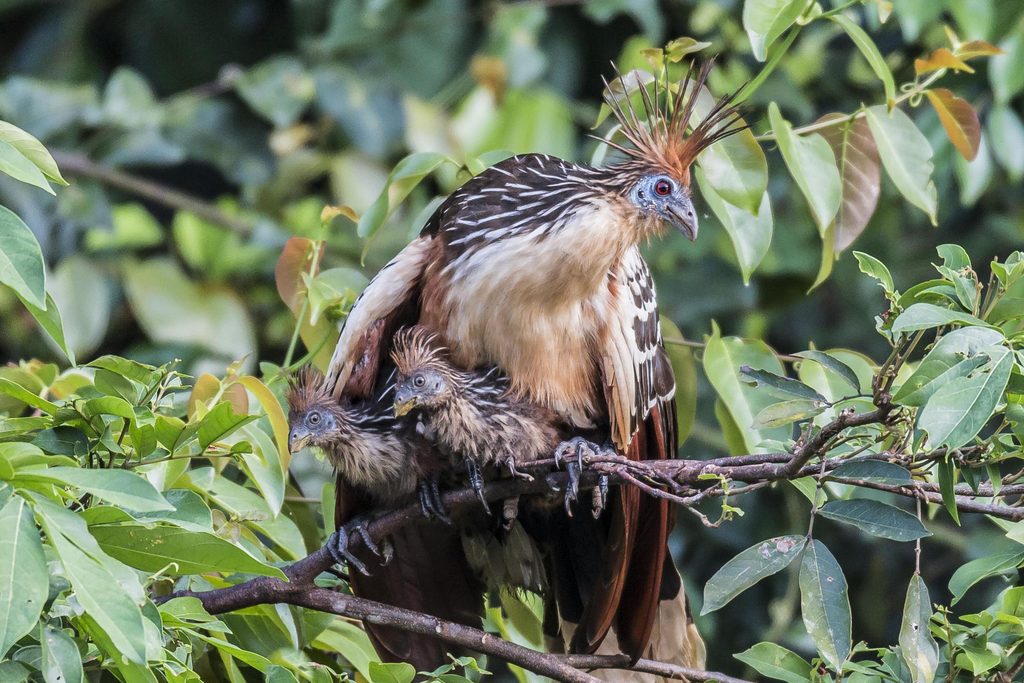
2. The Baby Bird That Can Escape by Swimming
Alt Text: Young hoatzin chick climbing near its nest above an Amazon river.
The hoatzin is one of the strangest birds in the Amazon, and its babies have an extraordinary escape strategy.
Hoatzins often build nests above water. If a predator approaches, a young chick may fall or deliberately jump into the river below.
But the story does not end there.
The chick can swim through the water and hide among vegetation. Once the danger disappears, it can climb back toward the nest.
Young hoatzins also have small claws on their wings that help them grip branches.
This unusual combination of swimming, climbing, and wing claws gives the young birds a remarkable advantage before they are capable of strong flight.
3. The Mother Caiman That Becomes a Bodyguard
Alt Text: Female spectacled caiman protecting young babies beside an Amazon river.
Crocodilians have a reputation as solitary predators, but mothers can show surprisingly strong parental behavior.
Female spectacled caimans protect their nests and remain attentive to their young after they hatch.
The babies communicate with their mother using sounds. When she hears them, she may respond and remain close to the group.
For tiny caimans, the first months of life are dangerous. Fish, birds, larger reptiles, and other predators can all threaten them.
A protective mother can therefore make an enormous difference.
It is a reminder that some of the Amazon’s most intimidating reptiles can also be remarkably attentive parents.
4. The Bird With a Voice That Can Shake the Forest
Alt Text: Three-wattled bellbird calling from a high Amazon rainforest branch.
The three-wattled bellbird is famous for an exceptionally loud call.
Its metallic, bell-like sound can travel through dense rainforest over considerable distances.
Male bellbirds use their calls to attract females and communicate across the forest.
The bird’s strange appearance makes the story even more interesting. A male has distinctive wattles around its face and throat, features that give it an almost prehistoric appearance.
In the dense Amazon, sound is extremely important because thick vegetation can make visual communication difficult.
For the bellbird, a powerful voice becomes a survival and reproduction tool.
5. The Turtle Babies That Face a Dangerous Journey
Alt Text: Giant South American river turtle hatchlings moving toward an Amazon river.
The giant South American river turtle begins life in one of the most dangerous environments imaginable.
Females lay eggs on sandy river beaches. When the hatchlings emerge, they must make their way toward the water.
During this short journey, young turtles can face predators such as birds, fish, and other animals.
Those that reach the river enter another challenging world.
Adults can become enormous, but the tiny hatchlings begin life only a fraction of that size.
Their survival depends on timing, instinct, and sheer numbers.
6. The Frog That Turns a Plant Into a Nursery
Alt Text: Amazon tree frog resting beside a water-filled bromeliad.
High above the Amazon forest floor, some frogs use plants as natural nurseries.
Water can collect inside the leaves of bromeliads, creating tiny pools suspended in the canopy.
These miniature pools provide shelter for developing amphibians.
For a small frog, the plant becomes an entire ecosystem.
There may be enough water and organic material to support tiny aquatic organisms that become part of the developing tadpole’s environment.
The strategy demonstrates how Amazon animals can use existing structures in the rainforest instead of creating their own homes.
7. When the River Becomes the Forest
Alt Text: Amazon rainforest river flooding trees during the seasonal wet season.
Perhaps one of the strangest Amazon stories happens every year on a gigantic scale.
During the rainy season, rivers rise and flood large areas of forest.
Trees that normally stand on dry land can become surrounded by water.
Fish move between tree trunks and branches, feeding on fruits and other food resources that would normally be found far above the river.
For several months, the flooded forest becomes a completely different ecosystem.
Some animals have adapted their entire lives around this seasonal transformation.
The Amazon is therefore not simply a forest beside a river. In many places, the river and forest become one connected habitat.
The Amazon Is Full of Unexpected Relationships
One of the most fascinating things about Amazon wildlife is how closely different species depend on one another.
Birds spread seeds.
Fish transport nutrients.
Mammals pollinate flowers and disperse plants.
Predators control prey populations.
Even tiny insects can influence the survival of enormous trees.
Remove one important connection, and the effects can spread throughout the ecosystem.
Why These Stories Matter
The Amazon is still one of the world’s most important centers of biodiversity.
Scientists continue to discover new species and previously unknown behaviors, especially in remote forests and rivers.
Protecting the rainforest therefore means protecting more than individual animals. It means preserving the complicated relationships that allow thousands of species to survive together.
Leave a Reply