
🌿 7 Strange Amazon Animal Stories That Reveal the Hidden Side of the Rainforest
Category: Wildlife | Nature | Amazon Rainforest
Tags: Amazon Rainforest, Amazon animals, strange animal stories, rainforest wildlife, wildlife facts, jungle animals, South America, exotic wildlife, animal behavior, biodiversity, nature stories, conservation
Meta Description:
Discover seven fascinating Amazon animal stories, from giant anteaters and pink river dolphins to poison frogs, capybaras, caimans, and remarkable rainforest survival strategies.
7 Strange Amazon Animal Stories That Reveal the Hidden Side of the Rainforest
The Amazon Rainforest is one of the most extraordinary wildlife environments on Earth. Beneath its enormous canopy, along its winding rivers, and inside its flooded forests, animals have developed remarkable ways to survive.
Some species have unusual diets. Others communicate through sounds, depend on family groups, or use the changing river levels to their advantage.
The most interesting stories are often not about the largest predators. They are about animals quietly doing extraordinary things every day.
Here are seven new Amazon wildlife stories worth discovering.
1. The Anteater With a Surprisingly Powerful Defense
Alt Text: Giant anteater walking through Amazon rainforest vegetation.
The giant anteater has no teeth, but that does not mean it is defenseless.
Its enormous claws are powerful enough to discourage predators when the animal feels threatened.
The giant anteater normally uses those claws to open termite mounds and ant nests. After breaking into the colony, it uses an extremely long, sticky tongue to collect insects.
It can flick its tongue in and out hundreds of times during a feeding session.
Despite its unusual appearance, the giant anteater is perfectly designed for its specialized diet.
2. The Bird That Smells Different From Most Birds

Alt Text: Hoatzin perched on a branch above an Amazon wetland.
The hoatzin has another unusual feature besides its leaf-eating lifestyle.
Because its digestive system ferments vegetation, it can produce a distinctive odor.
This has earned the species the informal nickname “stinkbird.”
The smell is connected to the fermentation process that helps the bird digest its leafy diet.
The hoatzin is therefore unusual not only in appearance and behavior but also in the way it processes food.
3. The Predator That Watches From Beneath the Water
Alt Text: Black caiman partially submerged in an Amazon river.

The black caiman is one of the Amazon’s largest reptiles.
It can remain mostly submerged while waiting for prey.
Only its eyes and nostrils may appear above the surface, allowing it to observe the river without revealing much of its body.
Young caimans feed on smaller aquatic animals, while adults can tackle much larger prey.
Its ability to disappear into dark water makes it an exceptionally effective ambush predator.
4. The Frog That Becomes a Living Taxi
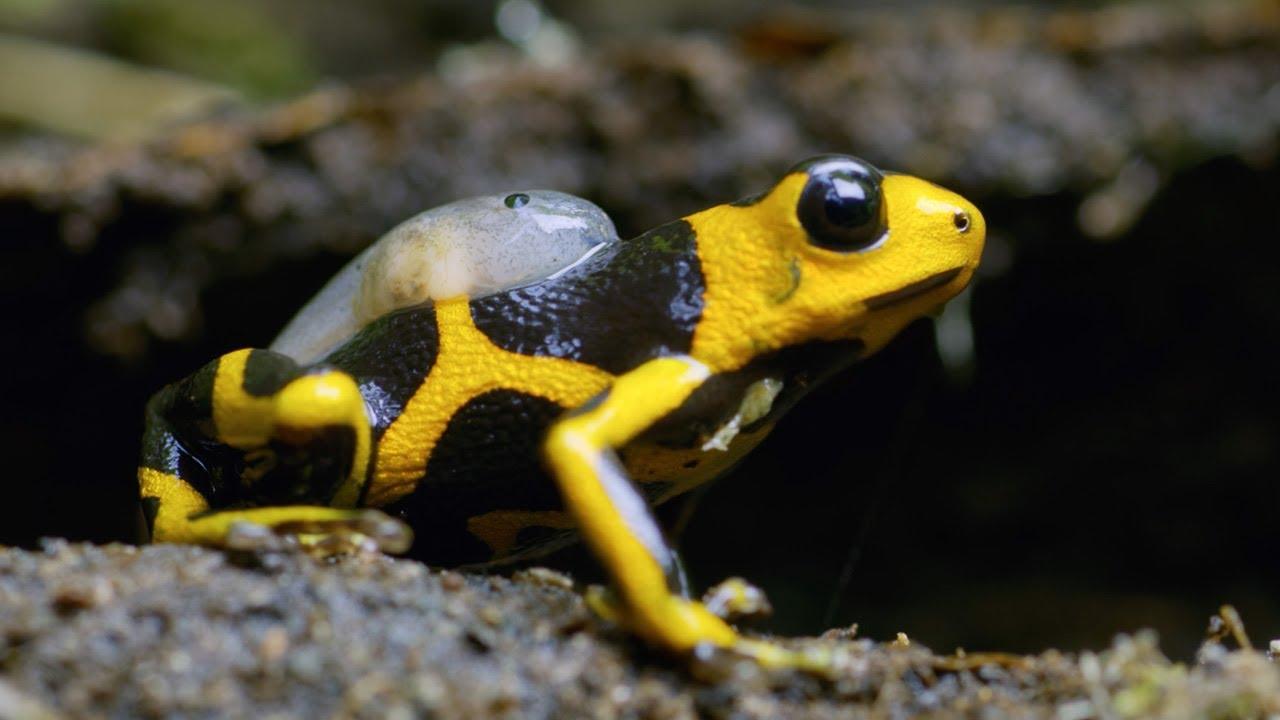
Alt Text: Poison frog carrying a tiny tadpole on its back through the Amazon rainforest.

Some poison frogs provide extraordinary care for their offspring.
After tadpoles hatch, an adult frog may carry them individually on its back.
The tiny tadpole clings to the parent’s skin while the adult travels through the forest searching for a suitable place to release it.
Often, the destination is a small water-filled plant high above the forest floor.
For such a tiny animal, this is an incredible journey.
5. The Dolphin That Can Be Bright Pink
Alt Text: Amazon river dolphin swimming near the surface of a rainforest river.

The Amazon river dolphin, commonly called the pink river dolphin or boto, can develop a striking pink coloration.
Young dolphins are generally darker or grayish, while some adults become increasingly pink as they mature.
They live in complex river systems where water levels can change dramatically during the year.
During floods, dolphins may travel among trees in flooded forests searching for fish.
Their flexible necks help them maneuver through areas where ordinary marine dolphins would struggle.
6. The Giant Rodent That Lives Beside the River
Alt Text: Capybara family resting beside an Amazon river.
The capybara is the world’s largest living rodent.
It is strongly connected to water and can remain submerged when threatened.
Capybaras commonly live in groups and communicate through a surprisingly varied collection of whistles, squeals, barks, and other sounds.
Young animals remain close to adults, giving the group additional protection against predators.
Their ability to combine land and water habitats makes them exceptionally well adapted to the Amazon environment.
7. When the Rainforest Disappears Underwater
Alt Text: Amazon flooded forest with trees standing in river water during the rainy season.
For part of the year, sections of the Amazon literally become underwater forests.
Seasonal floods can cover enormous areas, creating temporary aquatic highways between rivers and trees.
Fish swim beneath branches.
Birds feed from flooded vegetation.
Dolphins navigate between tree trunks.
Fruit that falls from the canopy becomes food for aquatic animals.
When the water eventually retreats, the forest returns to dry land.
This extraordinary seasonal transformation is one of the defining features of the Amazon ecosystem.
A World Built Around Water
Many Amazon animals cannot be separated from the river system.
Water provides food, transportation, nesting opportunities, and protection.
For some species, seasonal flooding is not a disaster—it is an essential part of life.
This is why protecting Amazon rivers is just as important as protecting the forest itself.
The Amazon Still Holds Countless Secrets
Scientists continue studying remote parts of the Amazon where wildlife remains poorly documented.
New species are regularly described, while familiar animals continue to reveal surprising behaviors.
Technology such as camera traps, acoustic monitoring, satellite imagery, and environmental DNA is helping researchers understand this enormous ecosystem.
Why Conservation Is So Important
Every species is connected to others.
Anteaters control insect populations.
Dolphins influence aquatic food webs.
Caimans are important river predators.
Capybaras transfer nutrients between land and water.
Frogs help control insects.
Protecting biodiversity protects the entire network.
Final Thoughts
The Amazon Rainforest is full of strange and wonderful stories.
A toothless mammal can defend itself with enormous claws. A bird can digest leaves through fermentation. A frog can carry its baby through the canopy. A dolphin can turn pink. And an entire forest can temporarily become an underwater world.
These remarkable adaptations remind us that the Amazon is still one of Earth’s greatest natural mysteries—and there are undoubtedly many more stories waiting to be discovered.
📸 WordPress Image SEO
| # | File Name | Alt Text |
|---|---|---|
| 1 | giant-anteater-amazon.jpg | Giant anteater walking through Amazon rainforest vegetation |
| 2 | amazon-hoatzin-bird.jpg | Hoatzin perched on a branch above an Amazon wetland |
| 3 | black-caiman-amazon-river.jpg | Black caiman partially submerged in an Amazon river |
| 4 | poison-frog-tadpole.jpg | Poison frog carrying a tiny tadpole through the Amazon rainforest |
| 5 | pink-amazon-river-dolphin.jpg | Amazon river dolphin swimming near the surface of a rainforest river |
| 6 | capybara-family-amazon.jpg | Capybara family resting beside an Amazon river |
| 7 | flooded-amazon-forest.jpg | Amazon rainforest flooded during the seasonal rainy season |
Leave a Reply